Just a couple of years ago, an unshakeable dogma ruled among AI researchers: "Scale solves everything." It was taken as gospel that only colossal models of 70 to 400 billion parameters could solve complex programming tasks, grasp multi-layered context, and autonomously drive tools. Everything smaller was automatically written off as primitive smartphone autocomplete.
Yet giant neural networks hit an economic wall: electricity bills are climbing, inference costs a fortune, and running such a behemoth on a personal laptop without connecting to someone else's cloud is impossible in principle. The industry desperately searched for an answer to one question: can real agentic intelligence be packed into a compact footprint?
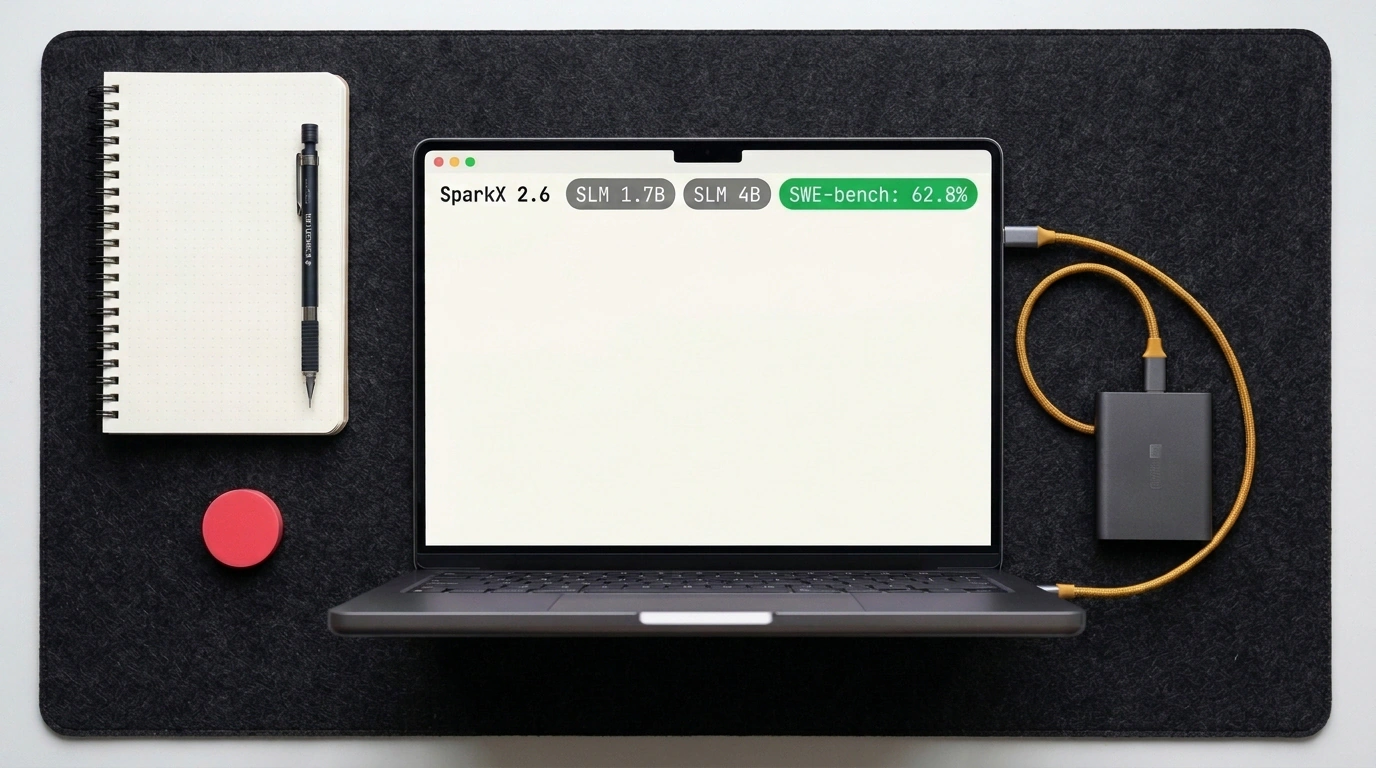
The answer to that challenge arrived with the release of the SparkX 2.6 family of compact Small Language Models (SLMs) from the XHToken lab and the SparkLLM team. Released under the permissive Apache 2.0 license on Hugging Face and ModelScope, two models hit open access: 1.7 billion (1.7B) and 4 billion (4B) parameters. Their benchmark scores made even hardened skeptics whistle. Let's look at the architecture of these "little guys," check their SWE-bench results, and see how they behave on ordinary consumer hardware.
Revolt of the Small Models: Why Giants Are Giving Way to SLMs
The main problem with large models is their monstrous inertia. If you want to run a local agent that sits quietly in the background of your OS, monitors the clipboard, helps refactor code in your IDE, and catches typos, a 70B model will eat all your RAM and make your laptop fans howl like a jetliner taking off.
The SparkX 2.6 developers set a clear goal: build an open model that reasons as well as last year's flagships, yet runs on a modest home computer. The secret to their efficiency lies in two things:
- High-grade training dataset filtering: instead of "raw internet," the focus went into synthetic chains of strict logical reasoning, scrubbed Git repositories, and step-by-step walkthroughs of algorithmic problems;
- Controllable Reasoning Budget: the model includes a built-in Chain-of-Thought mechanism, and developers can dynamically cap the number of thinking tokens to balance response speed against depth of analysis.
60% on SWE-bench: How a Tiny Model Beats Last Year's Flagships
The main yardstick of coding-model maturity today is the SWE-bench Verified benchmark. Rather than writing an isolated function in a vacuum, the neural network receives a real bug report (Issue) from an actual open-source GitHub repository: it has to study someone else's multi-file codebase, track down the root cause, edit the right files, and make all existing integration tests pass.
SparkX 2.6's results stunned experts:
- SparkX 2.6 1.7B successfully solved 59.8% of real-world tasks;
- The larger SparkX 2.6 4B cleared 62.8%!
To appreciate the scale of that achievement, remember: just a year and a half ago, closed paid flagships like the first version of GPT-4 barely scraped 20–25% on the same test, and open 70B-class models considered crossing the 40% mark an extraordinary triumph. Today, a compact 4-billion-parameter model fixes bugs in real code better than the giants of the recent past!
The second key benchmark—TAU-bench—measures a model's ability to act as a support agent: follow company rules, invoke external functions via API, and properly ask the user for missing details. Here, SparkX 2.6 scored 85.3% (for the 1.7B version) and 86.9% (for 4B), confirming rock-solid reliability with JSON Tool Calling. As we saw when examining the capabilities of Spark-X2.6-4B, the ability of small models to stick to a strict format opens the door to full autonomy in applied software.
Hardware Diet: 90 Tokens per Second on an Ordinary Laptop
The nicest part of this story is the system requirements. Both models are released under the permissive commercial Apache 2.0 license and are already converted into popular GGUF, MLX, and AWQ formats:
- SparkX 2.6 1.7B: in 4-bit quantization (Q4_K_M), the model file takes less than 1.2 gigabytes. It uses only about 1.5 GB of VRAM and cranks out over 90 tokens per second on Apple Silicon M2/M3 chips or budget GPUs like an Nvidia RTX 3060;
- SparkX 2.6 4B: in 4-bit requires roughly 3 gigabytes of VRAM, fitting comfortably even into the memory buffer of older office graphics cards.
You can literally download the model in three minutes via Ollama (ollama run sparkx:4b), hook it up as autocomplete in VS Code through the Continue extension or Cursor, and get a full-fledged autonomous coding assistant that works offline, never sends your code to outside servers, and generates suggestions instantaneously.
Limits of Applicability: Where Light Weight Backfires
Still, let's keep a cool head and recognize the physical limits of compact models. No distillation magic can cheat the laws of information conservation:
- Limited fact base: You physically cannot pack all of Wikipedia, ancient history, and the subtleties of different countries' laws into 1.7 billion parameters. Ask SparkX for an obscure biology fact or the biography of a little-known writer, and the model will either admit it doesn't know or confidently make something up. It was built for logic and code syntax, not to play an all-knowing encyclopedia. Any facts should be fed into its context via RAG (Retrieval-Augmented Generation).
- Prompt sensitivity: Unlike ultra-heavy models that can read a user's mind from muddled, sloppy phrasing, SparkX demands clear, unambiguous instructions. If a task's context is phrased carelessly, the model can get stuck looping on an intermediate reasoning step.
SparkX 2.6 is clear proof that the era of blind gigantism in AI is giving way to an era of targeted engineering optimization. Autonomous agents and local coding no longer need server farms: the future of local artificial intelligence already fits comfortably in your jacket pocket.