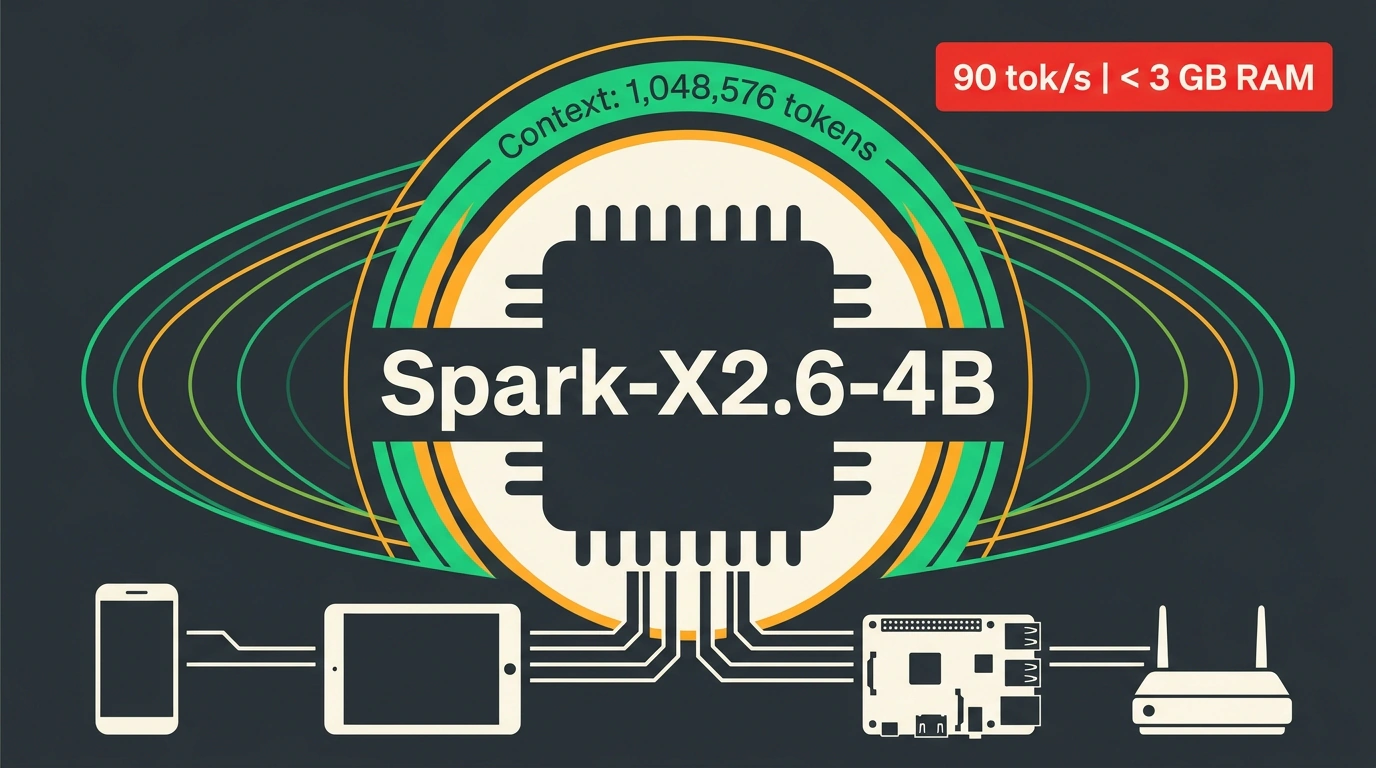
For a long time, AI engineers carried a dismissive bias: anything under 7–8 billion parameters was just a toy for smartphone demos. The prevailing wisdom said ultra-compact weights couldn't follow instructions reliably—they'd mangle output formats, get stuck in repetition loops, and hallucinate wildly the moment a task got slightly nuanced.
The release of Spark-X2.6-4B, built by XHToken (part of the SparkLLM family), forces a rethink of those outdated assumptions. At just 4 billion parameters, this model delivers capabilities that required 70B server-class networks only a year ago.
3:1 Hybrid Attention: Packing a Million-Token Context into 3 GB of Memory
The main roadblock to long context on tiny weights is quadratic growth in the key-value (KV) cache. Give a standard 4B model a million-token window, and your GPU memory chokes instantly on auxiliary attention matrices.
Spark-X2.6-4B's engineers solved that with an elegant hybrid attention layout:
- Three consecutive transformer layers use local Sliding-Window Attention (SWA), attending only to the nearest few thousand tokens.
- Every fourth layer switches to Full Global Attention, tying distant ends of the document together.
That 3:1 ratio unlocked a massive 1,048,576-token (1M) context window. Better yet, in 4-bit quantization the entire model plus its cache fits in under 3 GB of RAM—small enough to run on a Raspberry Pi 5, a tablet, or an ATM motherboard.
What's New in 2.6: Explicit Reasoning and Loop-Free Generation
In version 2.6, the team poured its energy into post-training alignment:
- Explicit Reasoning Mode: the model supports
<think>tags, letting you tune the depth of its internal chain of thought before it outputs a structured answer. - DPO against repetition loops: version 2.5 could occasionally get trapped repeating a single phrase during complex branching logic. Version 2.6 applies Direct Preference Optimization (DPO) tuned to kill repetition loops at the root.
- Rock-solid JSON: strict structured-output accuracy jumped by 18%.
Here is a local example of classifying customer support tickets and extracting entities using transformers:
import torch
from transformers import AutoModelForCausalLM, AutoTokenizer

model_id = "XHToken/Spark-X2.6-4B"
tokenizer = AutoTokenizer.from_pretrained(model_id, trust_remote_code=True)
model = AutoModelForCausalLM.from_pretrained(
    model_id,
    torch_dtype=torch.bfloat16,
    device_map="auto",
    trust_remote_code=True
)

prompt = """<|system|>
You are a high-speed edge classifier. Classify customer tickets and output JSON.
<|user|>
Списали 2490 рублей за тариф Бизнес, но доступ в личный кабинет закрыт. Договор #98124.
<|assistant|>
<think>
Категория: Billing (списание) + Account (доступ). Главная причина обращения — биллинг.
Сущности: договор 98124, сумма 2490, тариф Бизнес.
</think>
{"category": "Billing", "contract_id": "98124", "amount": 2490, "tier": "Бизнес"}"""

inputs = tokenizer(prompt, return_tensors="pt").to(model.device)
outputs = model.generate(**inputs, max_new_tokens=256, temperature=0.1)
print(tokenizer.decode(outputs[0][inputs.input_ids.shape[1]:], skip_special_tokens=True))
And if you want to run it locally with Ollama, a single standard command gets you started:
# Run the quantized version of Spark-X2.6-4B locally in Ollama
ollama run spark-x2.6-4b:latest "Классифицируй входящий финансовый документ"
Edge Use Cases: Tier-1 Support and Private Onboarding
Streaming at over 90 tokens per second on ordinary CPUs, Spark-X2.6-4B is a natural fit for edge automation:
- Instant triage of hundreds of thousands of incoming support emails with zero cloud API bills.
- On-device onboarding flows in mobile apps without shipping user data to remote servers.
- An Apache 2.0 license that gives teams full freedom to embed it in commercial products.