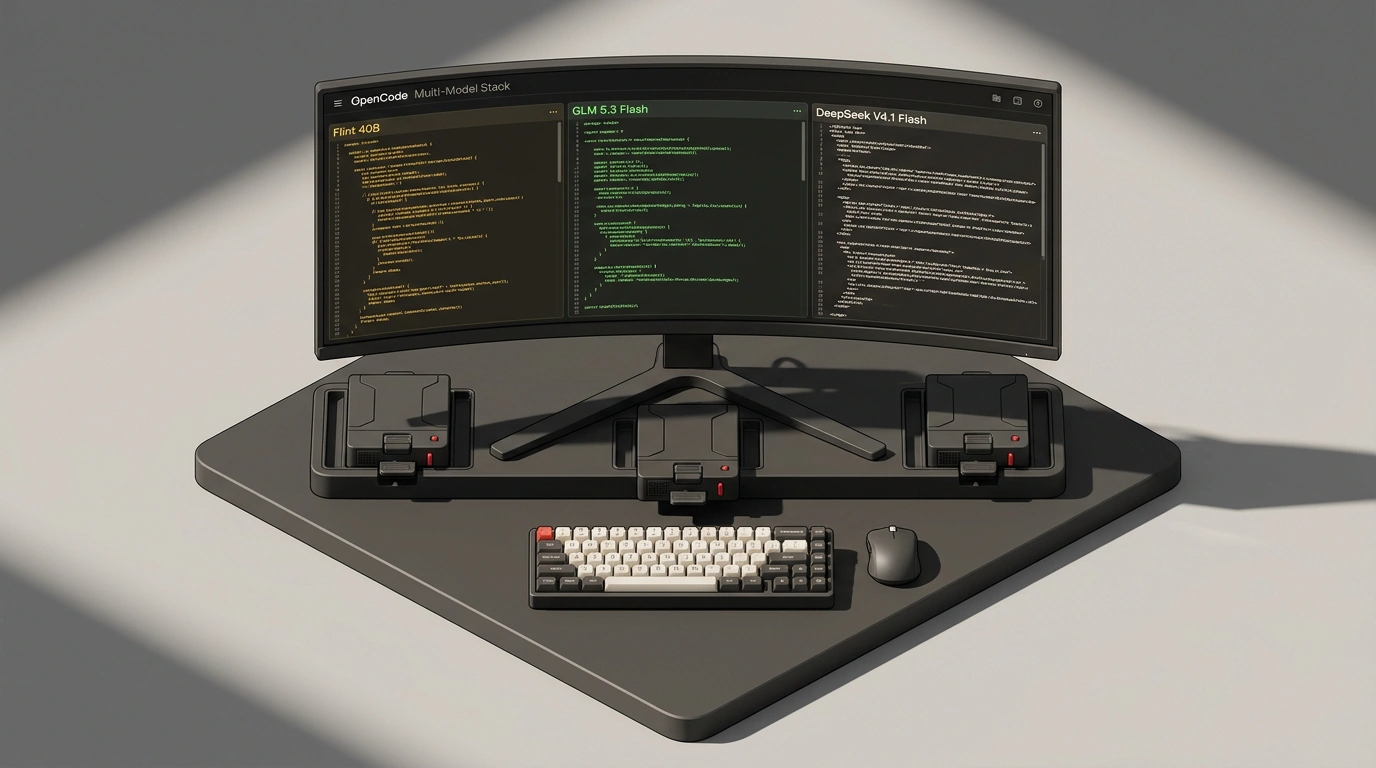
When developers first wire up an agentic coding environment like OpenCode, they usually reach out of habit for the heaviest, priciest proprietary models on the market. Two days later, the honeymoon is over: API bills evaporate at terrifying speed because the agent is constantly scanning files, running terminal test suites, and churning through dozens of intermediate drafts. Fortunately, the open-model ecosystem has matured to the point where you can assemble a completely free, blazing-fast stack for everyday engineering. Here is a look at two standout additions to the OpenCode catalog.
GLM 5.3 Flash
Built by Zhipu AI's research lab, GLM 5.3 Flash was engineered from the ground up for ultra-low-latency interactive development. On Artificial Analysis's independent leaderboard, it posted an overall score of 57, comfortably outpacing most compact models from the previous wave.
GLM 5.3 Flash's trump card inside OpenCode is the sheer speed of its Chain of Thought. Unlike lumbering flagships that can pause to ponder for 20–30 seconds over a trivial helper, GLM Flash sketches an action plan almost instantly and begins streaming tokens with a time-to-first-token under 150 milliseconds.
In a day-to-day workflow, it handles:
- Instant inline code completion right as you type.
- Generating routine boilerplate, object factories, and unit tests for
pytestorvitest. - Checking code against style standards, linters, and formatting rules.
- Visual debugging: because the model is natively multimodal, you can drag a screenshot of broken CSS layout or a database schema diagram straight into the OpenCode chat, and GLM Flash maps the visual bug directly to the lines in your repo.
DeepSeek V4.1 Flash
When a task spills beyond a single file and calls for thoughtful, multi-step refactoring in the terminal, DeepSeek V4.1 Flash steps up. It's a specialized agentic variant of the flagship DeepSeek family, built on a Mixture-of-Experts architecture with a conditional capacity of 196 billion parameters.
The marquee innovation in version 4.1 Flash is engram conditional memory. Normally, whenever an agent re-reads your project structure, it recomputes the key-value (KV) cache for every file from scratch, burning compute cycles. DeepSeek Flash's architecture stores compact semantic snapshots of unchanged project files as engrams. On subsequent passes over those modules, the agent pulls up the ready-made semantic snapshots instantaneously instead of re-parsing the code.
In OpenCode's agentic mode, the model streams at over 70 tokens per second, navigates directory trees with confidence, runs build commands in the terminal on its own, and patches compiler errors as they pop up.
Here is a sample providers.json config for OpenCode that splits responsibilities cleanly between the two models:
{
  "$schema": "https://opencode.dev/schema/providers.json",
  "providers": {
    "glm-flash": {
      "name": "Zhipu GLM 5.3 Flash Free",
      "endpoint": "https://api.opencode.dev/v1/models/glm-5.3-flash-free",
      "model": "glm-5.3-flash",
      "type": "chat",
      "contextWindow": 131072,
      "capabilities": ["code_completion", "refactoring", "vision_debugging"]
    },
    "deepseek-flash": {
      "name": "DeepSeek V4.1 Flash Free",
      "endpoint": "https://api.opencode.dev/v1/models/deepseek-v4.1-flash-free",
      "model": "deepseek-v4.1-flash",
      "type": "agentic",
      "contextWindow": 196608,
      "capabilities": ["terminal_execution", "multi_file_patching", "engram_memory"]
    }
  },
  "defaultAgentModel": "deepseek-flash",
  "defaultAutocompleteModel": "glm-flash"
}
And to apply the settings and launch an agentic session in your terminal, one initialization command does the job:
# Apply provider configuration and start an OpenCode agentic session
opencode config set-providers ./providers.json && opencode session start --workspace .
Both providers operate inside OpenCode under a strict Zero Data Retention policy, ensuring your proprietary codebase is never used to train public models.