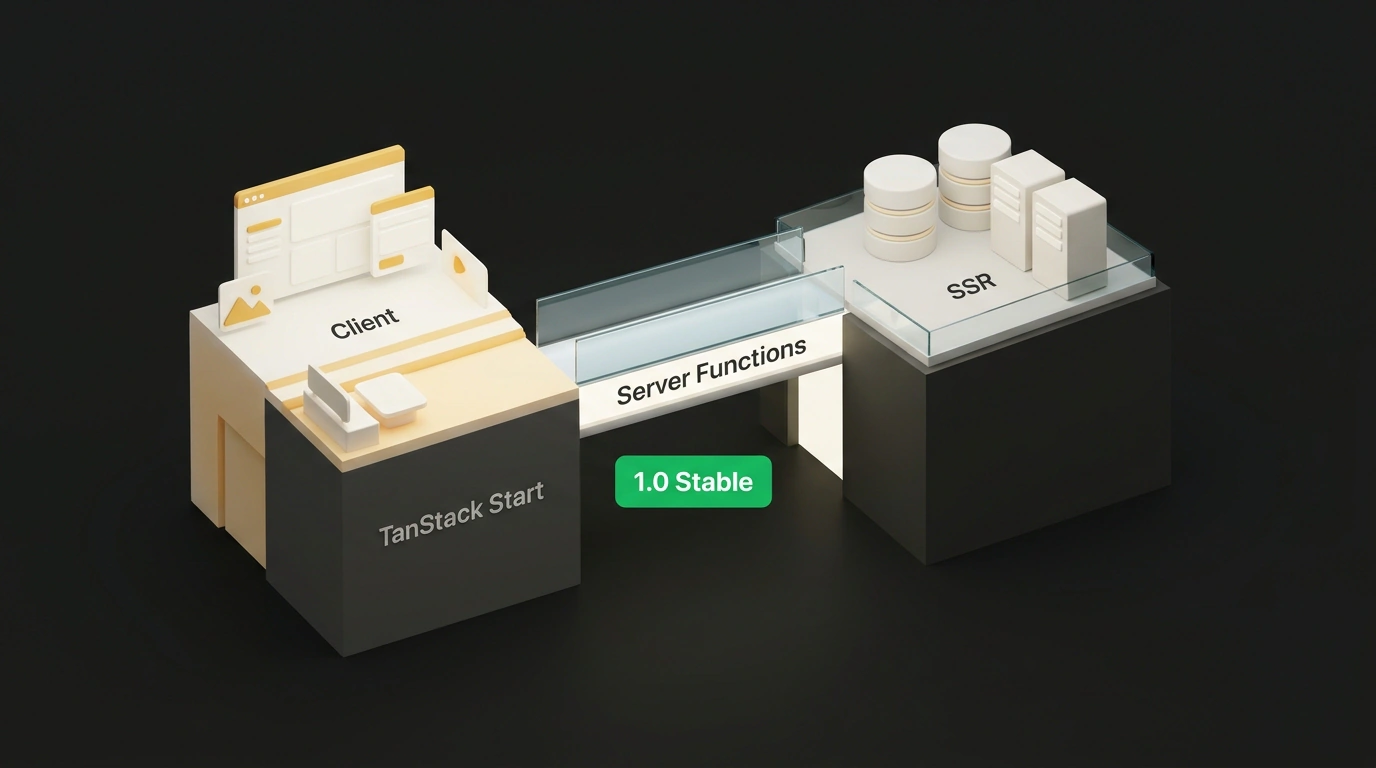
For the past three years, the React world has lived under the relentless push of React Server Components (RSC). Vercel and the Next.js team told the industry that the future of the web belonged to splitting every component tree across 'use client' and 'use server' directives.
Yet the deeper developers waded into that paradigm, the louder the frustration grew: closure leaks, unpredictable prop serialization limits, tangled debugging, and the nagging sense that a straightforward SPA framework had morphed into a sluggish beast tuned for one vendor's proprietary cloud.
Tanner Linsley—the legendary creator of React Query, TanStack Table, and TanStack Router—took a fundamentally different road. After a year of polishing in Release Candidate, TanStack Start has officially hit 1.0 stable (published to npm under 1.169.x as part of the shared monorepo, as detailed in React Status #494).
It is a full-featured, full-stack React meta-framework that brings back the joy of building fast web apps without the Server Components cult.
RSC Fatigue: Why the React Ecosystem Needed Another Path
Tanner Linsley didn't mince words about Server Components: RSC support across the ecosystem had long become a "checkbox on a tool's resume" just to fit the React 19 marketing narrative. Meanwhile, tanstack.com itself pointedly opted out of using RSC altogether.
What makes TanStack Start fundamentally different?
The framework preserves the familiar, predictable Single Page Application (SPA) mental model millions of developers already love. Every component in your app stays a normal, interactive React component. You use useState, useEffect, and animation libraries without constantly second-guessing whether they run on the client or the server.
At the same time, your app gets every perk of a mature server stack: instant Server-Side Rendering (SSR), HTML streaming across Suspense boundaries, and end-to-end type safety from the database all the way to a browser button.
Server Functions Architecture: Type-Safe RPC Without Directives
Instead of compiler directives like 'use server' that implicitly turn code into network calls, TanStack Start offers an explicit, crystal-clear abstraction: Server Functions (createServerFn).
You declare a function guaranteed to execute only on the server, with direct access to your database, secret environment keys, and filesystem. On the client, calling that function automatically compiles down to a type-safe RPC request:
// app/services/users.ts
import { createServerFn } from '@tanstack/start';
import { z } from 'zod';

// Input validation with Zod
const userQuerySchema = z.object({
  userId: z.string().min(1),
});

// Server function: the handler body never ships in the client JS bundle!
export const fetchUserProfile = createServerFn({ method: 'GET' })
  .validator((data: { userId: string }) => userQuerySchema.parse(data))
  .handler(async ({ data }) => {
    // Safely query the database here
    console.log(`[Server] Чтение пользователя ${data.userId} из БД`);

    return {
      id: data.userId,
      displayName: 'Елена Кузнецова',
      role: 'Staff Engineer',
      lastLogin: new Date().toISOString(),
    };
  });
You then wire that function into TanStack Router's loader. When a user opens the page directly, data is fetched on the server during SSR. When they navigate via a link inside the SPA, it triggers a client-side RPC call:
// app/routes/users/$userId.tsx
import { createFileRoute } from '@tanstack/react-router';
import { fetchUserProfile } from '../../services/users';

export const Route = createFileRoute('/users/$userId')({
  loader: async ({ params }) => {
    const profile = await fetchUserProfile({ data: { userId: params.userId } });
    return { profile };
  },
  component: UserProfileView,
});

function UserProfileView() {
  const { profile } = Route.useLoaderData();

  return (
    <div className="p-8 max-w-xl mx-auto bg-white rounded-2xl shadow-sm border">
      <h2 className="text-xl font-bold text-slate-900">{profile.displayName}</h2>
      <p className="text-sm text-slate-500 mt-1">{profile.role}</p>
      <div className="mt-4 inline-flex items-center px-2.5 py-0.5 rounded-full text-xs font-medium bg-emerald-100 text-emerald-800">
        Стабильный TanStack Start 1.0
      </div>
    </div>
  );
}
If you change the type of a returned field inside fetchUserProfile, the TypeScript compiler flags the mismatch inside UserProfileView immediately. No manual codegen step required.
Benchmarks Against Next.js 16.4: Up to 8.6x Higher Throughput
The 1.0 launch arrived alongside independent head-to-head benchmarks against flagship Next.js 16.4 on identical test apps:
- Throughput under load: When handling dynamic server requests hitting data, TanStack Start delivered 2.9–8.6x more RPS (requests per second) at the same CPU usage.
- Build speed: Cold production build times with full TypeScript type checking ran 1.7x faster in Start thanks to Vite under the hood.
Small wonder SolidJS creator Ryan Carniato publicly backed the release, calling Start's architecture "a React meta-framework whose design I can finally get behind wholeheartedly."
Deployment Freedom on Nitro—and When to Stick with Next
Under the hood, TanStack Start runs on the open-source Nitro server engine (the same engine powering Nuxt 4 and Analog). That gives you complete independence from Vercel's infrastructure: deploy in a Docker container with Node.js, run on Cloudflare Workers, or ship to AWS Lambda, Deno, or Bun with zero commercial lock-in.
When does Next.js still make sense?
- When your project is already deeply tied to Vercel infrastructure features (like Edge-cached Image Optimization or tag-based ISR invalidation).
- When your team has already spent a year architecting its codebase around RSC and rebuilt its workflows around it.
For everyone else tired of Server Component overhead who wants fast, predictable, type-safe React, TanStack Start 1.0 is the biggest breath of fresh air this season.
