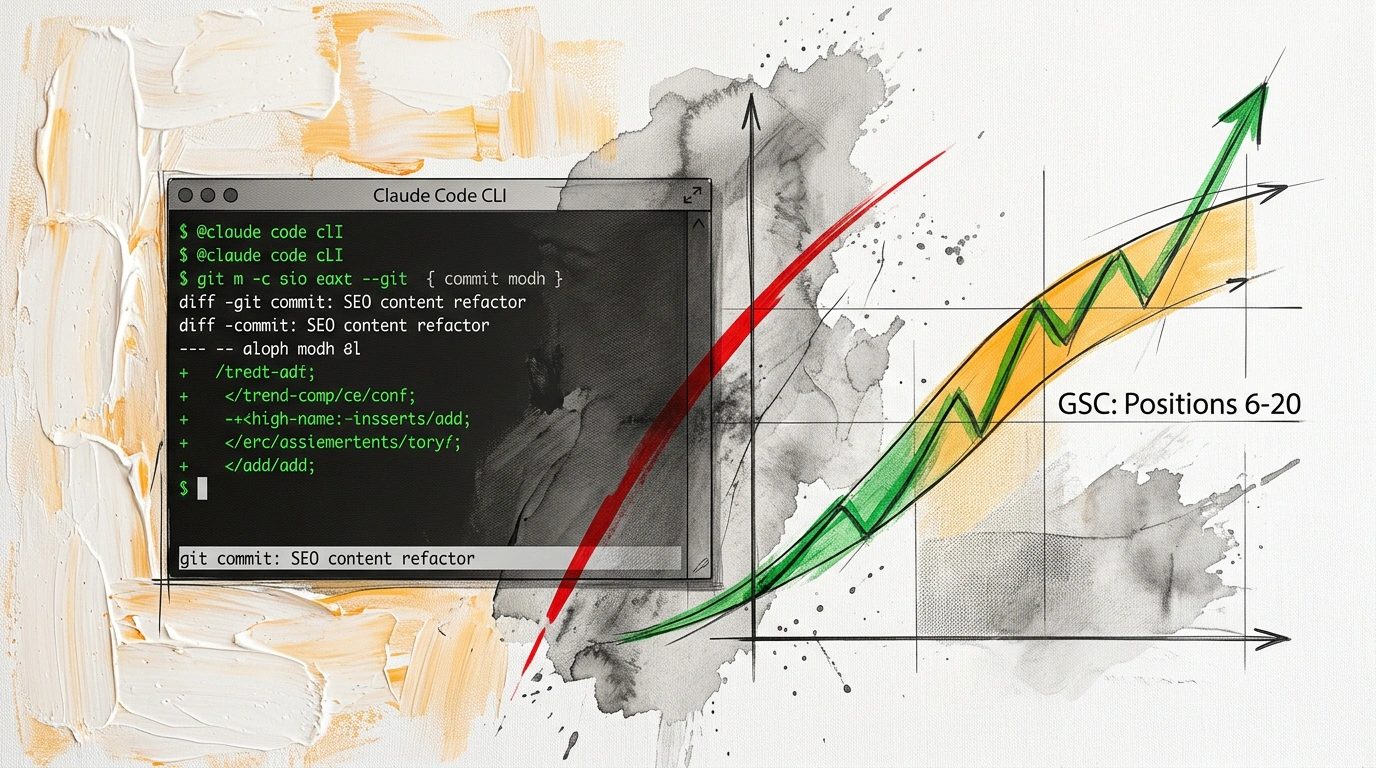
For decades, the classic SEO workflow has suffered from a brutal gap between analytics and actual code changes. Remember that bureaucratic relay race? An SEO specialist opens Google Search Console, exports a massive CSV spreadsheet, spends two days filtering keywords, flags underperforming pages, writes a brief for a copywriter, waits a week for the draft, hands it to a content manager, and finally asks a developer to push the edits to the repo. A single targeted tweak takes weeks.
With the Claude Code CLI terminal agent and the Model Context Protocol (MCP), you can compress that sluggish loop into a few minutes. The agent gets direct access to live analytics APIs and your site's source files—whether it's built on Astro, Next.js, or Hugo—at the exact same time.
Bridging via Model Context Protocol: Connecting the GSC API to Local Code
The linchpin of this setup is a dedicated MCP server (such as the open-source connector AminForou/mcp-gsc). Through it, Claude Code gains a clean set of structured tools:
get_search_performance: pulls clicks, impressions, CTR, and average positions filtered by date and URL.inspect_url: checks a page's live Googlebot indexing status.check_indexing_issues: flags canonical tag errors and broken structured data.
You run the agent right inside the root of your website repository. It maps URLs from analytics reports (like /blog/ai-agents-guide) straight to the physical source file on disk (src/content/blog/ai-agents-guide.md).
Striking-Distance Keywords: Automated Content Refactoring Without Spam Risks
The highest-ROI target here is striking-distance keywords—queries ranking in positions 6–20 (bottom of page one or top of page two) with solid monthly impressions (500–1,000+). Pushing those pages into the top 3 rarely requires rewriting the whole article; often, weaving a missing term naturally into an H2 subheading or sharpening the Meta Description snippet does the trick.
Here is a Python script to pull striking-distance queries automatically using the official API client:
import os
from googleapiclient.discovery import build
from google.oauth2 import service_account

SCOPES = ['https://www.googleapis.com/auth/webmasters.readonly']
KEY_FILE = os.getenv("GSC_SERVICE_ACCOUNT_KEY")
SITE_URL = "https://example.com"

creds = service_account.Credentials.from_service_account_file(KEY_FILE, scopes=SCOPES)
service = build('searchconsole', 'v1', credentials=creds)

request = {
    'startDate': '2026-09-25',
    'endDate': '2026-10-24',
    'dimensions': ['query', 'page'],
    'rowLimit': 50
}

response = service.searchanalytics().query(siteUrl=SITE_URL, body=request).execute()

print("| Запрос | Страница | Показы | Клики | Позиция |")
print("|---|---|---|---|---|")
for row in response.get('rows', []):
    query, page = row['keys'][0], row['keys'][1]
    imp, clicks, pos = row['impressions'], row['clicks'], round(row['position'], 1)
    if 6.0 <= pos <= 20.0 and imp > 500:
        print(f"| {query} | {page} | {imp} | {clicks} | {pos} |")
Once the script surfaces your growth opportunities, you invoke Claude Code with a single terminal command:
# Run Claude Code for targeted file optimization based on the audit report
claude "Прочитай вывод seo_audit.py, найди соответствующие Markdown-файлы в src/content/ и аккуратно обнови заголовки H2 и description для запросов в зоне быстрого роста. Покажи git diff перед коммитом."
Guardrails: Blocking Keyword Stuffing and Hallucinations
Automation should never turn into blind spam. Make sure three strict rules are baked into the agent's system prompt:
- No keyword stuffing: every inserted phrase has to read cleanly in natural, idiomatic English.
- Cannibalization check: before editing an article, the agent verifies that another page on the site isn't already targeting that same keyword.
- Mandatory diff review: the agent never pushes changes to production without explicit human sign-off on the
git diff.