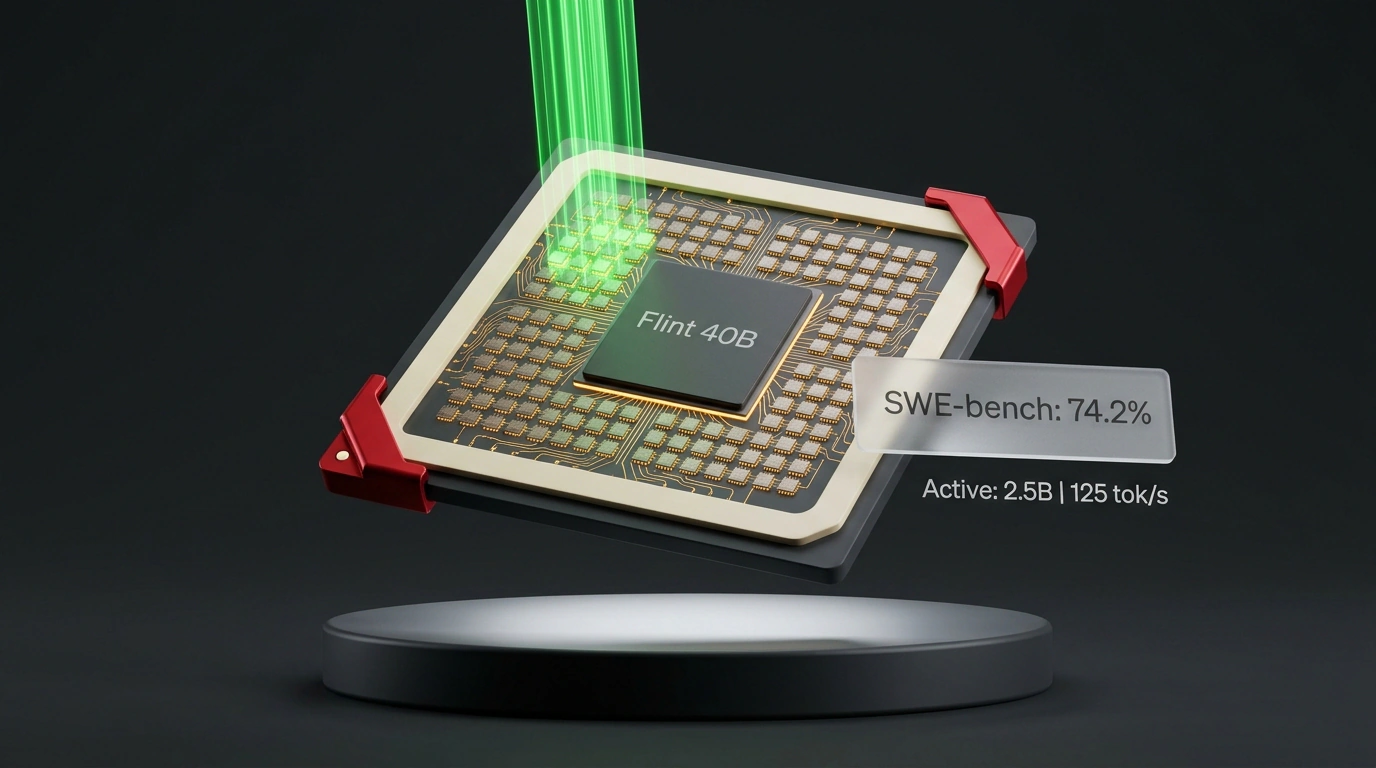
Every developer who has tried running a local coding model on a work laptop knows the wall of painful trade-offs. Lightweight 7B–14B models (like base Qwen or DeepSeek variants) spin up effortlessly and spit out code like a machine gun, but hand them a tricky multithreaded race condition or a messy cross-file refactor and they start hallucinating methods that don't exist. Heavyweight dense 32B–70B models reason on a completely different level, yet they demand 48–80 GB of VRAM and crawl along at 15–25 tokens per second on consumer hardware—a true test of patience.
Recursive Superintelligence, the startup led by well-known researcher Richard Socher, just cut straight through that Gordian knot by releasing Flint 40B under a clean Apache 2.0 license.
Ultra-Sparse 256-Expert Architecture: Getting 40B Quality at 2.5B Compute
Flint 40B's secret weapon is an aggressively sparse Mixture-of-Experts design. The model packs a respectable 39.8 billion parameters in total, yet only 2.5 billion weights fire for each generated token.
Here is how the network geometry breaks down:
- 49 layers total: the first two are dense layers for initial context capture, followed by 47 sparse MoE routing layers.
- Each MoE layer houses 256 specialized micro-experts.
- At every step, a dynamic token router picks exactly 6 domain experts plus 1 always-on shared expert that keeps global syntax coherent.
As a result, your CPU or GPU crunches math as if it were running a tiny 2.5B model, while drawing on the reasoning depth and broad knowledge of a 40-billion-parameter brain.
Autonomous Training via Eureka Machine and SWE-bench Verified Scores
Another jaw-dropping detail is how Flint 40B was trained. Recursive's small team trained the model in under four months using their in-house autonomous research platform, Eureka Machine.
Eureka Machine is an AI meta-system that generated thousands of synthetic software repositories on its own, simulated millions of reinforcement learning loops, tracked test compilation, and automatically pruned dead-end reasoning branches. Human engineers mostly set high-level criteria and acted as final arbiters.
Software engineering benchmarks tell the story clearly:
- On SWE-bench Verified—where the model gets a real open-source bug report and must clone the repo, pinpoint the issue, write a test, and produce a clean patch—Flint 40B hit 74.2%, taking the undisputed crown among all open models under 50B parameters.
- On IFEval for complex multi-step instruction following, it scored 95.1%.
- Its 262,144-token context window is roomy enough to hold the entire architectural docs of a mid-sized project in one go.
125 Tokens per Second on Apple Silicon in a Fully Air-Gapped Loop
Quantized to GGUF Q4_K_M, the model file weighs in at roughly 23 GB. That means any MacBook Pro with an Apple M4 Pro or M3 Max and 48 GB of unified memory runs it effortlessly, with plenty of RAM left over for macOS and your IDE.
On a laptop, inference cruises at a steady 125–130 tokens per second, and on servers equipped with GPUs like an RTX 4090, it tops 150 tokens per second—faster than a human can read.
Spinning up a local Flint 40B server with llama.cpp takes a single terminal command:
# Start a local OpenAI-compatible Flint 40B server
./llama-server \
  --model ./models/flint-40b-instruct-q4_k_m.gguf \
  --ctx-size 131072 \
  --n-gpu-layers 49 \
  --threads 12 \
  --port 8080 \
  --host 127.0.0.1
Once the server is up, you can wire Flint 40B into any code editor—VS Code, Cursor, Neovim—or hit the local endpoint directly from Python scripts:
import openai

# Connect to local Flint 40B inference
client = openai.OpenAI(
    base_url="http://127.0.0.1:8080/v1",
    api_key="local-dev-no-key-required"
)

response = client.chat.completions.create(
    model="flint-40b",
    messages=[
        {
            "role": "system",
            "content": "You are a senior systems engineer. Inspect memory allocations and optimize socket buffers."
        },
        {
            "role": "user",
            "content": "Find potential memory leaks in our epoll network event loop in src/net/worker.c"
        }
    ],
    temperature=0.1,
    max_tokens=2048
)

print(response.choices[0].message.content)
And because it ships under Apache 2.0, commercial teams have a green light to deploy it inside completely isolated corporate networks—keeping every line of proprietary source code off external servers.