Just a few years ago, software engineering ran on an unshakeable axiom: if you reached Senior or Lead, knew your way around distributed systems, and aced dozens of whiteboard interviews, you were storm-proof. Recruiters lined up in your LinkedIn inbox, compensation climbed exponentially, and a senior title felt like a lifetime insurance policy against layoffs.
The past two years have flipped that world upside down. Waves of cost-cutting and targeted layoffs are increasingly hitting engineers with ten years of experience, Big Tech resumes, and deep knowledge of compiler internals.
A joint breakdown by engineers Vlad Ten and Timur Shemsedinov, "Why Even Experienced Programmers Are Being Laid Off", digs into the real drivers behind this tectonic shift. It isn't blind penny-pinching to pretty up quarterly reports. What's changing is the very definition of what a business considers valuable engineering work.
The End of Venture Abundance: How the Business Lens Changed
To see what's going on inside executive and CTO offices, look at the macro backdrop. Zero interest rates and cheap venture capital trained IT companies to chase extensive growth. The top priority for startups and enterprises alike was hiring as many heads as possible, staking out market share, and showing investors team scale. In that hothouse climate, an engineer could spend months polishing abstractions, rewriting a working service in a trendy framework, or building a custom queue orchestrator—cash flowed freely, and nobody checked the return on investment.
Today, the economy is back to sober math. The metrics that matter now are payroll ROI and positive unit economics for every product line.
When the CFO and CTO sit down with the payroll sheet, they see an engineer making 500,000–700,000 rubles a month. And the first question asked in that room is blunt: "What measurable profit does this person bring to the company? Are they speeding up product hypothesis testing, or are they slowing the team down?" Too often, the answer isn't flattering.
The Trap of "Architectural Vanity" and Toxic Overengineering
The main ailment afflicting an entire generation of seasoned engineers is what you might call architectural vanity.
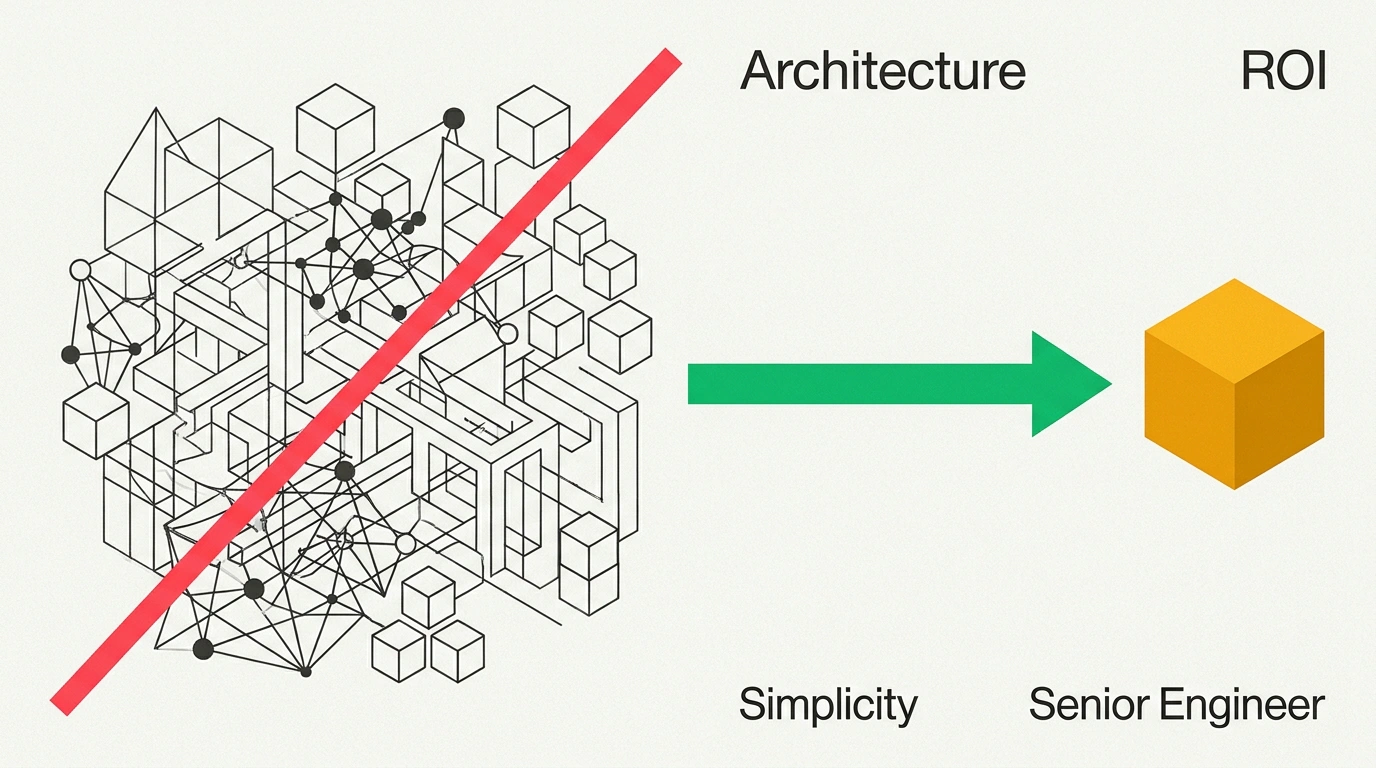
Writing straightforward CRUD services bores a veteran developer. They want to build monuments: slicing a compact app into twenty microservices, dragging Saga distributed transactions into the stack, inventing internal frameworks, and erecting towering layers of abstraction where a plain Go or Node.js monolith backed by PostgreSQL would do the job.
For the business, that mindset is a disaster:
- Longer Time-to-Market: Instead of shipping a new feature in three days to test user demand, the team spends two months negotiating gRPC contracts, standing up Kafka queues, and tuning a Service Mesh.
- The hidden maintenance tax: When someone asks the architect behind this masterpiece why everything runs so slowly, they demand three more DevOps engineers and two mid-level devs just to keep the contraption upright.
During belt-tightening, businesses cut those "architects" first. The ability not to write a complex microservice—and instead solve a business problem in five lines of plain code—has become the true mark of engineering maturity.
Saying 'my job is writing clean code for Jira tickets, let marketing worry about sales' is career suicide in today's market. An engineer has to understand how their code turns into company revenue.
AI Assistants Devalued Syntactic Routine
The second massive force is the spread of generative AI tools (Cursor, Claude Code, GitHub Copilot).
A big chunk of a senior's value used to live in raw recall: memorizing obscure standard-library flags, cranking out boilerplate fast, writing regexes, or wrapping a class in unit tests. Through sheer mechanical mileage, a veteran shipped working code noticeably faster than a junior.
Now AI assistants knock out that routine in seconds. A sharp junior or mid-level developer with a well-configured agent setup writes standard modules, migrations, and tests at the same speed as an industry veteran. Being a "walking syntax encyclopedia" no longer commands top dollar.
What Actually Protects an Engineer in Today's Market
Does all this mean seniors are obsolete? Not at all. The industry desperately needs strong engineers—their value has simply shifted from "how many lines of code I wrote" to "which costly problems I helped the company avoid."
Today, an engineer's resilience rests on three pillars:
- Product ownership: Sitting down next to a product manager, sizing up a hypothesis soberly, and saying: "Let's not build this module from scratch. We can test customer interest in two days using the existing form and save the company a million rubles."
- Fighting technical debt: Willingness to delete unnecessary code. Someone who strips out 10,000 lines of overcomplicated abstractions and turns a flaky cluster into a rock-solid monolith is worth far more to a business than the author of a shiny new layer.
- Orchestrating development: The engineer becomes a conductor who defines strict contracts, architectural boundaries, and tests, delegating code generation to AI agents while owning the final system quality.
The job market is simply returning to common sense: companies don't pay for how intricate your tech stack looks—they pay for speed, reliability, and real value for users.