Anyone who has tried using large language models to analyze a massive codebase knows the core pain of modern RAG (Retrieval-Augmented Generation) pipelines. To feed a monorepo into a model, you have to chop it into tiny text chunks and stuff them into a vector database.
In the process, the most important part vanishes—cross-cutting architectural links. Interfaces get severed, import paths lose their context, and when the model attempts a refactor, it naively hallucinates because it can't see the base class living in the neighboring folder.
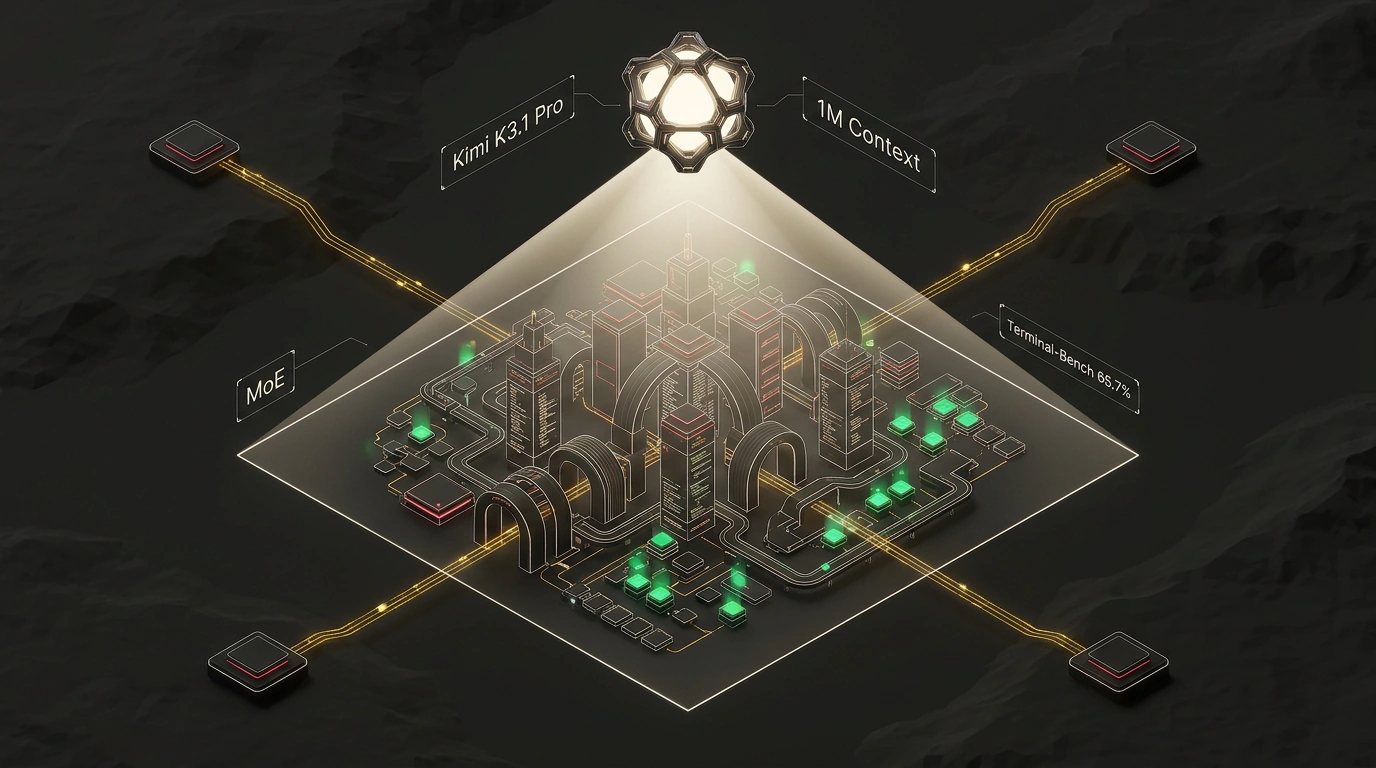
Chinese lab Moonshot AI has unveiled its next-generation flagship—Kimi K3.1 Pro—tackling the problem head-on with a record 1 million token working context window and a Mixture-of-Experts (MoE) architecture totaling around 3 trillion parameters.
3-Trillion-Parameter MoE Architecture and a Million-Token Context Window
What does a 1,000,000-token context window actually buy an engineer in practice? It means you can load an entire 80,000–100,000-line monorepo into a single prompt—complete with configuration files, database migration schemas, and test suites. The model sees the whole project at once, holding the dependency graph and architectural invariants in active memory.
Because it uses a Mixture-of-Experts architecture, generating each token activates only a specialized sub-network of experts, keeping power draw and inference speed practical. For interactive coding, the team also introduced a turbo variant, Kimi K3.1 Pro Highspeed, boosting token generation speed by 2–3x over the base model.
Terminal-Bench 4.0: 65.7% and Beating GPT-6 Astra
Moonshot AI didn't optimize solely for writing isolated functions—they focused on autonomous execution as a terminal coding agent.
The model was put through the Terminal-Bench 4.0 stress test (evaluated inside the strict Claude-Code agent harness):
- Kimi K3.1 Pro scored 65.7% on complex, real-world Linux terminal tasks.
- It comfortably beat flagship GPT-6 Astra (58.2%) and came within striking distance of reigning leader Claude Opus 5.5 (66.4%).
- On the
Kimi Hallu Bench Hardfactuality benchmark, error rates dropped from 23.4% to 8.3%, cutting hallucinated answers by more than half.
To showcase long-horizon planning, the model autonomously debugged a human gait biomechanics simulator over 167 iterations—navigating an anatomical atlas of 296 bones and 402 muscles and fixing 36 mathematical errors in muscle-torque calculations.
RAG-Free Monorepo Analysis and Drop-In API Compatibility
The nicest integration perk for existing pipelines is full compatibility between the Kimi API and the OpenAI SDK. You don't need to rewrite your client libraries—just swap the base URL and pass your API key.
Here is a real Python script for running a full-repo architectural audit:
import os
from openai import OpenAI

# Connect to the Kimi API using the standard OpenAI client interface
client = OpenAI(
    api_key=os.environ.get("KIMI_API_KEY"),
    base_url="https://api.kimi.ai/v1"
)

def audit_full_repository(repo_bundle_text: str, inquiry: str) -> str:
    """Analyze an entire monorepo in a single prompt up to 1M tokens"""
    response = client.chat.completions.create(
        model="kimi-k3.1-pro",
        messages=[
            {
                "role": "system",
                "content": "Ты — ведущий системный архитектор. Проанализируй весь репозиторий и найди узкие места в масштабировании."
            },
            {
                "role": "user",
                "content": f"Кодовая база проекта:\n{repo_bundle_text}\n\nВопрос: {inquiry}"
            }
        ],
        temperature=0.2,
        extra_body={
            "reasoning_effort": "high" # Enable extended reasoning chains
        }
    )
    return response.choices[0].message.content
For command-line workflows, the team also released the official Kimi Code terminal agent, where switching to the flagship model takes one command:
# Switch the active engine in the Kimi Code terminal agent
/model kimi-k3.1-pro
When sending 700,000–900,000-token prompts, the prefill stage takes noticeable time. Don't burn max context on quick single-line IDE autocomplete—lightweight models are a much better fit there.
Cybersecurity Filtering and Upcoming Open Weights Release
Perhaps the biggest headline of the launch: Moonshot AI announced it will release the model's Open Weights publicly on November 4, 2026.
Ahead of the weights drop, engineers ran strict offensive-security filtering across the training data—purging zero-day exploits and autonomous worm-generation scenarios to prevent uncontrolled cyberweapons.
Opening the weights of a 3-trillion-parameter MoE model at this tier will let large enterprises with air-gapped, on-premises environments run a frontier coding agent on their own hardware, putting corporate code privacy concerns to rest for good.
