When we read headlines about AI transforming design and engineering, it's easy to picture automotive or aerospace engineers kicking their feet up while a neural network sketches out a sleek new Porsche or jet turbine. Talk to any real mechanical engineer, though, and they'll bring you right back down to earth.
Sure, generating a gorgeous 3D concept car takes a couple of minutes today. That's when the real slog begins: Computer-Aided Engineering (CAE). To figure out whether airflow will rip a rear wing clean off, how heat dissipates across an engine block, or whether a chassis will resonate dangerously, teams run Computational Fluid Dynamics (CFD) and Finite Element Method (FEM) simulations. Solving massive systems of partial differential equations burns hundreds of hours on supercomputer clusters. Change a part's curve by two millimeters, and you're stuck waiting three days for the cluster to recompute the turbulence.
The strategic alliance between French lab Mistral AI and tech giant NVIDIA aims to eliminate that industrial bottleneck for good.
Surrogate Modeling: Replacing Numerical Solvers with Generative Physics AI
Instead of laboriously solving the Navier–Stokes equations via finite elements for every microscopic cell in space over and over again, Mistral and NVIDIA turned to surrogate physics modeling (Physics AI).
The idea is straightforward: train a neural network on millions of pre-computed fluid dynamics and structural simulations. The model learns the underlying nonlinear relationships between an object's geometry, flow boundary conditions, and resulting pressure or thermal fields.
As a result, Mistral's generative model can predict airflow patterns around a car body or pinpoint thermal hotspots in fractions of a second. Its margin of error compared to heavyweight classical numerical solvers stays within 1.5–2%, comfortably inside the tolerances for early-stage engineering design.
The Omniverse and NVIDIA Warp Stack: From Millisecond Math to Evolutionary Design
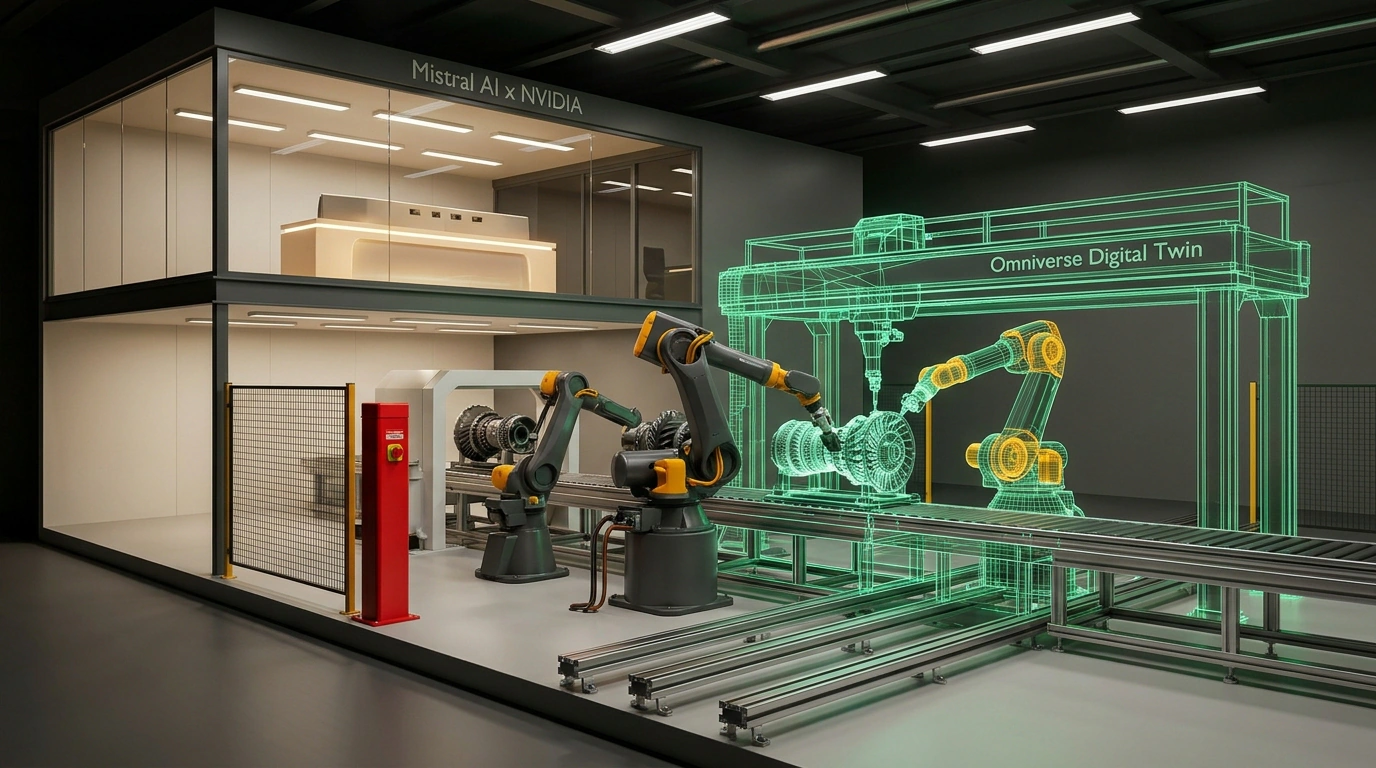
The deployment backbone for these models is the NVIDIA Omniverse digital twin platform paired with the open NVIDIA Warp framework, tuned for spatial physics math on GPU tensor cores.
The whole pipeline runs like a well-oiled engineering assembly line:
- A specialized autonomous agent powered by Mistral Large 4 ingests natural-language and engineering specs for a mechanical component.
- On the fly, it generates parametric 3D geometry in the open Universal Scene Description (OpenUSD) standard.
- The model tags the part as a SimReady asset with physical material properties: Young's modulus, yield strength, density, and thermal conductivity.
- The embedded surrogate physics network computes loads interactively in real time—as an engineer drags a spoiler's curve with their mouse, the pressure map and vortex trails update live at 60 frames per second.
Evolutionary Auto-Design: 100,000 Virtual Crash Tests Overnight
Shrinking physics simulation time from three days to a few milliseconds changes the very nature of engineering work. Humans no longer have to manually test two or three hypotheses a week.
Instead, teams can unleash evolutionary design algorithms: an agentic pipeline generates 100,000 part variations overnight, tests every single one in a virtual wind tunnel, culls weak shapes, and uncovers counterintuitive organic geometries that no human would sketch by hand—yet are tailor-made for industrial 3D printing.
NVIDIA and Mistral also announced joint work on open validation standards for CAD agents so engineering teams can independently verify simulation accuracy. It's a long-awaited leap for AI—moving beyond generating cat pictures to reshaping the physical world.