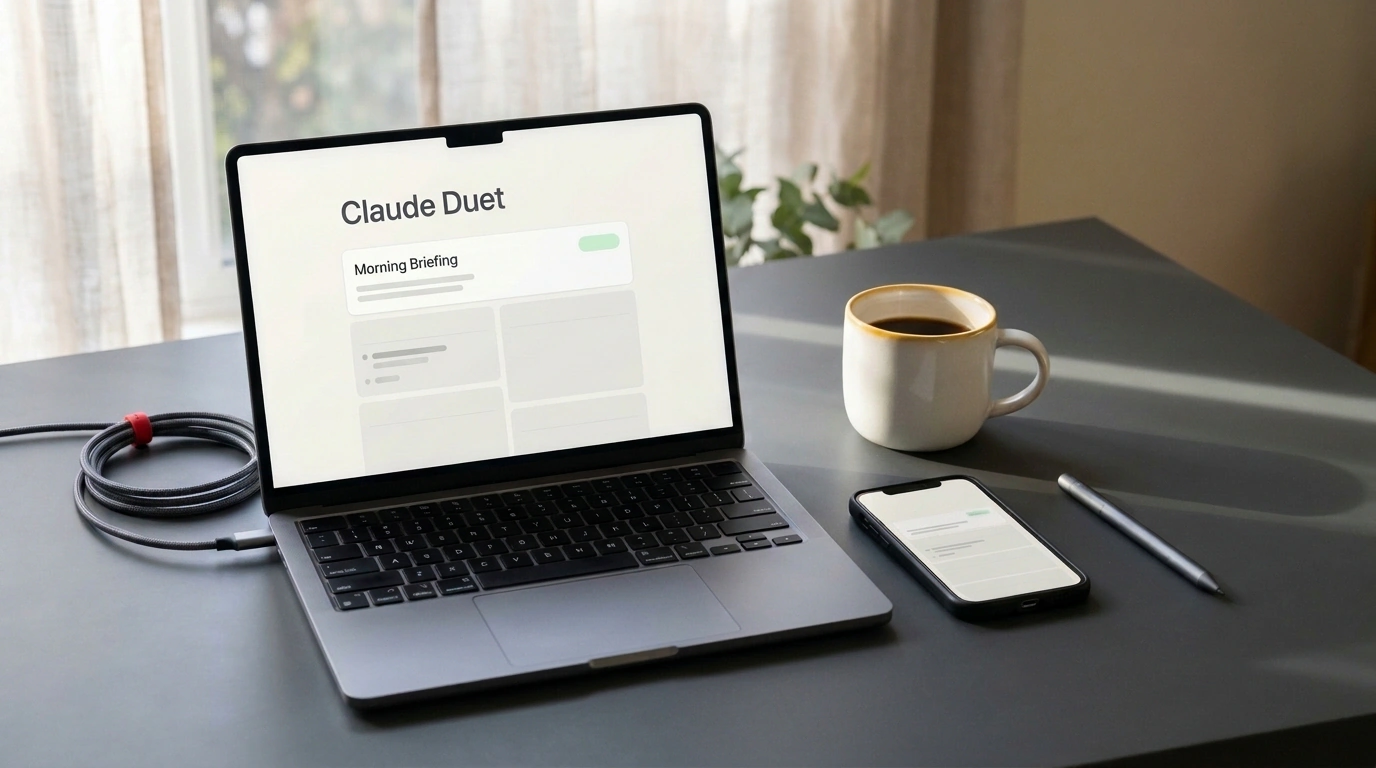
Think about how your typical workday with AI assistants goes right now. You open a browser tab, type in a prompt, wait twenty seconds, copy the output, tweak something, and close the tab. That's the classic reactive loop: the AI sits there like a calculator or a reference book on your desk, doing absolutely nothing until you poke it.
Anthropic wants to flip that whole workflow on its head with Claude Duet, a standalone app for iOS and the web. Here, flagship Claude Opus 5.5 stops being a passive chat partner and turns into a proactive teammate living on a dedicated virtual machine, working for you around the clock.
A Proactive Agent Instead of a Reactive Chatbot: How the Persistent VM Works
The core architectural shift behind Claude Duet is its own isolated virtual environment in Anthropic's cloud. The agent doesn't go to sleep when you swipe away the mobile app or close your laptop lid.
Every few hours, Duet quietly polls your connected integrations in the background: Google Workspace, company Slack channels, Notion knowledge bases, GitHub repos, and CRM tools. It scans the incoming stream of updates, cross-references them against your active project goals, and filters out the noise.
If a client sends contract redlines, a test runner fails on a server, or two meetings collide on your calendar, Duet doesn't spam you with frantic alerts. Instead, it investigates the issue, drafts a concrete next step—like a reply to the client or a pinpointed fix for the broken commit—and waits for the right moment to brief you.
Topic Channels, Morning Briefings, and Voice-Driven Artifact Editing
Instead of one chaotic, endless chat feed where yesterday's Python script is buried under a recipe for apple pie, Duet organizes your work into dedicated Channels. You can spin up separate spaces for "Mobile Client Dev," "Marketing Strategy," or "Financial Ops."
Each channel keeps its own persistent long-term memory, linked repositories, specs, and live interactive Artifacts—React components, SVG diagrams, spreadsheets, and documents.
Your morning in Duet doesn't start by wading through hundreds of unread messages; it starts with the "Morning Brief" screen. It's a clean, structured rundown of:
- what happened across your projects overnight while you were asleep;
- which background tasks the agent wrapped up successfully (like pulling weekly traffic analytics);
- which key forks in the road actually need your engineering or management call.
Duet's second big leap is synchronous voice control over the artifact canvas. Imagine you're looking at a generated React dashboard. Instead of typing out another prompt, you just say out loud: "Hey, switch the revenue chart from bars to a line graph and move the palette to a clean dark theme." Duet makes surgical edits directly to the component's AST on the fly, and the UI updates right before your eyes without reloading the page.
Guardrails and Trade-Offs: Quotas, Render Lag, and Cloud Lock-In
Sounds like magic, right? But what about security? Handing an autonomous agent the keys to your inbox and code repos is every attacker's dream.
Anthropic split Duet's permissions into two strict tiers:
- Passive actions: reading emails, auditing code, searching docs, drafting replies, and local refactoring. The agent handles these completely on its own.
- Active actions: sending emails to external recipients, merging branches into production repos, deleting files, or changing access permissions.
Before executing any active operation, Duet pushes a notification to your phone showing the exact diff and two buttons: "Approve" or "Reject." Without your Face ID biometric confirmation, not a single line of code lands in production. On top of that, financial transactions and payment gateway operations are hard-blocked inside the agent's runtime environment.
Riley Brown, who put Claude Duet through more than 10 hours of real-world testing, flagged a few practical bottlenecks worth keeping in mind:
- Token appetite: constant background channel polling and overnight analytical runs chew through your Claude Pro or Max subscription limits fast.
- Complex redraw lag: if an artifact spans thousands of lines of dense code, a voice edit can trigger a 2–3 second pause before the screen refreshes.
- Cloud dependency: the app is tightly coupled to Anthropic's servers, so enterprises with strict on-prem or air-gapped requirements can't deploy it inside their own infrastructure yet.
Even with those caveats, Claude Duet clearly signals where personal productivity is heading: the era of manual copy-paste prompting in a browser tab is giving way to persistent digital teammates.