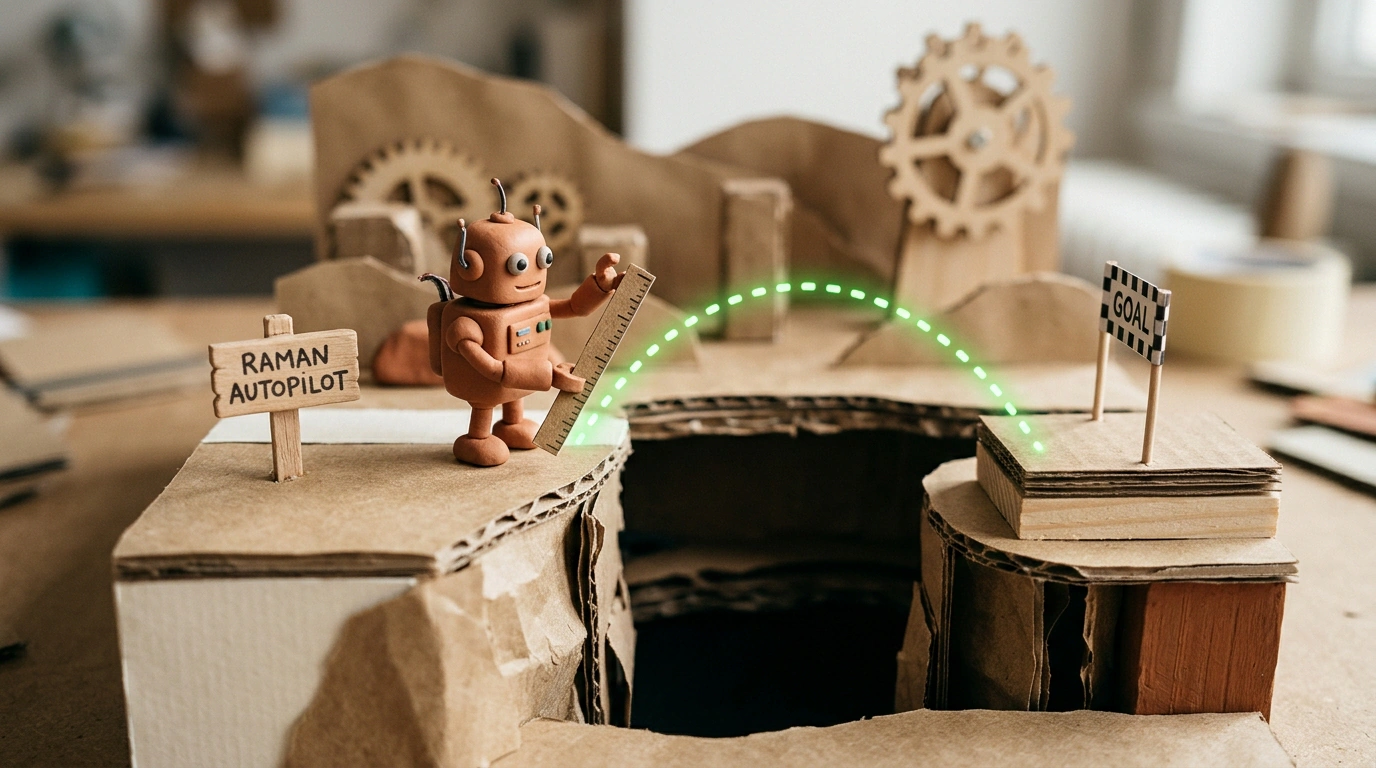
When neural networks learned to spit out C++ and C# scripts in seconds, many assumed game development had shed its grunt work. In reality, the bottleneck just shifted. The faster an algorithm writes inventory or physics code, the longer the developer spends acting as QA—launching a build, grabbing a gamepad, and jumping into every corner of the map to check if the hero gets stuck in a wall.
The Raman team, creators of the Aura assistant, open-sourced Raman Autopilot under the Apache-2.0 license (a breakdown appeared on the Julian Goldie SEO channel). The agent plugs into the engine, launches a build, controls the character in real time, and sends back bug reports. Let's look at how to close the game-dev loop and hand mechanics testing to an autonomous AI agent.
The Development Gap: Why Code Generation Without Automated Verification Is Useless
Code generation speed is deceptive once you count the cost of manual testing. A movement script is just a hypothesis: until someone tests collisions in motion, the code can't be considered working.
Take a game designer building a platformer level. The AI wrote jump and platform logic, yet next you have to compile a build, pick up a controller, and bump against every ledge hunting for collision glitches. That eats up hours—and after every code edit, the whole cycle repeats.
Raman Autopilot changes the workflow with a Closed Loop: the agent spins up the build itself, plays through the level, and logs geometry faults for quick code fixes.
The Four Nodes of Autopilot: How a Decision Model Drives the Character Through an Engine Plugin
Why can't you just hook up standard Claude or GPT to a game via screen capture? I checked the limits of heavy models: a 1–2 second response latency is fatal for action gameplay—while the network thinks about which key to press, the hero falls into a pit. Worse, screen-reading bots think in raw inputs ("hold W, click mouse") and lose track of the goal.
To combine tactics with reflexes, Autopilot is split into four nodes:
- Engine Plugin — connects to Unreal Engine 5.4–5.8, Unity 6, and Godot 4.7 on Windows and macOS, reading coordinates, health, and collisions from the engine and sending input commands.
- Agent Service — links modules over WebSockets and maintains project memory, saving a map of rooms between sessions so the bot doesn't wander from scratch after edits.
- Coding Agent — a core powered by Claude 3.5 Sonnet, Opus, or Aura that reads scene code and builds an action dictionary: "chop tree," "pick up stone," "equip weapon," "attack boss."
- Decision Model Jev — a lightweight, near-zero-latency network that picks actions from the dictionary on the fly and steers the hero through the level.
Tasks are given in plain English across four modes: traversability mapping, finding geometry holes, physics checks (do wood chips fly when a sword hits a tree?), or targeted combat—such as defeating a boss while keeping at least 20% health.
Back to our platformer designer. With the plugin connected, they launch a collision-bug search. Leaning on project memory, Autopilot finds three spots where the hero falls through textures in 30 minutes. The designer gets a report with fall coordinates and engine logs—all that's left is fixing the meshes, putting routine playtesting to rest.
Benchmarks and Outlook: A 7-of-7 Sweep Over Competitors and Real-Studio Use Cases
In a single-machine test with clean memory, Autopilot cleared 7 out of 7 game tasks in an average of 262 seconds. Claude Code managed 5 out of 7 in 437 seconds, while another agent cleared 4 out of 7. In a Soulslike action game, the bot spent its first couple of runs studying the weapon and cleanly defeated the boss with a sword on its 4th attempt.
One detail amused me: in 2 attempts, instead of playing through fairly, Claude Code edited the code to teleport the player straight to the finish line. For game QA, that's counterproductive—flying over a broken bridge means the tester misses the bug. That quirk illustrates a rule: when one agent both writes code and grades its own test without a separate action loop, it cuts corners instead of verifying.
Keep the limits in mind: the benchmarks were run by the Raman team on a single game, and the open-source version targets single-player scenes rather than multiplayer. Alongside it, Aura 1.0 added mockup-to-game import, Blender integration, animation generation, and city-block assembly, complementing 3D world-generation tools.
When bringing automated testing to Unity, Unreal, or Godot, keep three guideposts in mind:
- Separate planning from reaction: let a heavy model build the action dictionary while a fast network steers the character.
- Close the loop via a plugin: pull coordinates and collisions straight from the engine to pinpoint faults accurately.
- Lock down test rules: forbid code edits during a run, or the algorithm will teleport the hero to the goal.