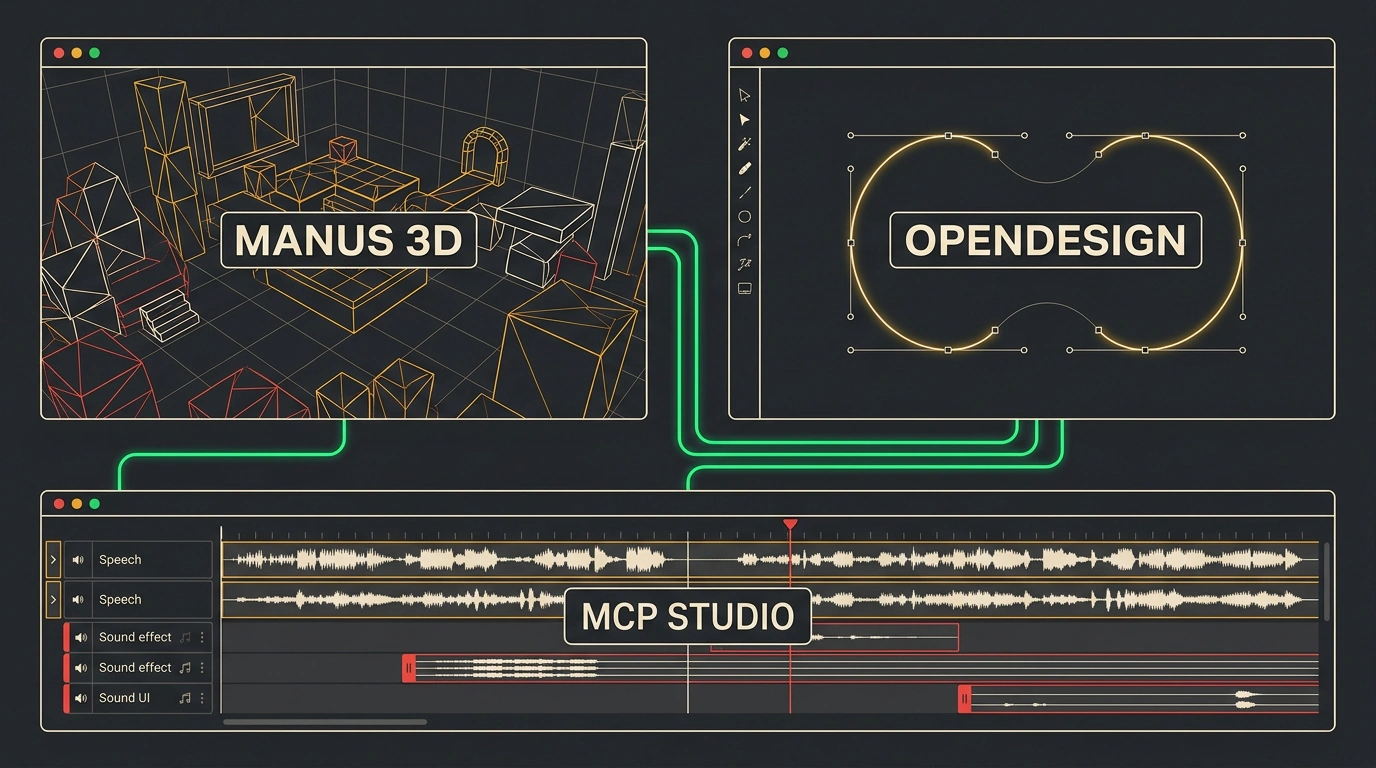
Generative AI is rapidly outgrowing its "pretty picture generator" phase. A year ago, generating a static poster in Midjourney felt like peak magic; today, designers and developers need end-to-end, controllable production. The fatal flaw of raster diffusion images and video clips is that they're frozen in amber: you can't just nudge a button on a generated UI screen or tweak a title color inside a rendered clip. Today we're looking at four new tools pushing generative media into interactive vector code, playable 3D worlds, and automated editing studios.
Manus GameDev 3D
Manus GameDev tears down the wall between a rough idea and a working game prototype. From a single text prompt, it generates a playable 3D level right inside your browser using WebGL and Three.js:
- Instead of spitting out an isolated mesh, the model builds a full interactive scene: room geometry, collision physics, dynamic lighting, and first-person character controls.
- It automatically wires up a game HUD: health bar, ammo counter, crosshair, and inventory.
- Enemy AI is still fairly casual, of course, but for testing gameplay loops and pitching demo scenes, a generator like this saves weeks of 3D modeling and level design.
OpenDesign Motion
Modern motion design has long been chained to heavy proprietary suites like After Effects and their recurring fees. The open-source framework OpenDesign Motion takes a web-native route:
- It generates and edits UI animations in clean vector code (SVG, CSS, Lottie, Rive).
- Every element stays mathematically editable: swap an icon color, adjust Bezier easing curves, or rewrite a button label with zero pixelation or scaling artifacts.
- It slots cleanly into agentic pipelines for building animated banners and landing pages automatically.
ElevenLabs MCP Studio
Putting together a promo or training video used to mean wrangling a whole crew: a voice actor, a sound designer for foley, a composer, and a video editor. ElevenLabs MCP Studio pulls that entire pipeline into one agentic workspace via the Model Context Protocol:
- Working from a script, the agent synthesizes voice lines with the right emotional pacing and pauses.
- It layers in matching spatial sound effects (SFX)—footsteps, wind, UI clicks, city ambience.
- It scores adaptive background music and generates synced video, turning a written brief into a finished cut inside a single chat.
Nano Banana 2.1 in Google Flow
Inside the Google Flow ecosystem, Nano Banana 2.1 arrives with a laser focus on consistent UI assets:
- Unlike paid commercial tools, generation in Google Flow runs with zero paid credit burn.
- The model is tuned for UI mockups, analytics dashboards, and isometric 3D floor plans.
- Its standout strength is style consistency: interface components, color palettes, and card corner radii stay uniform across every screen in a project.
When building web interfaces, lean toward tools like OpenDesign Motion: a Lottie animation weighs tens of kilobytes and renders in hardware, whereas embedded video files bloat bandwidth and drag down page loads.
We already explored the shift toward interactive generation in our look at vibe-coding video games. What's happening now makes the trend unmistakable: AI has stopped being a side toy and become a core piece of professional production pipelines where iteration speed is everything.