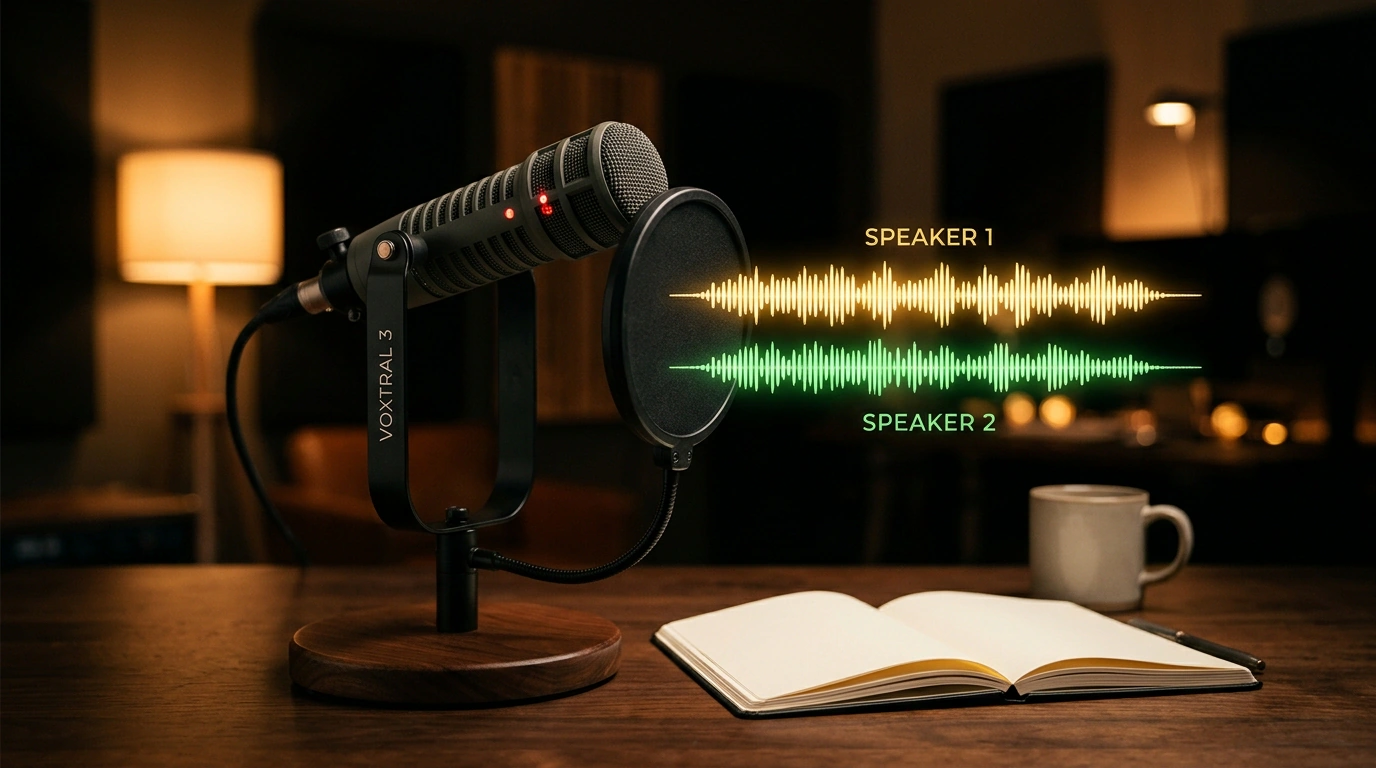
You know how messy a standard Whisper transcript gets on a real Zoom call or client phone recording: in a quiet studio it's spotless, but the moment two people talk over each other, the text turns into an unlabeled wall of words. Meanwhile, uncommon technical terms, colleagues' last names, or brand names get mangled into phonetic nonsense. Until now, getting usable output meant duct-taping external diarization libraries like pyannote.audio together with an LLM post-processing pass.
French lab Mistral AI tackled the problem from the ground up with its Voxtral 3 speech family—including the batch model Voxtral Small Transcribe 3 and a streaming Realtime edition. The goal is straightforward: give developers a turnkey speech brain for voice agents with zero external workarounds.
Under the Hood: 50+ Languages, Native Diarization, and Custom Vocabularies
Unlike traditional automatic speech recognition (ASR) systems, Voxtral 3 was trained from day one as a multimodal agentic component:
- 50+ languages with live code-switching: the model handles mid-sentence language switching effortlessly—vital for international teams mixing English technical jargon into other languages.
- Built-in Speaker Diarization: separates speakers right during transcription, tagging timestamps to tenths of a second (
Speaker 1,Speaker 2) without chaining extra heavy models. - Turn Detection: picks up intonational sentence endings so a voice assistant can jump in naturally—no awkward multi-second pauses and no cutting people off mid-breath.
- Context Biasing: lets you pass an array of domain-specific words—microservice names, product SKUs, or internal slang—directly in the API call. The model shifts token probabilities toward your list, eliminating silly phonetic typos.
Infographic of multilingual agentic speech: native two-speaker diarization, sub-500 ms latency, and a Context Biasing term dictionary.
In Practice: Batch Transcription and Streaming Voice Agents
Here is how a Python call to the Mistral API looks when transcribing a dense engineering standup with diarization and custom terms:
from mistralai import Mistral

# Initialize the Mistral AI client
client = Mistral(api_key="your-mistral-api-key")

with open("dev_standup.mp3", "rb") as audio_file:
    speech_res = client.audio.models.process(
        model="voxtral-small-speech-3",
        file=audio_file,
        language="en",
        diarization=True,
        context_biasing=[
            "Kubernetes",
            "OpenTelemetry",
            "ClickHouse",
            "DeepInfer"
        ]
    )

for segment in speech_res.segments:
    print(f"[{segment.speaker}] {segment.start:.2f}s - {segment.end:.2f}s: {segment.text}")
And if you're building a phone support bot or an on-site voice concierge, the streaming WebSocket client delivers first-token latency under 500 milliseconds:
import asyncio
from mistralai.realtime import VoxtralRealtimeClient

async def run_voice_agent():
    async with VoxtralRealtimeClient(model="voxtral-mini-transcribe-3-realtime") as session:
        await session.connect()
        print("Connected to Voxtral speech engine")

        async def handle_turn(event):
            print(f"User finished speaking: {event.text}")
            # Forward text to LLM for instant response generation

        session.on("turn_detection", handle_turn)
        # Stream microphone audio chunks in real time
        # await session.send_audio(stream_chunk)

asyncio.run(run_voice_agent())
For companies handling customer personal data or sensitive call recordings, Mistral's European footprint is a major plus: its cloud infrastructure is fully GDPR-compliant, and model weights are available for self-hosted deployment on your own GPUs.
We already tracked how fast the race among voice AI agents is heating up, where fractions of a second make or break a customer interaction. Voxtral 3 puts production-grade voice interfaces within reach of any developer, without the headache of tuning acoustic pipelines by hand.