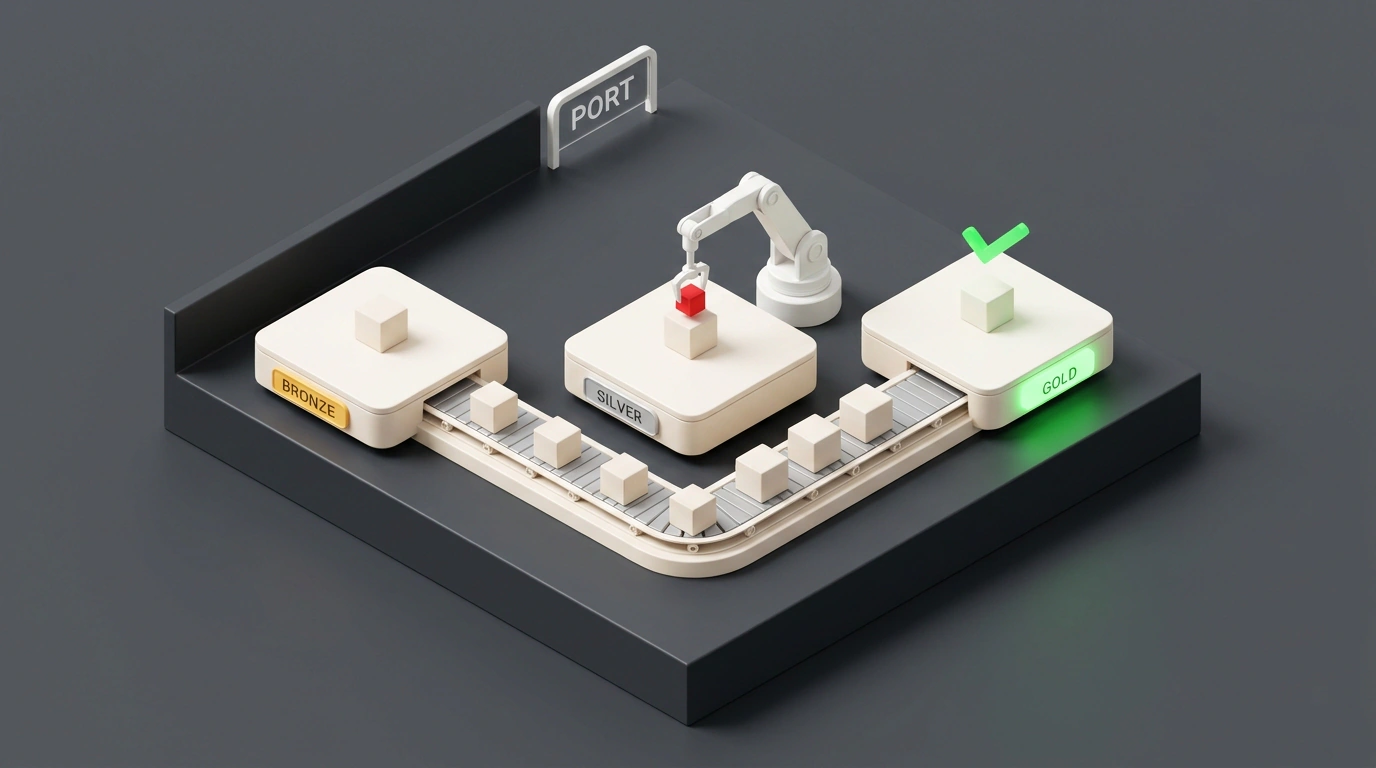
You've probably noticed how fast software development is changing: the moment you give Claude Code, Cursor, or Aider room to operate, solo tasks get knocked out in minutes. But try turning five of those autonomous coders loose on a shared team repo without strict guardrails. Within a couple of days, your codebase turns into a junkyard: agents happily spin up duplicate utilities, ignore your linting rules, nuke shared dependencies, and declare victory just because the code barely compiled.
I spent a good while thinking about how to rein in that neural-network enthusiasm, and engineer Cole Medin's approach nailed it: you shouldn't treat autonomous coders like wizards with magic wands—you should treat them like junior interns in an engineering department. And every intern needs clear rules of the game, measurable quality standards, and strict checks before anything ships.
The backbone of this kind of software factory is an Internal Developer Portal (IDP)—specifically Port (getport.io), which acts as both a unified Software Catalog and an automated referee for code maturity via Service Scorecards.
Factory Architecture: From Service Catalog to Maturity Grades
Instead of feeding an agent an entire monolith at random, each service is registered in Port as a Blueprint. That entry locks in the language, the GitHub or GitLab repository, the owning team, and the current API spec (OpenAPI or AsyncAPI). When an agent picks up a task, it pulls context from the service's registered passport rather than guessing.
The real discipline comes from Service Scorecards, broken down into clear tiers:
- Bronze: baseline hygiene. A clear README, a valid Dockerfile, and a passing build.
- Silver: engineering standard. At least 70% unit test coverage, an integrated SAST vulnerability scanner, and zero critical linter warnings.
- Gold: production readiness at scale. A configured production CI/CD pipeline, SLO/SLA monitoring, and up-to-date dependencies with no known vulnerabilities.
Here is what a declarative Service Scorecard looks like in YAML for Port:
scorecard:
  identifier: production_readiness
  title: "Production Readiness Scorecard"
  blueprint: microservice
  levels:
    - name: Bronze
      rules:
        - identifier: has_readme
          title: "README.md exists in root"
          query:
            property: has_readme
            operator: "="
            value: true
        - identifier: build_status
          title: "Main branch build is passing"
          query:
            property: last_build_status
            operator: "="
            value: "success"
    - name: Silver
      rules:
        - identifier: test_coverage
          title: "Unit test coverage >= 70%"
          query:
            property: test_coverage_pct
            operator: ">="
            value: 70
        - identifier: no_critical_bugs
          title: "Zero critical security alerts"
          query:
            property: critical_vulnerabilities
            operator: "="
            value: 0
The Closed Loop: A Test Breaks, an Agent Fixes It
The slickest part of this setup is the automated Self-Healing Loop. Picture this: overnight, a build breaks on main, or a third-party library update drops your test coverage below 70%. The service immediately loses its Silver status in Port.
Infographic of the service self-healing loop: test coverage dropping below 70%, a Webhook trigger, and a coding agent fixing the bug.
That drop fires a Port Automation. A webhook sends an event to your agent orchestrator (say, a FastAPI or LangGraph pipeline). The payload isn't some vague cry for help—it carries the exact context: the latest commit diff, the failed test log, and a reference to the broken scorecard rule.
The agent spins up an isolated container, clones the repo, sets up the environment, reproduces the failure locally, and writes a fix.
# Sample webhook payload from Port to the agent orchestrator
curl -X POST https://agent-orchestrator.internal/api/v1/self-heal \
  -H "Content-Type: application/json" \
  -H "Authorization: Bearer ${INTERNAL_ROUTER_TOKEN}" \
  -d '{
    "event": "scorecard.level_dropped",
    "service_id": "auth-service-v2",
    "repository": "github.com/company/auth-service-v2",
    "target_branch": "fix/auth-test-regression",
    "failed_rule": "test_coverage_pct",
    "current_value": 64.5,
    "required_value": 70.0,
    "last_failed_test": "tests/test_oauth_refresh.py"
  }'
The autonomous agent opens a Pull Request strictly on a separate branch prefixed with [AI-Fix]. Direct pushes to protected branches are blocked at the repository level. The agent's access token (GitHub PAT) gets minimal pull-requests: write permissions, and merging into main only happens after final approval from a tech lead or on-call engineer.
Rolling out agentic workflows like this at larger companies proves one thing: the bottleneck isn't model intelligence—it's process discipline. We dug into that same dynamic in our breakdown of the Forward Deployed Engineer methodology: until you codify your acceptance criteria for humans, AI will only multiply your technical debt.
Port's free tier covers teams of up to 15 users, which is plenty for dialing in your factory. Just make sure you cap agent iterations and runtime from day one—otherwise a script stuck in a loop on a tricky bug will burn through your monthly token budget in a single sleepless night.