Discussions about how AI will reshape the software engineering job market usually swing between two extremes: apocalyptic predictions that programming is dead, and dismissive skepticism from seasoned engineers ("LLMs just write glorified autocomplete"). While theorists debate, hard empirical data is piling up inside the industry itself.
A research team at Anthropic—the company behind the Claude models—led by Nathan Wilmers, Regina Catipon, Maxim Massenkoff, and Peter McCrory published a landmark report titled "How AI restructured work and employment at Anthropic". They looked inside their own engineering org to measure exactly how hiring, task distribution, and team productivity shifted after broad adoption of autonomous coding agents.
The numbers in this report force a fresh look at where software engineering is headed.
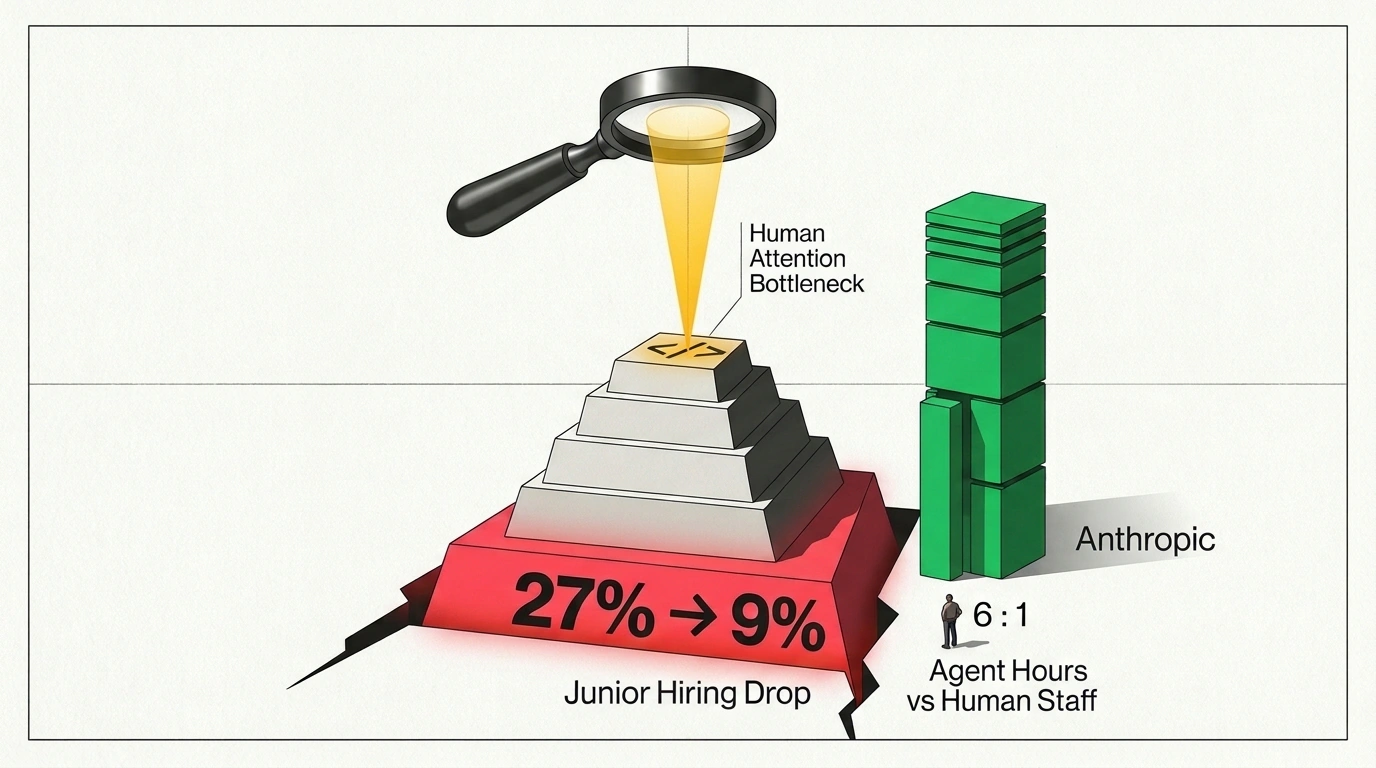
The Junior Hiring Drop: 27% Down to 9%
The study's headline finding hits right at the entry ramp into the profession.
Historically, engineering teams grew like a pyramid: roughly a quarter of hires were junior developers. They took on foundational work—writing routine tests, squashing minor bugs, building simple forms, and documenting APIs. Over a year or two, a junior got their reps in, learned the codebase's architecture, and naturally grew into a confident mid-level engineer.
At Anthropic, that balance collapsed in just six months. The share of entry-level engineers among all new technical hires plunged from 27% to 9%.
The reason is straightforward: the tasks juniors traditionally cut their teeth on are now handled faster, cheaper, and more reliably by autonomous Claude Code agents. Need a suite of unit tests from a spec? The agent finishes in two minutes. Hunting down a typo in a config file or refactoring a legacy component to a new interface? An assistant runs it across ten branches in parallel. Demand for hires without deep engineering foundations evaporated almost overnight.
Agents vs. Humans: A 6-to-1 Ratio
At the same time, senior engineers at the company saw productivity jump exponentially:
- Average git commits per engineer jumped 5.1x in just six months of heavy agent use.
- Total interactive machine hours spent by autonomous agents writing and running code exceeded the entire company staff's working hours by 6x.
- In specialized R&D groups, that gap hit an astonishing 19 to 1: for every hour a research engineer worked, neural agents ran nineteen hours of parallel code generation!
Interestingly, automation spilled into non-technical roles too. Operations staff, lawyers, and marketers at Anthropic used models to write scripts and automate busywork 45x more often, while direct SQL queries they generated against internal databases more than tripled.
The New Bottleneck: Human Attention
Does a 5x jump in commits mean software ships to production five times faster? Not at all.
Anthropic's researchers pinpointed a new fundamental constraint: the human attention bottleneck.
When agents crank out thousands of lines of code in minutes, writing syntax is no longer the limiting factor. Instead, the bottleneck shifts to a human's capacity to:
- read and understand the proposed diff;
- verify the code has no subtle logic bugs, hallucinations, or security holes;
- check that the change respects the system's overall architectural integrity.
Software engineering is rapidly turning into "meta-work." Engineers spend less time typing language keywords by hand and more time writing tight specs, setting up test harnesses, orchestrating agent swarms, and reviewing output.
Anthropic's empirical data exposes a systemic risk for the global tech market. When companies stop hiring juniors, they break the career ladder that produces seniors. Senior engineers don't graduate fully formed from university—they grow through hundreds of real-world tasks. If we hand every entry-level rung to AI today, in five to seven years the industry could face a severe shortage of experienced architects able to verify what those agents produce.
Anthropic's experience proves that AI isn't erasing engineering—it is ruthlessly rewriting the rules of entry. Staying valuable in this new landscape takes more than knowing language syntax; systems thinking, architectural judgment, and a sharp eye for reviewing machine-generated work are now the core skills.
