Any backend engineer who has wired an LLM into a strict production pipeline knows the core pain of generative AI: probabilistic unpredictability. You set temperature=0, lock the seed, define a strict response schema—and a hundred requests later, your parser crashes because the model dropped a closing brace or prepended chatter before the JSON object. Worse still, dynamic GPU batching means the exact same request can return different tokens depending on how many other requests happened to share the card in that millisecond.
DeepSeek's research lab just shipped a major upgrade to its open inference engine DeepInfer, aimed at eliminating those trade-offs for self-hosted models—starting with the high-speed DeepSeek V4.1 Flash.
Determinism Regardless of Batch Size
The flagship architectural change is Batch-Invariant Inference, toggled via DEEPINFER_BATCH_INVARIANT=1.
Standard inference engines group parallel requests into dynamic batches to keep GPU cores busy. The catch is that floating-point math (FP16/BF16) isn't associative: the order in which vectors get summed inside the attention kernel shifts based on neighboring requests in the batch. DeepInfer rewrote its low-level CUDA kernels so that, with a fixed seed, a prompt produces bit-for-bit identical output whether the server is handling one request or slammed by a hundred concurrent calls.
Grammar-Guided Decoding: Broken JSON Becomes Physically Impossible
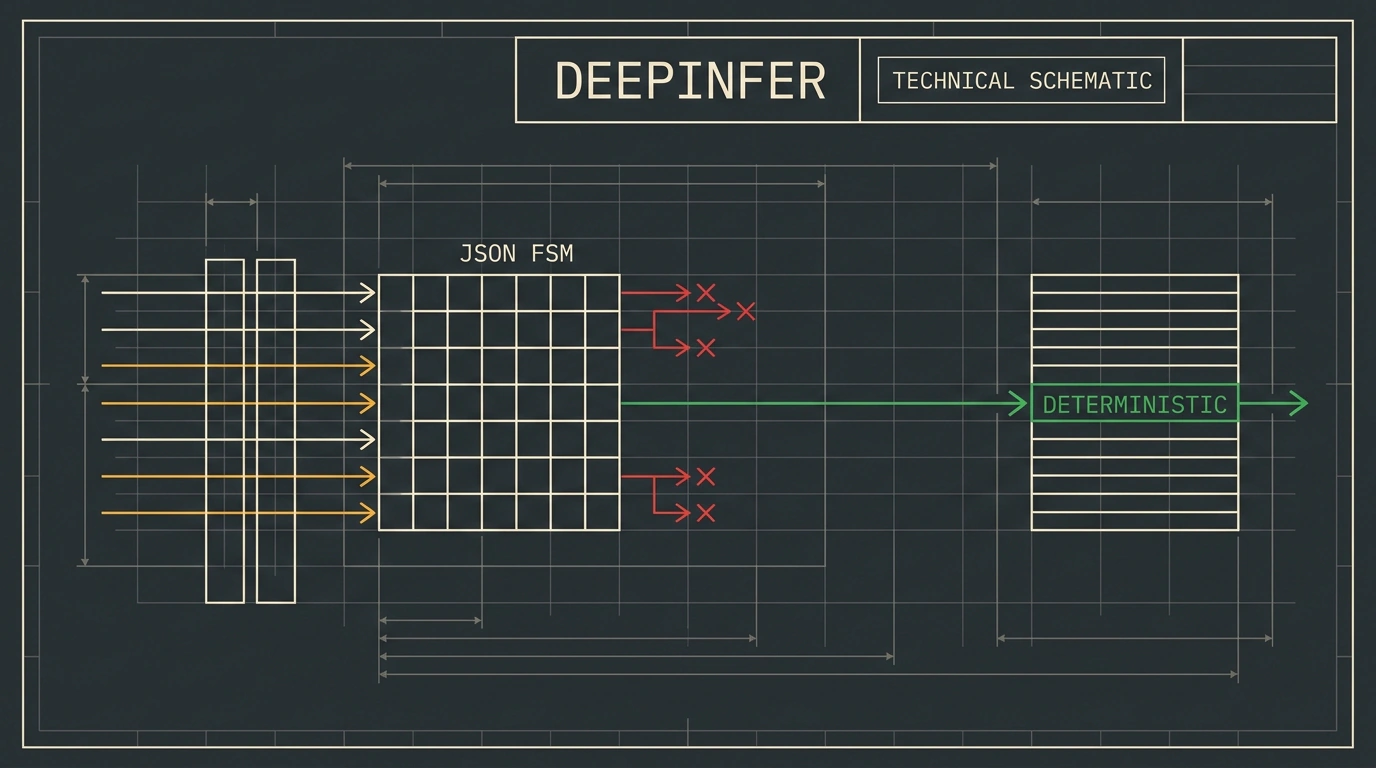
The second major upgrade is hardware-accelerated Grammar-Guided Decoding. Instead of crossing your fingers and parsing raw text with CPU-bound Python libraries afterward, the schema compiles into a finite-state machine (FSM) directly in GPU memory.
Diagram of FSM grammar-guided decoding: a green path of valid JSON tokens vs. a red barrier blocking syntax errors.
At every next-token prediction step, the engine masks the logits: any token that would violate the target JSON schema gets its probability zeroed out. If the schema expects an integer, the model is physically incapable of emitting a letter or a quote.
Here is how to start a DeepInfer server with hardware grammar acceleration and guaranteed determinism:
# Launch the DeepInfer inference server with hardware schema enforcement
export DEEPINFER_BATCH_INVARIANT=1
export CUDA_VISIBLE_DEVICES=0

python3 -m deepinfer.server \
    --model deepseek-ai/DeepSeek-V4.1-Flash \
    --max-batch-size 64 \
    --grammar-acceleration cuda \
    --port 8080
And here is a Python client request passing a strict JSON schema to classify an incoming support ticket:
import requests

# Define the expected structured output schema
support_schema = {
    "type": "object",
    "properties": {
        "intent": {"type": "string", "enum": ["billing", "technical", "feature_request"]},
        "priority": {"type": "integer", "minimum": 1, "maximum": 5},
        "order_id": {"type": ["string", "null"]}
    },
    "required": ["intent", "priority", "order_id"]
}

payload = {
    "prompt": "Ticket: Server renewal payment failed for #ORD-7711, need urgent help!",
    "temperature": 0.0,
    "seed": 1337,
    "structured_output": {
        "schema_type": "json",
        "schema": support_schema
    }
}

response = requests.post("http://localhost:8080/v1/generate", json=payload)
print(response.json()["text"])
# Output is guaranteed to match the schema:
# {"intent": "billing", "priority": 5, "order_id": "ORD-7711"}
Enabling DEEPINFER_BATCH_INVARIANT=1 disables Multi-Token Prediction, trimming peak generation speed by roughly 10–15%. For agentic pipelines and automated integration tests, rock-solid output stability easily pays for that modest slowdown.
Alongside grammars, the engine adds built-in Recipe Libraries for common production tasks: named-entity recognition (NER), SQL validation, and document transformation. As we noted in our look at DeepInfer's ultra-fast inference architecture, open engines are outgrowing simple weight wrappers and turning into fault-tolerant industrial infrastructure.