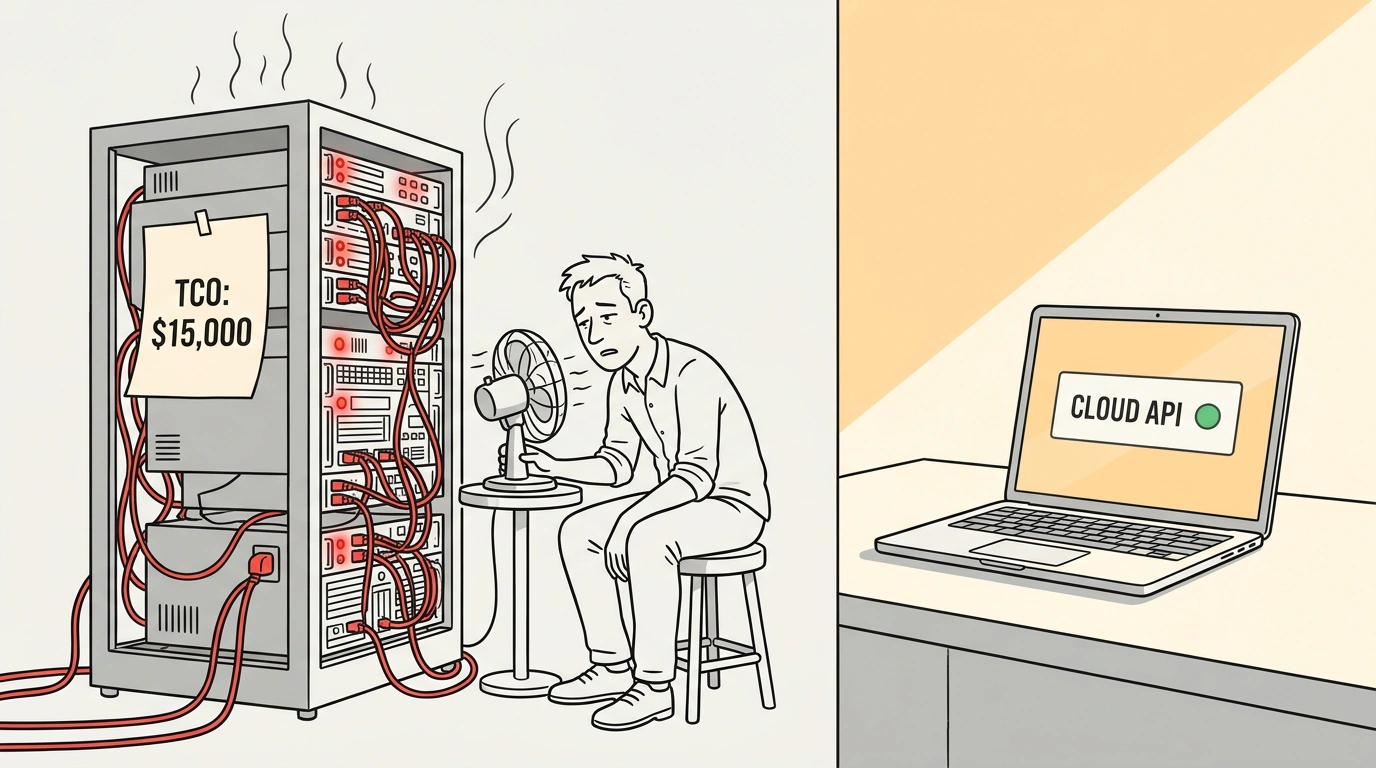
A popular rallying cry has been making the rounds in developer circles: "Ditch your ChatGPT and Claude subscriptions, build a home GPU rig, spin up open Llama or DeepSeek weights, and enjoy total digital freedom." It sounds romantic and empowering. Let's set the slogans aside for a moment and run the actual math.
Matthew Berman—one of the loudest champions of local AI, with his own rack of servers and dozens of GPUs—just delivered a remarkably sobering verdict. As he puts it: on paper, nobody should be easier to convince of local AI's superiority than someone who already owns the expensive hardware, has the technical chops, and genuinely wants to own his data. Yet advising an everyday specialist or small studio to abandon cloud APIs for a home GPU farm is pure economic self-deception.
Let's break down why a home AI data center in 2026 remains a very narrow niche.
TCO Economics: Where the Money Actually Goes
The central myth of home hardware is: "I'll pay once for the GPUs and get free intelligence forever." In reality, Total Cost of Ownership (TCO) hits like a truck:
- The hardware floor: nimble 8B–14B open models are fine for sorting email, but they crumble on complex reasoning compared to frontier models. To get anywhere near cloud-grade reasoning, you need a 70B to 120B parameter model—which demands 48 to 96 GB of ultra-fast VRAM.
- The build price: a workstation packing two to four RTX 4090s or workstation-class RTX 6000 Ada cards, plus a solid motherboard and power supplies, runs at least $7,000–$15,000.
- The hidden bills: under heavy load, that rig pulls 1.5–2 kW/h of electricity, sounds like a jet engine, and turns your office into a sauna that needs dedicated cooling.
Financial and technical TCO comparison chart: home GPU farm costs up to $15,000 vs. cloud API subscriptions.
Compare that sticker price to a $20–$30/month Claude Pro or ChatGPT Plus subscription: the cost of a single home workstation covers 10 to 15 years of continuous cloud access to the latest frontier models, with zero hardware depreciation or burnt-out chips to worry about.
The Frontier Gap and the Sysadmin Trap
The second hurdle is The Frontier Gap—the relentless pace of closed cloud systems.
Cloud labs ship upgrades every couple of weeks, rolling out multi-step reasoning architectures, test-time compute, and million-token context windows. Squeezing a 70B model down to 4 bits to cram it onto a single consumer card inevitably degrades output: the model starts making confident mistakes on edge cases, breaking subtle logic, and dropping facts.
Worse, instead of shipping products, you risk turning into a full-time sysadmin:
- fighting NVIDIA driver mismatches and new CUDA releases;
- chasing random segfaults while compiling
flash-attention; - hand-tuning quantization parameters and hunting VRAM leaks in vLLM.
When Local AI Is Truly Non-Negotiable
- Data falls under strict state secrets or extreme NDAs carrying criminal liability
- Processing personal medical records inside a closed clinical network
- Offline operation in disconnected environments (ships, oil rigs, remote expeditions)
- Algorithm research inside specialized AI labs
We covered open-weight deployment scenarios in detail in our piece on moving to local AI, and the core takeaway holds firm: for 95% of everyday business and engineering work, cloud APIs win hands down on quality, speed, and total cost. Put your hours into your product, logic, and architecture—not babysitting a server rack in your spare bedroom.