Think about how the internet worked for the past thirty years. The entire World Wide Web rested on an unspoken social contract between creators and search engines: "You write articles, reviews, and documentation; we crawl your pages for free, and in return we send you traffic—real people who click links, buy your services, read your books, or view your ads." That simple symbiosis built a staggering library of open human knowledge: any student could find a walkthrough for a tough math problem, and any engineer could track down a deep dive on an obscure bug.
Today, that contract is in shreds. In a sharp essay, researcher Nick Saraev documents an irreversible crisis across the open web: AI search agents (Google AI Overviews, Perplexity, ChatGPT Search) have kicked off a chain reaction that is burying the internet we grew up with.
Zero-Click Search and The Great Blockade
The first blow hit the basic mechanics of how people consume information—a shift known as Zero-Click Search:
- An AI search assistant reads dozens of pages, synthesizes a finished answer, and drops it right at the top of the results page.
- You get your answer in three seconds and close the tab. There's zero reason to click through to the original site.
- Industry data shows organic search traffic for independent media, technical blogs, and reference sites plummeting 40–70% in a matter of months.
Site owners answered with The Great Blockade. Why hand over your hard work to OpenAI, Anthropic, or Google crawlers for free if you get nothing back? According to Cloudflare, over 35% of the world's top 1,000 websites have locked down their robots.txt files and put up hard blocks against AI scrapers like GPTBot and ClaudeBot.
Retreat Behind Closed Doors and Model Collapse
With ad revenue from pageviews drying up, creators of high-quality work are retreating behind walls. Why publish deep research on the open web if a bot will summarize it away tomorrow?
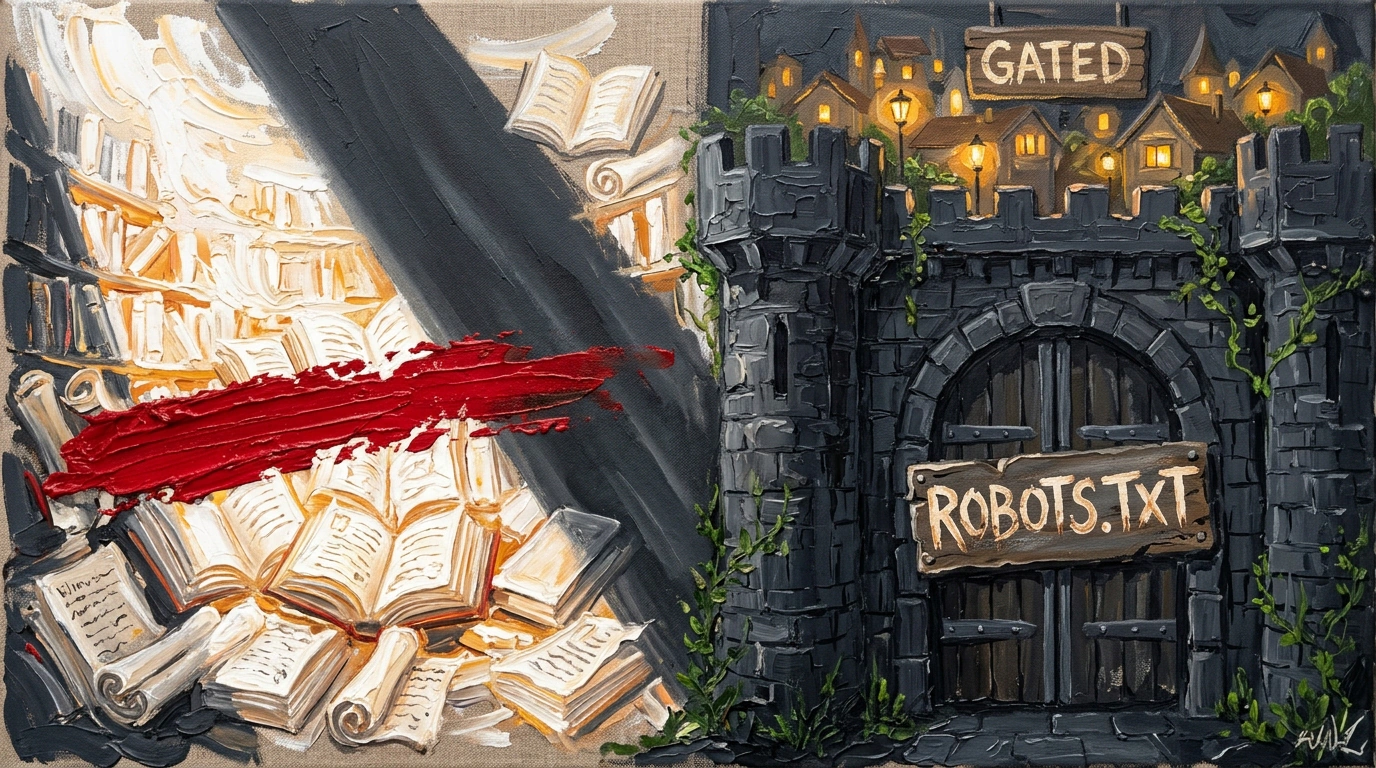
Conceptual diagram of the open web crisis: website traffic dropping up to 70%, crawler blocks in robots.txt, and closed-loop model collapse.
Creators are migrating into Gated Communities: paid Telegram channels, private Discord servers, paywalled Substack newsletters, and Skool groups. Left behind on the open web are mostly commercial storefronts and AI-generated filler.
The most dangerous consequence, though, boomerangs straight back onto AI labs themselves: Model Collapse:
- As the open web stops receiving fresh, sharp, human-written insights, crawlers end up scraping text generated by other neural networks.
- The result is informational cannibalism (Model Autophagy Disorder). Models train on each other's synthetic hallucinations, amplifying statistical artifacts, flattening language, and degrading in reasoning quality.
The classic 'write an article to earn ad impressions' model is dead. The only durable business model left is building direct, high-trust relationships with your audience and running private expert communities where crawlers can't reach.
We already saw early tremors of this standoff in our report on platforms locking out shopping bots. The open web as we knew it—humanity's free, public library—is fracturing into paid enclaves. And that shift will affect everyone who relies on the web for answers.