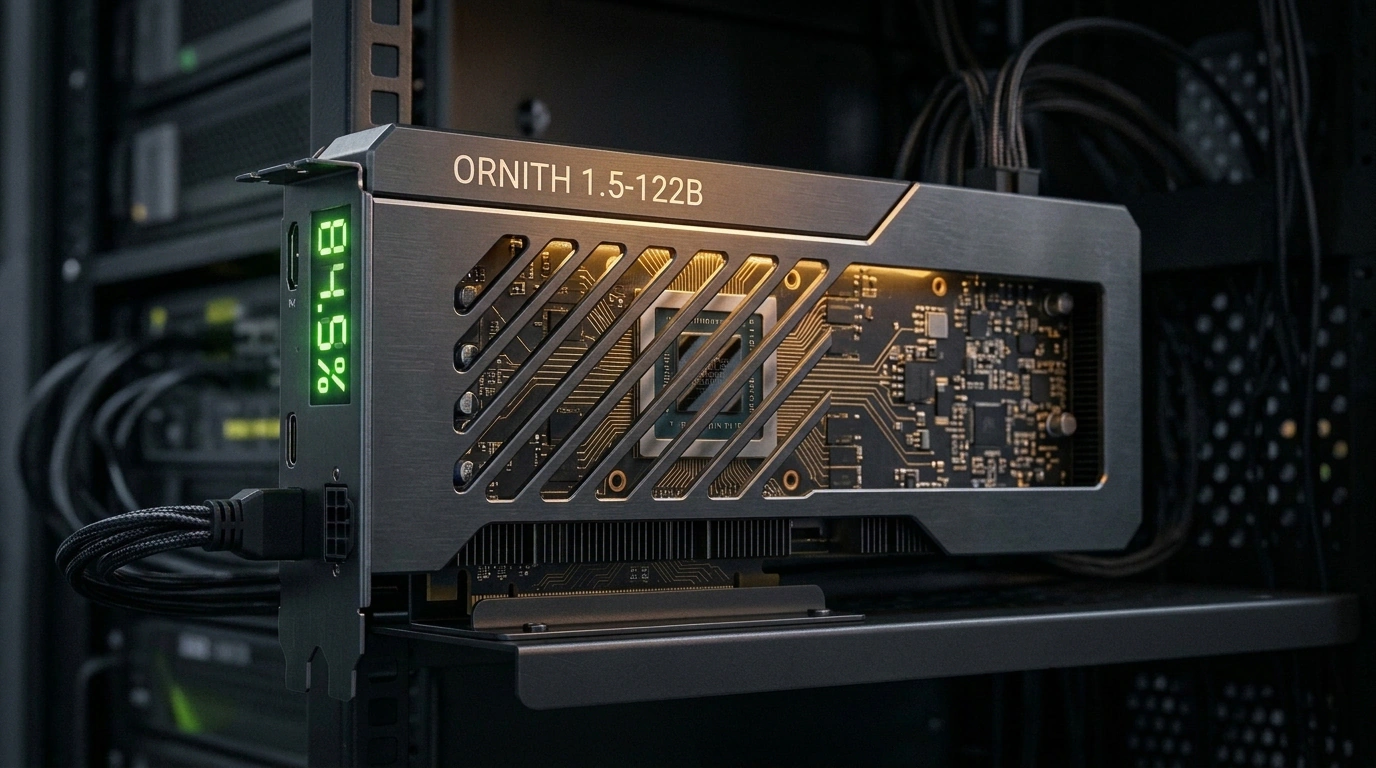
If you've ever tried fixing real production bugs with open-weight models, you know the bitter truth: local models breezed through simple Python scripts, but the moment you threw them at a multi-file repository with tangled architecture, they folded. The gold-standard real-world coding benchmark SWE-bench Verified stayed an exclusive fortress for closed giants—clearing 80% belonged strictly to proprietary models like Claude 3.5 Sonnet, OpenAI o1, and GPT-4o, forcing companies to send their source code to external clouds.
The release of Ornith 1.5-122B under a permissive MIT license changes the rules. Its sparse Mixture of Experts (Sparse MoE) architecture doesn't just match the closed leaders with a record 84.5% on SWE-bench Verified—it does so while targeting deployment on a single graphics card.
Inside the Architecture: Sparse MoE and a Self-Training Loop
Ornith's developers sidestepped the limits of traditional dense models with three core choices:
- Mixture of Experts: the model holds 122 billion total parameters (~125B). Thanks to sparse activation, only a specialized subset of weights fires for each token. That preserves deep coding knowledge without crushing compute requirements at generation time.
- Massive context window: expanded to 262,000 tokens (262K)—plenty of room for the core of a mid-sized web service along with its helper modules and test suites.
- Autonomous Self-Training Loop: the model didn't learn to code from textbooks. In a closed loop, it generated programming tasks across difficulty tiers, built automated test scaffolding, produced dozens of candidate rollouts, ran them, and updated weights via reinforcement learning (RL) based on test outcomes.
Independent benchmark scores back up its maturity:
- SWE-bench Verified: 84.5%;
- SWE-bench Pro (no-hack): 76.9% (for comparison, the previous generation of open models averaged around 44%);
- TerminalBench 2.1: 81.2% on complex command-line workflows.
Practical Deployment: Running the Server on One Card
At full precision (FP16/BF16), 122B parameters still demand a 4-GPU server node of A100s. Ornith 1.5's real engineering magic shows up with 4-bit quantization (AWQ): the model fits comfortably into a single 48 GB professional GPU (such as an NVIDIA RTX 6000 Ada) or an 80 GB H100.
Engineering infographic of compressing a 122B open model: shrinking weights from a server cluster onto a single 48 GB GPU via AWQ quantization.
Here is how to spin up an OpenAI-compatible server using vLLM:
# Launch the Ornith 1.5 inference server with AWQ quantization on a single GPU
python3 -m vllm.entrypoints.openai.api_server \
    --model ornith/ornith-1.5-122b-awq \
    --tensor-parallel-size 1 \
    --gpu-memory-utilization 0.95 \
    --max-model-len 131072 \
    --trust-remote-code \
    --port 8000
Once the server is live, you can point any agentic client (Cursor, OpenCode, or a Python script) at it as a standard endpoint:
from openai import OpenAI

# Connect to the local inference server
client = OpenAI(base_url="http://localhost:8000/v1", api_key="local-token")

prompt = """Fix the regression in django/db/models/sql/query.py:
The clone() method incorrectly shares internal join aliases when subqueries are chained.
Return minimal unified diff format only."""

response = client.chat.completions.create(
    model="ornith-1.5-122b-awq",
    messages=[
        {"role": "system", "content": "You are Ornith 1.5, an expert software engineering model. Produce production-ready diff patches."},
        {"role": "user", "content": prompt}
    ],
    temperature=0.0,
    max_tokens=4096
)

print(response.choices[0].message.content)
Under 4-bit quantization, you may notice a slight dip in accuracy on obscure SQL dialects or less common languages like Haskell. For mainstream stacks (Python, TypeScript, Go, Rust), diff quality stays on par with top cloud models.
Looking at how terminal environments are evolving—something we covered in our OpenCode 2.0 ecosystem review—Ornith 1.5 is a genuine turning point. Companies no longer have to pay per token to proprietary clouds: an industrial-grade coding agent now fits neatly inside a private server perimeter.