If you've spent the last six months setting up AI agents, you know that nagging sense of fragmentation: Anthropic had its own system prompt and tool syntax, OpenAI had its own AGENTS.md, and third-party coding assistants each invented custom plugins. Switch from one environment to another, and you had to rewrite all the plumbing from scratch. Big tech was busy building walled gardens.
Now the ice has finally broken. Developer and researcher Simon Willison highlighted a major tectonic shift: the tech giants have called a truce on format wars, teaming up under the Linux Foundation to launch the independent Agentic AI Foundation (AAIF) alongside the open Agent Skills specification.
Who's at the Table and What They're Contributing
AAIF's list of platinum co-founders carries serious weight—each chipped in $350,000 in annual dues: AWS, Anthropic, Block, Bloomberg, Cloudflare, Google, Microsoft, and OpenAI.
Even more important than the money is what they're putting into the commons:
- Model Context Protocol (MCP): Anthropic's protocol for connecting external tools now moves under neutral, independent governance. No sudden commercial lock-in from a single vendor.
- The AGENTS.md format: OpenAI's declarative standard for describing repository architecture rules and project constraints for coding agents is now public property.
- The autonomous agent goose: fintech giant Block donated its open-source agent framework to the foundation.
- Adjacent protocols: standards like Agent2Agent (A2A), Agent Router, and OpenSandbox are also joining under the AAIF umbrella.
The Agent Skills Spec and Progressive Disclosure
In parallel, Anthropic spun out its mechanism for packaging expert workflows into an independent open standard called Agent Skills (published at agentskills.io). VS Code, Cursor, OpenCode, Claude Code, and OpenAI Codex extensions already support it.
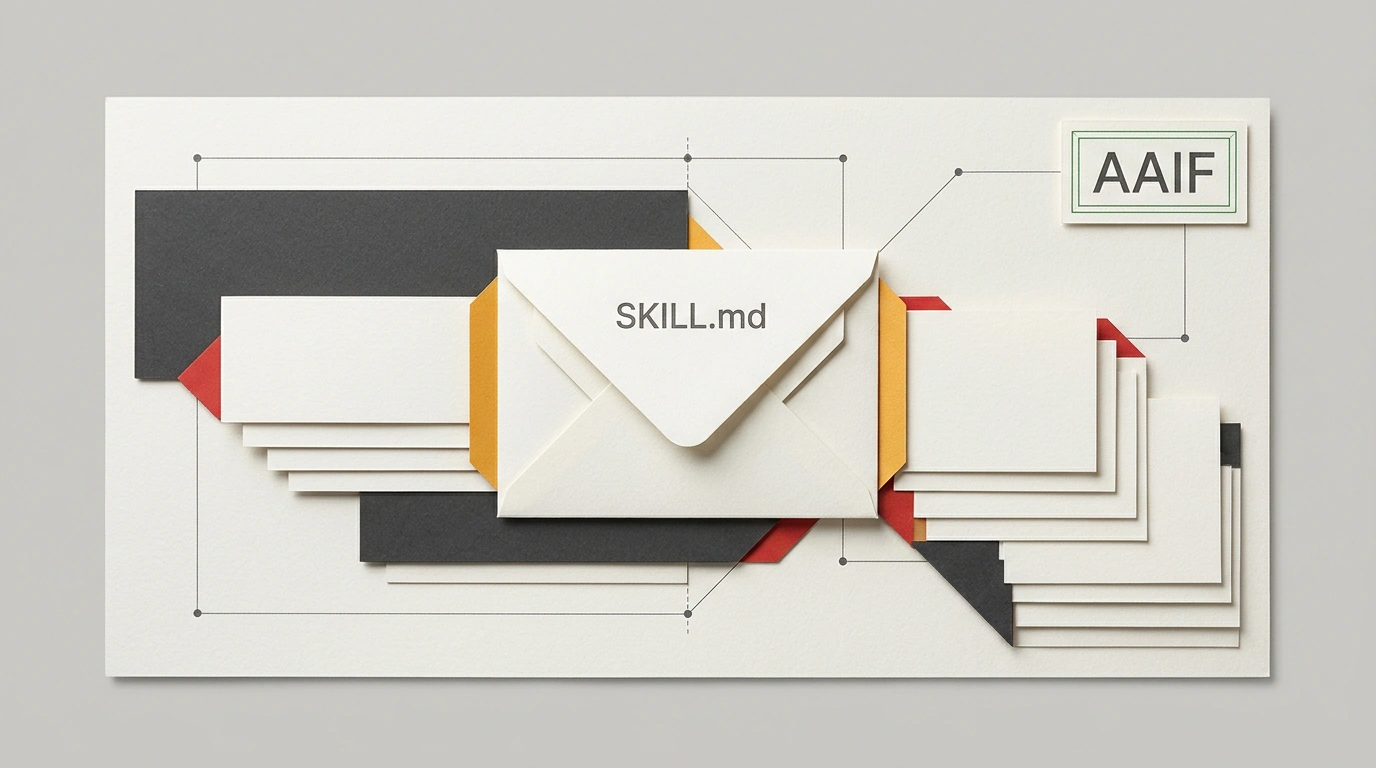
Engineering diagram of the modular Agent Skills architecture showing the SKILL.md file hierarchy and Progressive Disclosure.
At the heart of the spec is an elegant idea: Progressive Disclosure. Previously, people stuffed instructions for every conceivable scenario into the system prompt, bloating the context window by tens of thousands of tokens before the user even asked a question.
In Agent Skills, each skill lives in a self-contained folder:
financial-audit-skill/
├── SKILL.md       # Required: YAML frontmatter + text instructions
├── scripts/       # Optional: validation and calculation scripts (Python, Bash)
├── references/    # Optional: heavy reference docs, schemas, and regulations
└── assets/        # Optional: report templates and configurations
The magic is in how the agent interacts with SKILL.md. On startup, the model reads only a compact YAML header—name (up to 64 characters) and description (up to 1,024 characters). That takes roughly 100 tokens of context. Only when a relevant task comes up in conversation does the agent dynamically load the full instruction body or invoke a bundled script.
Here is what a canonical skill manifest looks like under the official spec:
---
name: csv-data-sanitizer
description: Clean and normalize financial CSV exports, remove duplicates, and validate date formats. Use when importing bank ledgers.
license: Apache-2.0
compatibility: Requires python >= 3.10, pandas
metadata:
  version: "1.0.0"
  author: "devops-team"
allowed-tools: Bash Read
---

# Ledger Sanitization Instructions

1. Check file encoding with the script: `python3 scripts/check_encoding.py input.csv`.
2. Strip empty rows and validate the `YYYY-MM-DD` date format.
3. Save the normalized output to `output_clean.csv`.
A skill written to the SKILL.md standard works just as cleanly in Cursor when you're building a backend, in Claude Code inside your terminal, and in an internal company agent pipeline.
This move shifts the industry out of scattered experiments and into mature engineering discipline. We tracked the rise of this stack in our piece on Agentic Engineering, and a neutral consortium confirms where things are headed: open protocols win, proprietary cages lose.
