A striking contradiction has taken hold in the AI industry. Creators of the largest language models spend enormous resources scrubbing datasets: drafts and failed hypotheses are stripped out, leaving only spotless final papers. Yet real science works the exact opposite way—in laboratories, most experiments end in failure, and those dead ends trace the true boundaries of natural laws.
When the research team at Deep Principle trained the open-weights model Hydrogen 1.0 on archives of failed experiments, it outperformed the world's most expensive closed systems. I dug into the developers' technical report: let's see why studying others' mistakes proved more effective for AI than memorizing right answers.
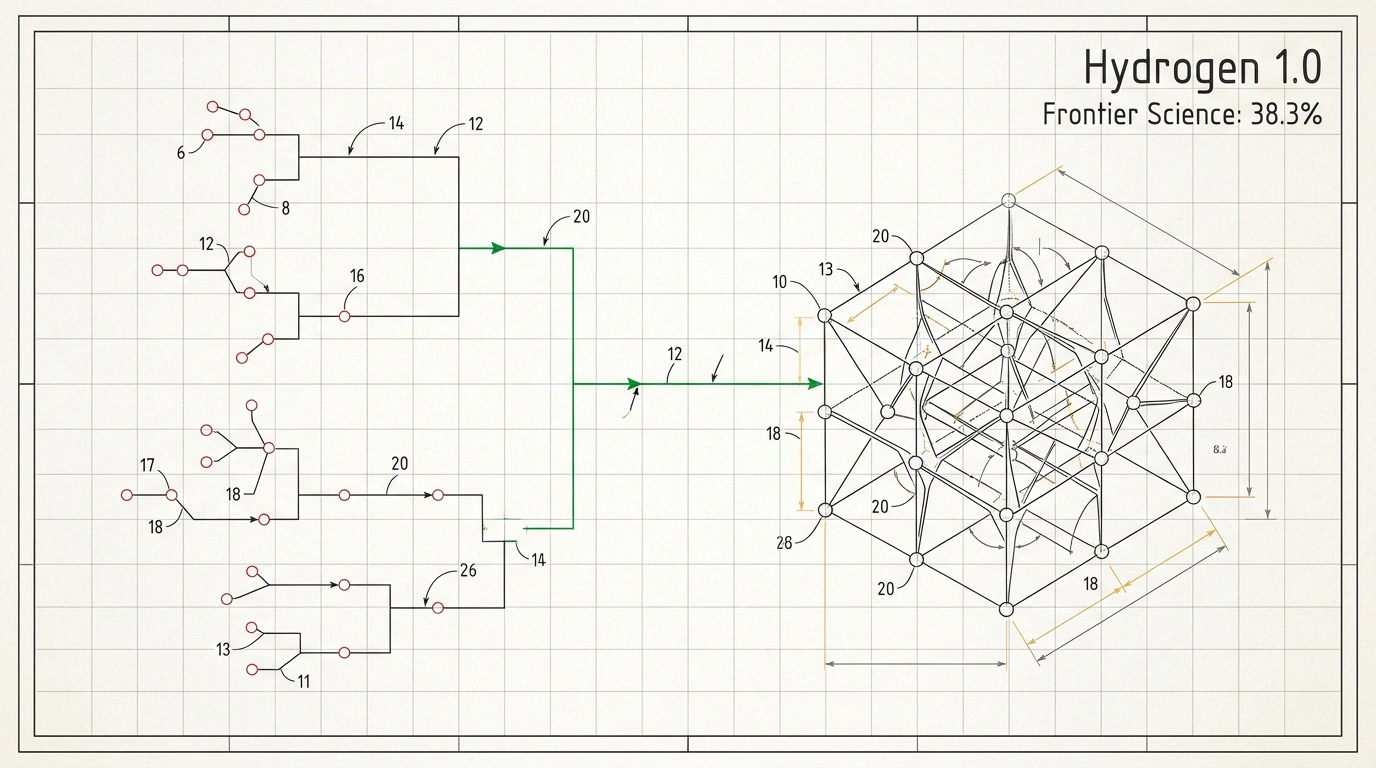
Breakthrough on Frontier Science: 38.3% for an Open Model vs. 33.3% for the Closed Leader
Conventional wisdom says only closed commercial giants can solve problems on the frontier of science. Released on November 2, 2026, Hydrogen 1.0—broken down by analyst Julian Goldie in his episode—disproved that assumption with hard numbers.
On the interdisciplinary Frontier Science Research benchmark (FSR—a test covering chemistry, materials science, and bioengineering), Deep Principle's model scored 38.3%, beating leader GPT-6 Astra's 33.3% by 5 percentage points. What impressed me is its pragmatic architecture: built on the open GLM-5.3 Mixture of Experts (MoE) backbone—where only a small slice of the network activates for each word—roughly 40 billion of its 753 billion parameters fire per token. Its context window holds 1,000,000 input tokens and up to 128,000 output tokens, enough to load entire monographs and measurement tables.
How Failed Experiment Logs and Search Trajectories Cure AI of Guessing
You might fairly ask: where does such a lead come from with a modest active parameter count? Standard models are rewarded during alignment for a smooth final answer—like a sleepy student guessing a plausible-looking formula. In science, however, over 90% of experiments fail, and without knowing why they broke, an algorithm has no feel for physical constraints.
Deep Principle built a four-layer dataset: theory across chemistry, materials, and life sciences; live workflows from its own scientists; records from Electronic Laboratory Notebooks (ELN); and discovery trajectories—full chains from hypothesis and error to parameter adjustments. I covered a similar pruning of weak branches in our review of Gemini Deep Think's parallel reasoning mode, but Hydrogen 1.0 bakes that skill straight into its weights via trial archives.
When a chemical engineer designs a new heat-resistant polymer and asks for a synthesis route, the training difference shows immediately. An ordinary neural network spits out a slick recipe from successful papers that turns to tar in the reactor. Hydrogen 1.0, drawing on ELN logs, analyzes the hypothesis and eliminates three dead-end synthesis paths before answering, flagging hidden temperature limits where the catalyst breaks down.
For a researcher, that saves weeks of lab time and reagents: the engineer sees dangerous temperature zones upfront and runs the reaction inside a working window. After studying thousands of documented failures, the network stops mimicking the style of victory reports and starts reasoning by elimination.
From Chemical Reactors to Workflows: Local Deployment and Testing Business Hypotheses
This kind of deduction through dead-end rejection is just as useful outside the lab. Hydrogen 1.0 weights are open under the MIT license alongside 4-bit NVFP4 (via NVIDIA ModelOpt) and MXFP4 (for AMD accelerators) builds. Companies can run the model on their own servers without sending secrets to external APIs—especially with the fast routing from our breakdown of MoE inference optimization in vLLM. And Julian Goldie recommends bringing the failure-first principle into everyday work: use AI to spot three friction points in onboarding emails, surface the top three gaps across 20 real customer questions, and log breakdowns during the first 30 minutes of testing new services.
Hydrogen 1.0's success points to where the industry goes next. Supplies of clean public web text are exhausted, so the next leap in AI accuracy will come from teams that open up their internal bug logs, discarded hypotheses, and failed test protocols for training.