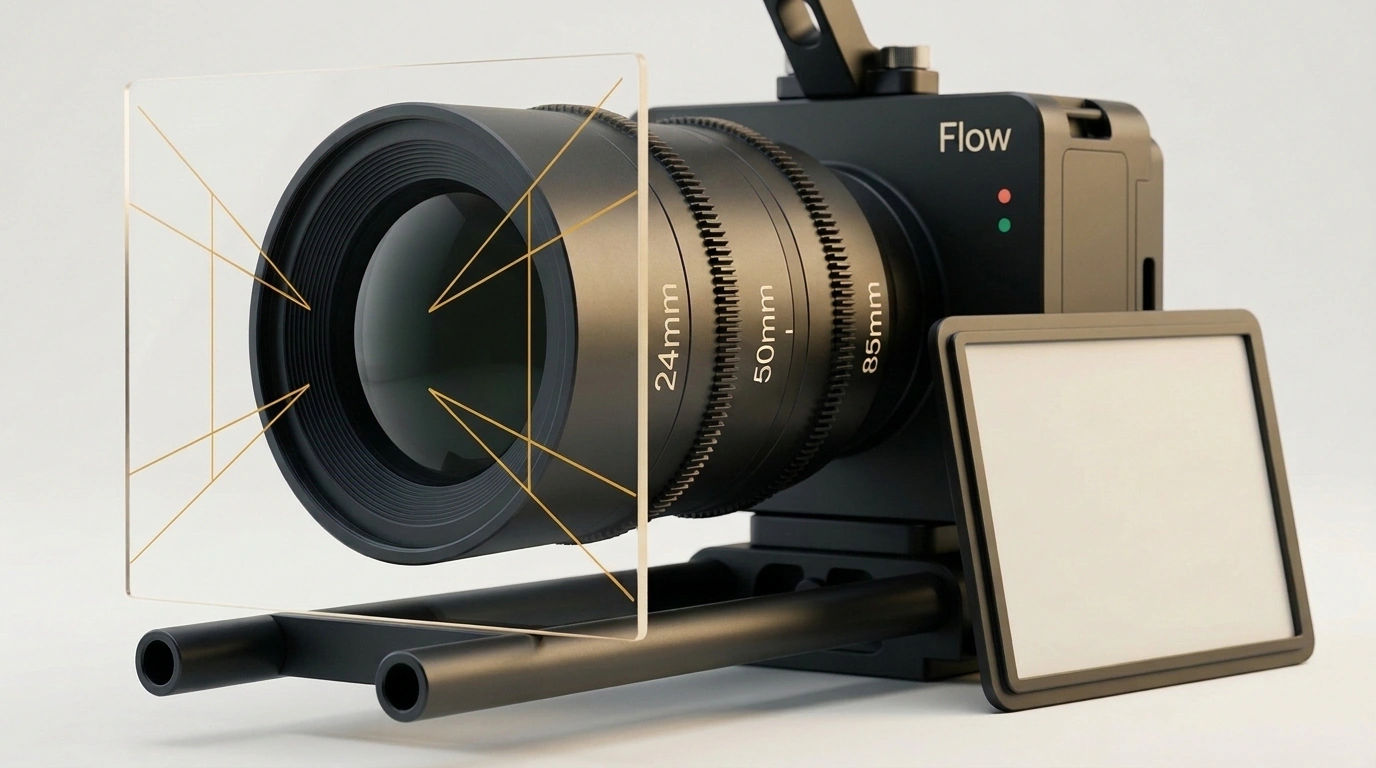
When an AI image turns out flat, people usually try one of two things. Either they sprinkle magic words like cinematic, 8k, photorealistic—which add gloss without fixing framing—or they regenerate ten times hoping for a better angle. Both miss the real issue: the subject, clothes, and light are described, while the lens is missing.
In Google Flow (images powered by Nano Banana, video by Veo and Gemini Omni), models understand photography terms. The team shared a lens cheat sheet from 16mm to 135mm and noted that still frames spend zero Flow credits, making it easy to test optics before generating video.
Three Lens Families: Wide, Normal, and Tight
Focal length is a lens setting in millimeters that controls field of view. Lower numbers show more of the world around your subject; higher numbers frame tighter on the subject.
| Family | Lens | What Happens in Frame | When to Use It |
|---|---|---|---|
| Wide | 16mm | Ultra-wide angle and scale | Halls, architecture, landscapes, sci-fi |
| Wide | 24mm | The location is the hero | Streets, spacious offices, interiors |
| Normal | 35mm | Environment visible, closer to subject | Lifestyle shots, documentary style |
| Normal | 50mm | Natural proportions without distortion | Universal default, portraits, products |
| Tight | 85mm | Tight framing, subject in focus | Portraits, beauty, fashion shoots |
| Tight | 135mm | Distant view, heavily compressed background | Cinematic isolation on busy backgrounds |
Unsure where to start? Pick 50mm. Use 24mm for streets or rooms, and 35mm for documentary feel. An AI model isn't glass optics: the millimeter number acts as a strong cue rather than exact physics, so framing varies slightly between runs.
The '85mm' Trap and Forgotten Camera Distance
Portraits trip people up most often. It's tempting to type 85mm and expect automatic bokeh (soft background blur). Yet depth of field also depends on aperture and shooting distance. With 85mm alone, the background often stays sharp—add framing (tight shot of face and shoulders) and background cues (soft, out-of-focus background).
The second trap is perspective distortion, which shifts facial proportions or room depth. Distance to the subject creates that effect, not the lens itself: you step closer with a wide lens and step back with a portrait lens. Pair "lens plus distance": write camera close to her for 24mm, and camera further back for 85mm.
One scene, two different shots
Prompt for 24mm:A photo-realistic photo of a woman in a dark grey wool coat. She's standing on an old cobblestone street at sunrise. Soft golden morning light. Wet pavement. Old buildings all around. Shot on a full-frame camera with a 24mm wide angle lens. Camera close to her. Medium shot with the buildings clearly in view. 16 by 9. No text, no watermark.
Variant for 85mm:
Keep the woman, coat, and sunrise identical, and swap only the camera block:
Shot on a full-frame camera with an 85mm portrait lens. Camera further back. Tight shot of her face and shoulders. Soft out-of-focus background. 16 by 9. No text, no watermark.
Locking the scene and changing one camera line turns a street story into an intimate portrait. Fewer gaps across lens, distance, framing, and background yield far more consistent shots.
A Five-Minute Test in Google Flow and the 'Zero Credits' Catch
You can build your own reference grid in five minutes. Open Google Flow in desktop Chrome or Edge, switch input to Image, pick 16:9 (ready for video), choose your model and variant count, and run one scene four times changing only the lens (24mm, 35mm, 50mm, 85mm) to compare side by side.
Now for "0 credits" without illusions. Still images don't tap your Flow credit pool, which is reserved for video and upscaling. Per Google Flow help, free accounts get 50 daily video credits (unused ones expire), while Google AI Plus, Pro, and Ultra add 200, 1,000, and 10,000–25,000 monthly credits; failed or filtered runs refund within an hour.
Zero credits doesn't mean unlimited, though. Image models have separate daily quotas and spam protections: heavy models hit daily caps on free accounts, and parallel batches trigger cooldowns. You also need to be 18+ in a supported region—VPNs won't bypass this—and non-Chromium or mobile browsers may glitch.