"The goal of the company is to drive token cost to zero." That's how Suhail Doshi states the mission of his new startup, Particle AI. He previously launched analytics platform Mixpanel at age twenty and grew it past $100M in annual revenue and a billion-dollar valuation. That goal sounds like a slick pitch-deck slogan until you see a real AI invoice.
Picture a simple scenario. You're on a flat $200/month Claude subscription, running coding agents, editing videos, polishing copy, and feeling like you have unlimited compute. Then you move those exact same workflows to a direct API and get hit with a $12,000 bill at the end of the month. That's what happened by accident to developer and AI builder Riley Brown at his previous startup. Today, the gap between a "convenient subscription" and the true cost of compute is so wide that token pricing has moved from boring accounting to a core strategic choice for anyone building AI products. Let's look at the real numbers to see when paying 20x to 30x more for a flagship like Claude Fable 5.2 actually pays off, and where you're just paying for habit.
The $200 Subscription Trap and Why 24/7 Agents Break the Math
As long as you interact with an AI manually in a chat window or code editor, you rarely see what its work actually costs. Riley Brown keeps two personal $200/month Claude subscriptions. He spends about 80% of his time on creative work and video, and 20% on coding, and at that pace the plan feels bottomless. The secret is simple: classic tariff cross-subsidization. A flat subscription is much cheaper for heavy users than buying the same tokens at API rates because the lab averages out the load between people who send three prompts a week and people who burn limits until dawn.
Once tasks move to the API, that illusion vanishes instantly. It comes down to how much a single session has grown over the past four years. In late 2022, a typical ChatGPT session lasted one or two turns: ask, get an answer, close the tab. Once models got web search and basic tools, sessions stretched to three or four turns. Today, an autonomous agent working on a complex task easily runs 256, 300, or even 500 steps in a row. And on every step, it drags the accumulated context along with it.
The next wave is already here: always-on agents like Hermes Agent, Grokbot, or GPT Dots that run 24/7 without you watching. Some monitor cybersecurity, others react in the background to Linear tickets and Slack messages, and some launch in swarms of a thousand parallel copies. Putting a swarm like that on a closed flagship at full API rates is a fast way to burn a quarterly budget over a single weekend.
That also explains the pricing strategy of major labs. Pretraining a new frontier model costs billions of dollars, while the window during which it stays unquestionably "premium" has shrunk to roughly six months. After six months, cheaper rivals catch up. Labs have to recover their massive investments through high token margins while their model still holds the "smartest tool" label.
Because of this math, the market is about to split into two distinct worlds. Most everyday users won't pay even $15–20 a month for AI access, just as nobody pays a monthly subscription for Google web search. The consumer segment will inevitably shift toward ad-subsidized models, which OpenAI is already testing, or e-commerce affiliate fees, which Instinct is eyeing. Meanwhile, real cash spending on tokens will concentrate in business. Companies pay not for entertainment, but for a measurable edge over competitors, and they're ready to track the cost per million tokens down to the cent.
Cost calculator: $200/mo subscription vs. API and open models
Try moving the sliders above. The calculator models a typical agent loop (12,000 input tokens and 1,500 output tokens per turn) and immediately shows the tipping point. When you have only a few tasks, prompt caching keeps flagship bills in check. Push the turn count up to a couple hundred, though, and output token costs on closed models shoot far past a flat subscription, while open models stay around a couple dozen dollars.
What the 30x Gap Actually Costs and Where Trillions of Tokens Go
Instead of guessing, let's check Anthropic's official pricing alongside live data from OpenRouter. OpenRouter is a unified API gateway and marketplace that lets developers switch between dozens of closed and open models without rewriting code, while publishing global stats on real token usage.
On the closed frontier side sit Claude Fable 5.2 and Claude Opus 5.5, alongside GPT-6.2 Astra and Gemini 4 Carbon. On the opposite side are open-weight models: their trained weights are publicly available, so any cloud provider or specialized startup can run them on its own GPUs, fine-tune them for specific tasks, and sell inference near cost with slim markups. The price spread for generating output tokens between these two camps is dramatic.
Cost per 1M output tokens on public API pricing (November 2026)
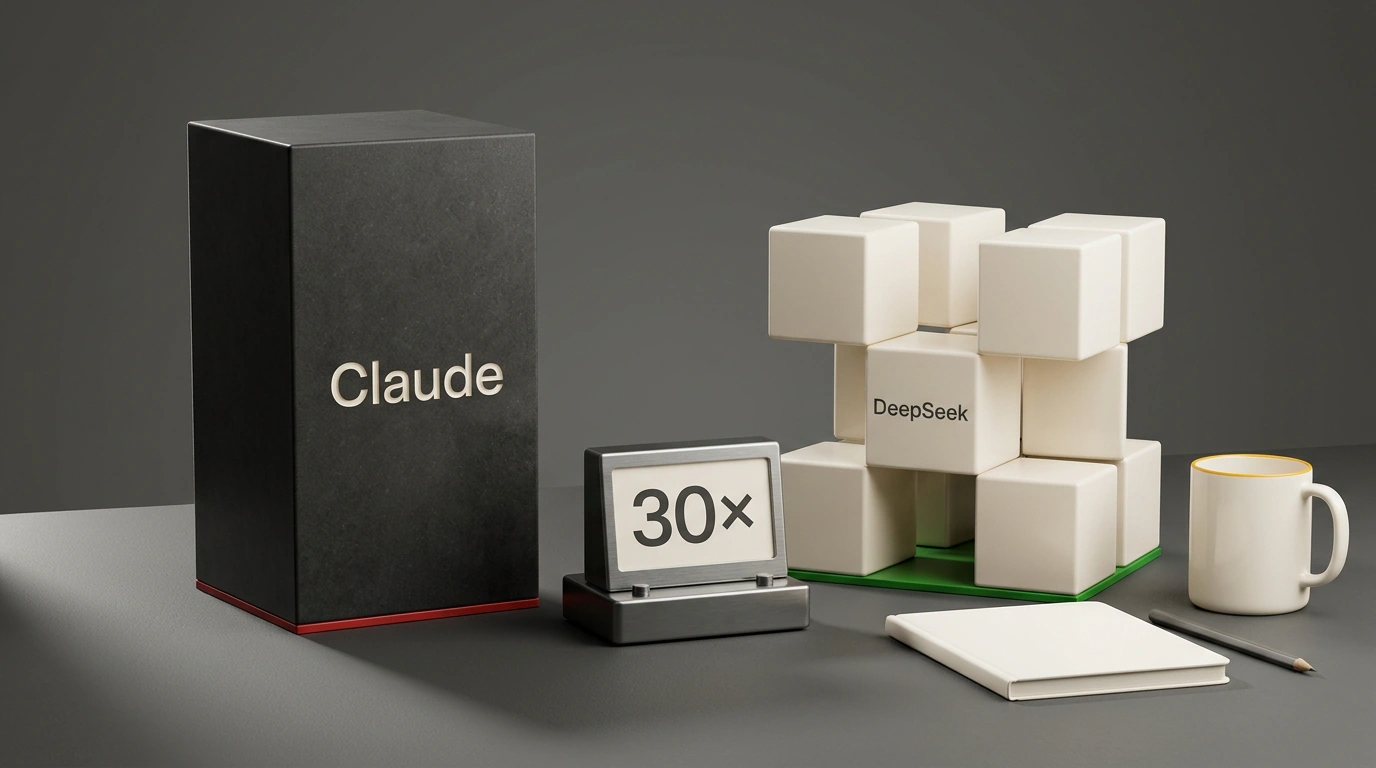
The chart makes that much-debated 30x gap immediately clear. Input tokens follow a similar split: flagship Fable 5.2 costs $8 per million, Opus 5.5 costs $4, open DeepSeek V4.1 Flash 1017 asks just $0.30, and Particle-1 and GLM 5.3 Flash drop to $0.07 and $0.04. In practice, base DeepSeek is roughly 27 to 33 times cheaper than Anthropic's top flagship, while specialized Particle-1 wins by 80 to 114 times on nominal token price.
To be fair, comparing models strictly on the base input line would be misleading. Anthropic offers an aggressive cache-read discount on Claude Fable 5.2: just 0.025x of the base rate, or $0.20 per million input tokens. If an agent works with a huge static context (like reading the same codebase repeatedly), caching softens the input bill. Output tokens—the model's reasoning and generated code—are never cached, and in long agent loops they eat up the bulk of the budget.
OpenRouter model ranking by actual volume of processed tokens (Source: openrouter.ai)
The market is voting with trillions of tokens. Looking at the OpenRouter rankings as of November 22, 2026, the scale of the shift is unmistakable. In first place by a wide margin is DeepSeek V4.1 Flash 1017 at 65 trillion tokens per week (up 16% in seven days and 226 trillion for the month, a 745% jump). Right behind it in second place is standard DeepSeek V4.1 Flash at 15.4 trillion tokens per week. Together, two versions of one family process 80.4 trillion tokens in seven days. Third place belongs to Z.ai's GLM 5.3 Flash (12.2 trillion per week), while closed Claude Opus 5.5 sits down in sixth with 6.97 trillion tokens.
If you're picking a workhorse among open-weight models today, three families lead the pack. At the top is DeepSeek (V4.1 Flash 1017 and V4 Pro), with minimal overfitting to synthetic benchmarks and the heaviest real production traffic. Second is Z.ai's GLM line (GLM 5.3 Flash and GLM 5.3 Prime), delivering strong quality at near-penny pricing. Rounding out the top three is MoonshotAI's Kimi (Kimi K3.1 Pro and a heavy 3-trillion model), which leans slightly more toward benchmarks but handles tough tasks reliably.
Every six months, open models catch up to yesterday's flagship and cut the cost of frontier-grade tasks by an order of magnitude. That exact shift is what powers a new wave of inference companies.
How Particle AI Builds a Business Driving Token Prices Toward Zero
To avoid any confusion: San Francisco-based Particle AI is Suhail Doshi's new venture, unrelated to IoT hardware maker Particle or the Particle News app. It's a specialized inference layer for open-weight models. Right now, the platform hosts three models with a 1-million-token context window: its own Particle-1, DeepSeek V4.1 Flash 1017, and GLM 5.3 Flash. Zero Data Retention is on by default (your prompts aren't saved for training), and non-urgent background jobs can use a Flex mode at 50% off base pricing. You can connect directly or route through OpenRouter, Vercel AI Gateway, and Cloudflare.
The most interesting piece is how Particle-1 was created. Instead of burning tens of billions of dollars pretraining a model from scratch, the team took the open DeepSeek V4.1 Flash 1017 base and put it through deep RL post-training. In plain terms, RL (reinforcement learning) fine-tunes an already trained model using rewards and penalties. For example, the model gets rewarded when it solves a task accurately without rambling through ten screens of internal thinking.
The team built datasets targeting token inefficiency and trained the model out of unnecessary chatter. According to Suhail Doshi's own numbers (no independent third-party benchmarks exist for this figure yet), Particle-1 uses 42% fewer output tokens than base DeepSeek and responds roughly that much faster. You save twice: the price per token is lower, and the model needs nearly half as many tokens for the same task. At the same time, Doshi openly admits a limitation: some customers see great results, while others say they don't notice much difference yet in their specific category. The team is collecting those complaints to build the next iteration.
Particle AI open-model inference platform by Suhail Doshi (Source: particle.ai)
This raises a fair question: how do you make money if your stated goal is to push your product's price near zero? The answer is economies of scale. For the first time since payment networks, a digital resource—machine intelligence in tokens—converts directly into cash value. The closest analogy is Stripe, whose co-founder Patrick Collison happens to be an investor in Particle. Stripe operates on tiny margins: under 2.3% per transaction, and even lower for enterprise clients. Yet global online payment volume keeps growing, and thin margins across trillions in flow build a massive business.
Tokens follow the same mechanics. When request volume grows by hundreds of percent over a few months, low margins are offset by an avalanche of traffic. Fast, cheap inference also attracts a huge developer base, creating a platform for new products—just as NVIDIA built GPUs for gamers years before they became the backbone of the entire AI industry. Having already built a billion-dollar company (and launched Playground AI), Doshi brushes off typical startup anxiety about lacking an early "moat": companies fail first and foremost when their product stops delivering real value.
The Five-Task Method: Building Personal Evals Instead of Trusting Marketing Charts
If open models are dozens of times cheaper and already process tens of trillions of tokens, why do developers and product managers still cling to pricey closed flagships? Two very human reasons explain it. First is brand trust: when a deadline is looming, it feels safer to pick the most expensive Claude than to gamble on a cheaper alternative. Second is choice paralysis. With five popular models and four reasoning modes each, you have twenty combinations. Nobody wants to run a research study before writing a quick script or video outline.
Yet once you overcome that inertia and test your own real tasks, surprises pop up fast. In Suhail Doshi's own tests (including design tasks against DeepSeek V4.1 Flash and GPT Astra), the praised Claude Fable 5.2 scored only 10–20% better than a model 30 times cheaper, and on several design cases there was no difference at all. Price wasn't the only friction: the Particle team found that Fable 5.2's safety filters periodically blocked completely legitimate work on inference optimization and model training. After a couple of refusals like that, it's hard not to wonder whether a classifier is quietly routing sensitive technical prompts to a weaker or truncated response.
The escape hatch is remarkably simple: personal evals. The word "evals" (short for evaluations) often intimidates newcomers, even though it just means a folder with a small set of your own repeatable tasks where you compare models side by side. A famous example is developer Simon Willison's test: after every model release, he asks the new AI to draw an SVG of a "pelican riding a bicycle" and immediately sees how its spatial reasoning has improved.
For real work, you don't need a pelican—five or six routine tasks from your week are enough. This works just as well for code as it does for marketing, writing, scripts, or video editing. Spend one evening setting up your mini testbed, and you'll never have to take a lab's marketing chart at face value again.
How to build a personal eval in one evening
- Create a local
Evalsfolder and drop in 5–6 real tasks you do every week (for example, reviewing a brief, editing an article, writing a SQL query, rough-cutting a video, or generating a landing page). - Run the exact same prompt through 3–4 models across different price tiers via OpenRouter—say, flagship Claude Fable 5.2, base DeepSeek V4.1 Flash 1017, Particle-1, and GLM 5.3 Flash.
- Put the outputs side by side and judge them yourself without looking at brand names: see where the gap actually justifies paying 30x more, and where a cheap model gets 85–90% of the way there.
- For advanced automation, save your full edit history (the trajectory) from taking a draft text, code, or video to a polished final state.
- Feed that trajectory into the strongest available model (like Fable 5.2) and ask it to turn your edits and taste into a clear automated scoring rubric so you can test every new release against it.
Don't expect a magical "two-click eval service" to solve this for you anytime soon. A whole closed industry has grown up around building complex RL environments—virtual sandboxes with automated action checks—specifically to train frontier models. Those companies have zero incentive to share their evaluation methods publicly, because high-quality tests and rubrics are the core trade secret behind future flagships. Your own five-task benchmark remains your most reliable compass.
Why the Best Interface for AI Is No Interface at All
Token economics is only half the story. The other half is what tools these models actually use. Familiar apps filled with buttons, timelines, menus, and sliders—like video editors or Canva—were designed for humans, built around our eyes, hands, and mice. For a language model, a graphical user interface (GUI) is the clumsiest layer imaginable. It has to "look" at a screenshot, guess button coordinates, and click blindly.
In headless mode, with no graphical window and direct control through code and the command line, a model's hands are untied. The reason is obvious: model training data contains gigabytes of documentation and scripts for CLI utilities and APIs, and none of the artificial friction of a UI exists there.
Video editing shows this clearly. Engineer Muhammed Zulali reverse-engineered his Jeep Cherokee, hooked Claude up to control the vehicle, and then edited an entire video about the experiment using Claude Fable 5.2. That video easily crossed 2 million views on YouTube. In practice, a clear pattern emerges: connecting an AI to a pro editor like DaVinci Resolve through a special MCP wrapper produces worse results than handing it raw FFmpeg—the free command-line tool for cutting, splicing, and transcoding video. Models like Codex show an especially stark contrast: in pure code they pull off things that trip them up constantly inside a GUI wrapper.
The same shift is happening in design and 3D. Instead of dragging boxes around in Canva, a model renders a crisp PDF directly in code. In 3D suite Blender, every button and setting already maps to a Python API. Riley Brown made a video (with over a million views) where Fable builds 4K scenes from scratch in Blender for the Cycles render engine. Rather than waiting ten hours for his MacBook to render, the agent rented a cloud GPU on RunPod on its own, uploaded the scene, and pulled back the finished frames.
| Workflow Task | Traditional GUI Path | Headless Code & AI Path |
|---|---|---|
| Video editing | Manual timeline cuts in DaVinci Resolve or clicking through an MCP wrapper | Direct FFmpeg commands: scripted cuts, color grading, captions, and transitions |
| 3D graphics & rendering | Slow mouse-based scene assembly in Blender and 10-hour laptop renders | 4K scene generation via Blender Python API + auto-rented GPU on RunPod |
| Document layout | Dragging blocks and fonts by hand in Canva | Direct programmatic PDF rendering from structure and style rules |
| Version control | Manually saving files like final_v3_real.mp4 across folders | The model inspects Dropbox or iCloud, saves rollbacks, and cleans up clutter |
Living without a traditional UI does bring one annoying headache: version chaos. Anyone who has tried vibe coding or scripted video generation knows the feeling—you only see the final screen and have no idea where that great version from half an hour ago went. The instinct is to bolt a "Version History" button onto an editor. In the era of strong models, however, features migrate out of apps and into the model itself. You don't need separate version-control software; the model can inspect your Dropbox or iCloud, spot outdated drafts, and offer to archive good takes or clean up clutter. Historically, it mirrors office paperwork: when computers arrived, nobody built a mechanical arm to shuffle manila folders—the entire workflow moved digital.
The Original GTA Test and Robotics' "Flappy Bird Moment"
To be clear about where facts end and speculation begins: everything about future breakthroughs in gaming and robotics reflects Suhail Doshi's personal forecasts and Riley Brown's observations, not an industry consensus. Still, those observations point to concrete shifts you can already test today.
Just ten months ago, the ceiling for flagship Opus 4.1 was a half-broken clone of the simple iOS game Flappy Bird, and even that took six or seven prompt iterations. With Opus 5.5, a single prompt produced a working 3D multiplayer shooter in the style of Call of Duty using Convex and Vercel—and they added new mechanics live on stream from viewer chat requests.
That led to the idea for GTA Bench, a lure benchmark for research labs. The question is simple: what percentage of an original Grand Theft Auto title (starting with the first one and eventually up to GTA VI) can an AI recreate with 100% fidelity so a human player can't tell the clone from the original? All the individual pieces are already on the table: 3D generation in Blender and CAD, audio synthesis, networking code, multiplayer. All that's missing is an ambitious shared target that forces teams to connect everything into one system.
Things look even more striking—and unsettling—in robotics. Over the past two or three months, three seasoned robotics engineers Suhail spoke with went through a genuine existential crisis. The reason: they watched standard large language models like Claude and Astra directly control a robotic arm, getting it to write a sentence or draw a picture without classic heavy control stacks.
Minimalist blueprint drawing of a robotic arm sketching straight lines on an engineering tablet under AI control.
That is robotics' "Flappy Bird moment." When veterans with twenty years of writing low-level kinematics suddenly get nervous, a major inflection point is close. Within a year or two, controlling a home or warehouse robot could become just as straightforward a coding task—"pick up the glass of water from the table"—as editing a video with FFmpeg is today.
What to Learn and How to Avoid Getting Stuck in a Narrow Role
Suhail Doshi has been coding since seventh grade, starting with Visual Basic 6 because he wanted to build bots for StarCraft. That makes his admission even more candid: from January to March, he went through a real "grieving period" for his old craft. His personal verdict is blunt: software engineering in the old sense is dead and has turned into AI engineering. You can debate how absolute that phrasing is, but denying the direction of travel makes little sense.
If you're just entering the field or deciding where to invest your evenings, a 20- to 30-year cycle is unfolding ahead of us, giving you plenty of time to adapt. Instead of memorizing yet another frontend framework, it pays far more to learn the core mechanics of modern models: how transformers work, what happens with tokens, how the KV cache works (the model's memory that avoids recomputing all previous text on every new word), and how training and inference optimization work in practice.
There's a huge upside in this tectonic shift, especially if you don't have twenty years on your resume. AI just shuffled the chairs around the table. Ten years ago, neither Sam Altman nor Dario Amodei had a seat at the top tech table. Today, no corporation on Earth can hire someone with "ten years of LLM inference optimization experience"—that person doesn't exist. It's the exact same dynamic as 2008 after the App Store launched, when companies desperately hunted for mobile developers and nobody had five years of iPhone experience. Resetting old credentials acts like an express elevator for the curious.
Paul Graham's classic essay How to Do Great Work fits right here: in fast-moving fields, the winners aren't people following an approved textbook, but people following genuine curiosity—like Suhail with his StarCraft bots, or Riley hanging out in Discord channels with early Midjourney and GPT-3 back in 2022.
The only real danger right now is getting trapped in a narrow corporate role that structurally blocks you from growing alongside new tools. Consider a colorist in New York: someone who grades film frames brilliantly, yet rigid studio silos stop them from editing a full film or using AI pipelines. If your current team works like that, the answer is clear: find an AI-native environment where the scope of your work isn't boxed in by a job description from the last decade. The best benchmark for the next year is simple: pick a project that used to require an entire team—a Sundance-ready short film, a Bluey-level animated show, or an interactive mini-game instead of a dull PDF lead magnet—and try building it yourself.