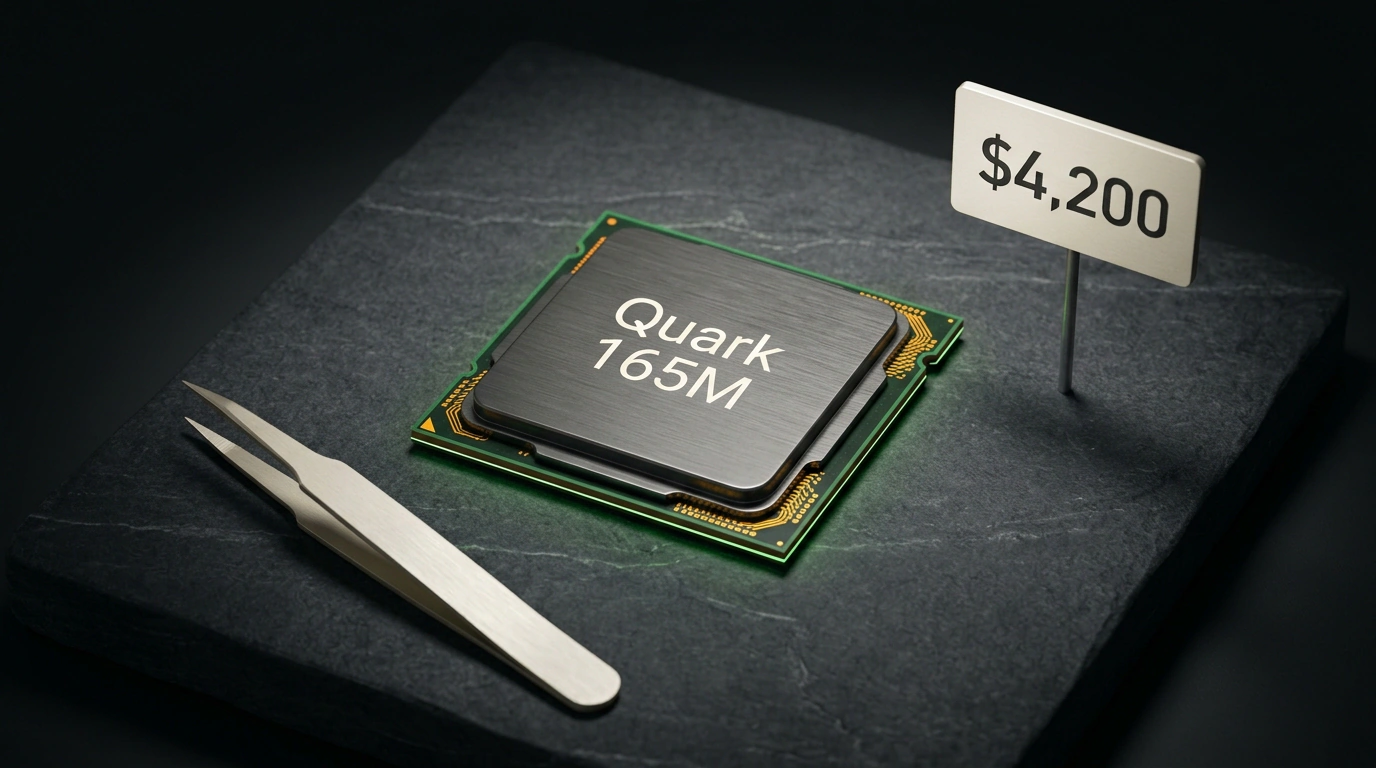
Training a language model from scratch usually costs about as much as launching a small satellite. That makes a report from independent German lab Empero all the more striking: on November 15, 2026, the team released open model Quark with 165.3 million parameters and a 128,000-token context window. The total compute bill came to $4,200—roughly the price of one high-end work laptop.
That figure covers the entire journey: a scrapped first architecture, failed runs, synthetic data generation, pretraining on 500 billion tokens, extending context to 128K, and an RL stage. Quark is roughly a thousand times smaller than 2020's GPT-3 and isn't trying to compete with giants like Claude. Instead, the team used a cheap mini-model to test its training pipeline ahead of a larger release.
What $4,200 Bought and Why There Are Four Checkpoints
For that budget, Empero rented around 1,300 H100 GPU-hours (partially funded by lium.io). Pretraining ran on a single node of eight H100s, and the server crashed seven times along the way. Cloud nodes fail all the time, yet automatic recovery brought training back up in 2 to 4 minutes from the exact same step and data order without a single loss spike.
On Hugging Face, the family is listed as Quark-150M (exactly 140M parameters excluding embeddings) under an Apache 2.0 license. Anyone can download, fine-tune, and use the weights commercially using PyTorch, transformers>=5.23, and trust_remote_code=True.
The team released four checkpoints (saved snapshots at different training stages). 32K-Raw was captured at 472B tokens before the final learning-rate decay so others can continue pretraining cleanly. 32K-Base reached 500B tokens, 128K-Base trained on 10B more tokens for long context, and 128K-Zero went through 32 hours of GRPO reinforcement learning straight from the base model—no SFT chat tuning and no distillation, with 95% of rewards coming from sandbox checks.
How 12 Local Layers Cut Memory Fourfold
The main bottleneck of long context is the KV cache—the model's working memory during generation where it stores intermediate keys and values for every token read. In a standard transformer, every layer keeps the entire document in memory. Imagine reading a 300-page contract and keeping all 300 pages spread open on your desk just to read each new line. At 128,000 tokens, that cache easily grows larger than a tiny model itself.
Quark has just 16 layers arranged in a three-to-one pattern: 12 local layers and 4 global layers, one every fourth step.
Diagram of Quark 165M's hybrid 16-layer architecture: 12 local and 4 global attention layers (Source: empero.org)
Local layers use a sliding attention window over just the last 256 tokens plus a short 4-token convolution—holding only 255 cache tokens and 3 convolution tokens in memory. Only the 4 global layers see the full document, while each layer after the first mixes in values from layer one via a learned gate (MGVR). The payoff is real: at 128,000 tokens in bf16, the KV cache takes around 0.5 GB instead of the 2 GB needed for 16 global layers—roughly 75% savings.
Where the Mini-Model Shines and Where It Fails a School Riddle
In its technical report, Empero candidly calls Quark a research testbed rather than a daily assistant. Trained mostly on English, it knows little world trivia and will confidently make up facts.
Among peers (120–170M parameters, up to 500B tokens), Quark-150M-128K-Base achieved the highest average score across nine lm-eval benchmarks at 52.8%, beating Mamba-130M (50.6%) and Pythia-160M (47.4%). SmolLM2-135M, trained on 2 trillion tokens, still leads overall at 55.3%, though Quark beat it on WinoGrande and SciQ.
Pure RL showed clear gains too: beforehand, the model hallucinated tool outputs (3 correct out of 1,152), while 32 hours of GRPO pushed terminal task success across 15 harnesses from 2.6% to 64.5%. Turning on internal [MONOLOGUE] lifted logic scores from 44% to 67%. Still, those figures come from training runs, and on the classic bat-and-ball riddle ($1.10 total, bat costs a dollar more), the model still answers "$2.10" even with reasoning enabled.
At 128K context, Quark passed 5 of 8 synthetic tests, though only in a simplified single-token check without free-form generation, and it failed quote-attribution lookups at any length. Long context degraded during RL, web search didn't improve, and one of the 15 harnesses never worked. The run stopped early due to budget, safety testing was minimal, and each stage ran only once.