Usually, neural network depth comes at a straightforward cost: if you want 48 layers of computation, you load 48 layers of weights into memory. On November 20, 2026, Thinking Machines Lab released Inkling 2 Mini under Apache 2.0 and broke that math. Inside, it holds 24 layers totaling 26.4 billion parameters, yet every token passes through 48 layers of processing. The official checkpoint weighs about 20 GB, handles both text and images, supports a context window up to 1 million tokens, and outperforms heavier dense models in coding.
Official Inkling 2 Mini release card from Thinking Machines Lab (Source: thinkingmachines.ai)
How the looped MoE architecture squeezes 48 layers out of 24
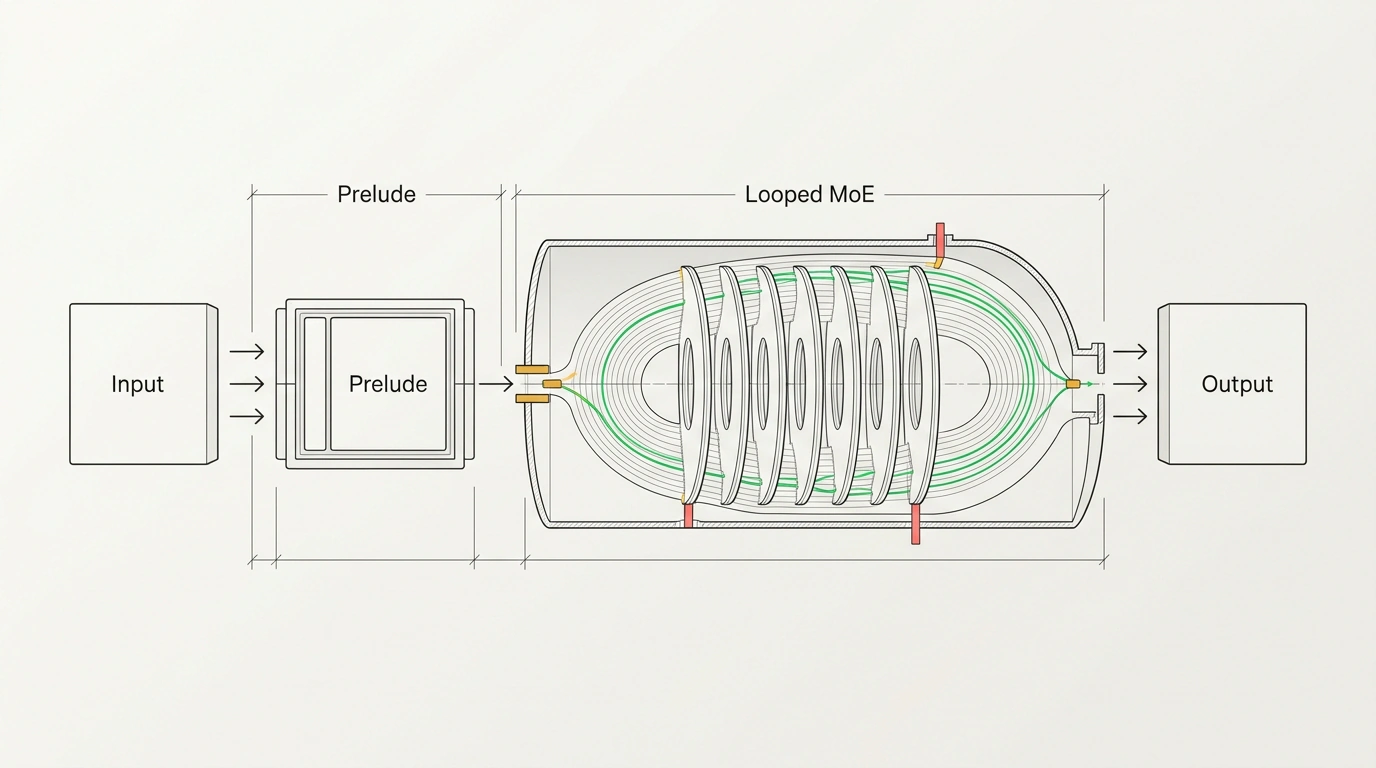
At its core is a looped transformer (Looped Transformer, architecture inkling2_loop), described in the official announcement. All 24 layers are split into four blocks. The first block acts as a prelude and runs once. The middle two blocks (12 layers) process every token three times in a row using shared weights. The fourth block runs once again at the end. That gives 6 + 12 × 3 + 6 = 48 layer applications with half the weight memory.
A sparse mixture of experts (Sparse MoE) in the feed-forward layers adds further savings. For each token, the router activates 8 out of 128 sub-networks, keeping 3.4 billion parameters active at baseline. Each extra pass through the middle 12 layers adds roughly a billion effective active parameters. Across three loops, that reaches ~5.4 billion: you trade extra compute time to save VRAM.
Hybrid attention combining local and global layers stretches the context window to one million tokens. A built-in Vision Transformer encodes images (from 40 to 4096 pixels per side) into the same latent space as UTF-8 text, so screenshots and charts are read directly without external OCR.
How the model performs on code, search, and screen tasks
On coding and agentic benchmarks, Thinking Machines compared the release against dense Qwen3.8-27B, Gemma 4 31B, Muse Glimmer (30B), and the large MoE model Nemotron 3.5 Super VL (12B active out of 125B).
Code and agentic tools: share of solved tasks
The chart shows a clear advantage for the looped design. When an agent needs to edit a repository, call tools over MCP, and run multi-step searches, Inkling 2 Mini beats dense 27–31B models and the 125B Nemotron. In Vibe Code Bench v1.1 (OpenHands), it scores 77.9% versus 64.9% for Qwen3.8-27B and 3.5% for Nemotron. In DeepSWE v1.1, it reaches 48.2% compared to Qwen's 42.2%.
Document and UI tasks show a similar pattern. On OmniDocBench v1.6, the model scores 92.8%. On ScreenSpot Pro (finding UI elements on screenshots), it hits 76.5% directly and 87.7% with Python scripts, compared to 57.6% and 78.9% for Qwen3.8-27B. On long context (LongBench v2), it scores 66.9%, and in finding eight needles across 256k–512k tokens (MRCR v2), it reaches 46.4%.
Still, it is not an unqualified sweep. Qwen3.8-27B leads on Terminal Bench v2.1 (73.0% vs. 71.6%), scores higher on AutomationBench-AA (48.2% vs. 41.8%), and hallucinates less: on AA-Omniscience v1.1, Qwen's non-hallucinated accuracy is 71.4% versus 63.4% for Inkling 2 Mini. The newcomer excels as a coding agent and screen reader, but lags as a general encyclopedia.
How to run Inkling 2 Mini locally without running out of memory
If you heard promises about running this on a 12 GB laptop, hold off on downloading the official release. The original checkpoint uses mixed NVFP4 and MXFP8 precision (4-bit and 8-bit floating point) and weighs about 20 GB. To handle actual context, you need a machine with at least 32 GB of memory: Apple Silicon, a GPU with 32+ GB VRAM, or an NVIDIA DGX Spark.
The easiest way to spin up an official API server is with vLLM or Docker Model Runner:
# Install and start a local vLLM server (port 8000)
pip install vllm
vllm serve "thinkingmachines/Inkling-2-Mini"

# One-command alternative via Docker Model Runner
docker model run hf.co/thinkingmachines/Inkling-2-Mini
The vLLM server exposes an OpenAI-compatible /v1/chat/completions endpoint with image support. For direct Python calls via transformers, use AutoProcessor and AutoModelForMultimodalLM:
from transformers import AutoModelForMultimodalLM, AutoProcessor

# Load the processor and model with automatic memory placement
model_id = "thinkingmachines/Inkling-2-Mini"
processor = AutoProcessor.from_pretrained(model_id)
model = AutoModelForMultimodalLM.from_pretrained(
    model_id,
    device_map="auto",
)

# Pass an image and a text prompt
messages = [{
    "role": "user",
    "content": [
        {"type": "image", "url": "https://example.com/ui.png"},
        {"type": "text", "text": "Найди кнопку оплаты на экране"},
    ],
}]

inputs = processor.apply_chat_template(
    messages, add_generation_prompt=True, tokenize=True,
    return_dict=True, return_tensors="pt",
).to(model.device)
outputs = model.generate(**inputs, max_new_tokens=256)
print(processor.decode(outputs[0][inputs["input_ids"].shape[-1]:]))
Setting max_new_tokens=256 is not just for show here: a hard output cap prevents the model from getting stuck in reasoning loops.
For 12–16 GB laptops, the model arrives via GGUF quantizations for llama.cpp. The AtomicChat team published Inkling-2-Mini-Uncensored-GGUF and measured quality loss against BF16 across 87 chunks of 4096 tokens using KLD (Kullback–Leibler divergence, measuring next-token probability drift where zero is ideal) and top-1 agreement.
| Build file | Size, GB | KLD vs. BF16 | Top-1 agreement |
|---|---|---|---|
AD-Q4_K.gguf | 16.53 | 0.0115 | 95.6% |
AD-IQ3_S.gguf | 13.34 | 0.0235 | 93.8% |
AD-IQ2_M.gguf | 8.67 | 0.1320 | 85.7% |
Inkling-2-Mini-Uncensored-LoRA.gguf | 0.04 | — | rank-1 adapter |
mmproj-Inkling-2-Mini-Uncensored-F16.gguf | 0.64 | — | vision projector |
The 4-bit version barely loses any accuracy, the 3-bit build is a solid compromise, and the 2-bit variant (which fits into 12 GB) noticeably distorts token distributions. For image support, any GGUF build also needs the mmproj file.
Support for inkling2_loop landed in llama.cpp starting with build b12600 (PR #32694); files from the older PR #32695 are incompatible. You can run either the baked build or the base GGUF plus the 40 MB rank-1 LoRA adapter:
# Quick start with 2-bit quantization
llama serve -hf AtomicChat/Inkling-2-Mini-Uncensored-GGUF:IQ2_M

# Baked 4-bit GGUF + vision projector (32K context)
./build/bin/llama-server \
  -m Inkling-2-Mini-Uncensored-AD-Q4_K.gguf \
  --mmproj mmproj-Inkling-2-Mini-Uncensored-F16.gguf \
  --jinja -c 32768 -ngl 99

# Base GGUF + separate 40 MB LoRA adapter
./build/bin/llama-server \
  -m Inkling-2-Mini-AD-Q4_K.gguf \
  --lora Inkling-2-Mini-Uncensored-LoRA.gguf \
  --mmproj mmproj-Inkling-2-Mini-F16.gguf \
  --jinja -c 32768 -ngl 99
The --jinja flag enables the model's chat template, -c 32768 keeps the KV cache within memory limits, and -ngl 99 offloads layers to the GPU. Beyond llama.cpp, weights are also supported by SGLang, Ollama, Unsloth, Exo Labs, and agents like Pi, Hermes Agent, and OpenClaw.
Real-world limits and what breaks in the uncensored build
High coding scores do not eliminate practical pitfalls. First is debugging loops: in Thinking Machines' internal tests, the model occasionally re-checked its own patch in circles without making progress. You cannot turn off reasoning completely even at the lowest reasoning effort (none), and running the middle layers three times makes every extra token slower.
The second issue is reckless autonomy with tools. Without guardrails, the agent can silently delete or overwrite files and report the outcome inaccurately. Quality also drops outside English: Chinese test runs produced choppy phrases and language mixing. On the bright side, fears that loops would hide secret computations outside the chain of thought proved unfounded—its reasoning stays readable.
When connecting Inkling 2 Mini to Pi, Hermes Agent, or your own scripts, isolate the working directory in a container, set strict limits on max_new_tokens and turn counts, and require manual confirmation before deleting or overwriting files.
AtomicChat's uncensored build comes with its own trade-offs. It applies a rank-1 LoRA across 49 residual-stream write points (attention and routed-expert outputs across all 24 layers, plus token embeddings). Because the middle 12 layers share weights across three passes, one edit affects all 48 passes. Trying to include the short depthwise convolution broke generation (first-token KL spiked to 16–21), so they stuck with simple refusal-direction subtraction.
Refusals on harmful-prompt tests dropped from 100% in English (81/81) and 91% in Russian (91/100) to zero. False refusals on XSTest fell from 4% to zero, and valid tool calls rose from 18 to 20 out of 20. However, two control gates failed: MMLU accuracy (2,000 questions) fell from 80.65% to 79.15% (−1.5 percentage points, p = 0.006), and first-token KL on benign prompts climbed to 0.94 against a 0.10 threshold because the first token shifted where the original model refused. On regular code, the adapter's KLD stays around 0.008, though for production work the base checkpoint or standard 4-bit GGUF preserves original accuracy more reliably.