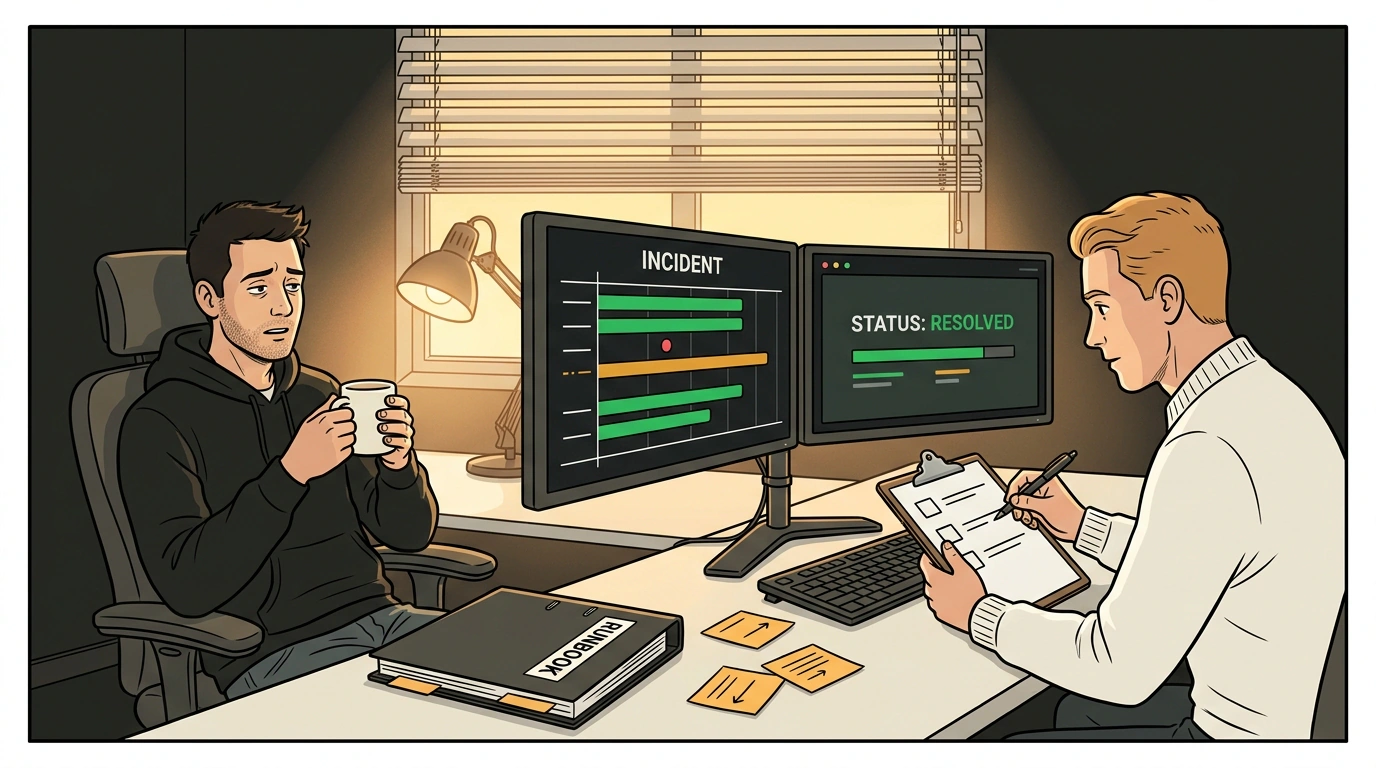
At 1:50 AM, silence fell over the incident bridge. The on-call engineer read step eight out loud, waited a couple of seconds, and said, "That's it, the document ends there." Meanwhile, the customer portal kept throwing errors, failing roughly one in five logins. Someone half-heartedly suggested running step two again.
It is a familiar scene. On-call guides (known in SRE as runbooks) never actually end with "if the above did not work." Beyond that line lie judgment calls you cannot turn into checkboxes. Yet at 3 AM, the on-call engineer still hits that blank wall.
That night, a simple question saved the call: "What changed yesterday?" Nobody on the bridge knew. A platform engineer opened the deploy log and spotted a load balancer config tweak shipped at 16:40 by another team that wasn't even on the call. They rolled back the config at 2:22 AM, and logins recovered by 2:30. A week later, someone added step nine to the runbook—leaving the real problem untouched until the next weird outage.
How runbooks age and where the 'why' disappears
Every production runbook older than a couple of years shows rings of past outages. SRE engineer Tim Irving examined a typical tier-2 customer portal guide. It had last been reviewed in full on March 14, 2017, then patched at the bottom after each fire:
- Check the login error and latency dashboard (with a note: "new link to be added later").
- Restart the service on the active node.
- Do not restart both nodes at once: standby takes over active sessions, otherwise all users get logged out.
- Clear the session cache.
- Do not fail over to the DR site.
- Check certificate expiration on the load balancer.
- Note (2018): do not run the nightly batch before 6 AM.
- If login latency exceeds two seconds, disable the retry queue.
Step three still explains why the rule exists. Steps five and seven lost their reasons completely. Engineers follow them blindly without knowing what disaster they prevent.
Explanations vanish out of sheer haste. As a runbook grows, long paragraphs slow down a sleepy engineer trying to find a command at 3 AM, so people trim them on purpose. Cognitive scientist Erik Hollnagel calls this the ETTO principle—the Efficiency–Thoroughness Trade-Off: in real work, people almost always trade completeness for speed.
Judgment doesn't vanish, though; it moves into the "oral edition" of the runbook. Newcomers learn from veterans which steps to skip and which links are dead. Those chats almost always start with: "Well, actually, there's a catch…"
Past the final step, the job changes completely. Instead of following checkboxes, you have to ask: where is it failing, what do the failures share, what are the symptoms, and what shipped yesterday? Someone who knows their logs and tools finds the 16:40 change. Someone handed only a cheat sheet stops where the text ends.
What breaks in a dry written handover
A shift handover note during a long outage is just another runbook, written on the fly at 2 AM by someone exhausted. It captures status, customer impact, workstreams, owners, and the next update time.
Bare facts make it across. Everything else gets lost.
During one incident, Tim Irving handed off at 6:00 AM with a neat note: impact, three workstreams, owners, and a 7:00 AM update. When he rejoined the call at 11:40, the day shift was calling the storage vendor again. Night on-call had already paged them at midnight and completely ruled out storage by 1:00 AM. Yet the note only read "storage: no fault found"—with no confidence level and no name attached. The day team burned the entire morning re-testing a closed theory.
Written summaries almost never capture four layers of context: which investigation paths are weak and why; who is already burned out; who needs shielding from status calls because they are driving the fix; and whose analysis helps versus who is muddying the waters.
An incoming incident commander works with what is on the screen. A veteran eventually reads the room from voices on the bridge, while a less experienced lead sends the team in circles.
Losing context has one upside. Researcher Emily Patterson studied shift handovers at NASA's shuttle mission control and dispatch centers: a fresh person sometimes breaks the previous shift's tunnel vision on a wrong theory. The flaw of a dry note is that it washes away both bad fixation and good judgment together.
Three honest reasons you shouldn't write everything down
It is tempting to say, "Just write better runbooks and handover notes!" In practice, that hits three walls.
First, some knowledge cannot be written down at all. Philosopher Michael Polanyi framed this in 1966 in The Tacit Dimension: we know more than we can tell. Psychologist Gary Klein gave the classic example in Sources of Power. A fire crew was fighting a "kitchen" fire, yet water barely helped, and the room felt eerily quiet and too hot. Acting on sudden unease, the commander ordered everyone out—seconds before the floor collapsed into a roaring basement fire he didn't know existed. He called it a sixth sense, though his brain had simply combined physical clues from experience. You can't put "feel the basement" into a checklist.
Second is ethics and HR. Writing "on-call is too sleep-deprived to think straight" or "keep an eye on this participant" may be true tonight, but in a permanent log it becomes an unfair label that won't survive an HR review. People judgments expire in a day; written text lasts for years.
Third is volume. If a senior engineer dumped everything they knew onto paper, you'd get a 500-page manual: the first five pages would be read a hundred times, and the rest once. That brings you right back to Hollnagel's trade-off that stripped explanations out of steps five and seven.
Gaps in documentation are deliberate choices, and usually the right ones. The last line of any runbook is always the name of the person who knows what isn't in the steps.
A handover protocol that actually works
What doesn't fit in a note goes over voice. A reliable handover takes three steps and a brief overlap.
First, post the written note with hard facts in the channel. Next comes a live talk-through: which theories are closed and who proved them, where the team is stuck, who is exhausted, and where leadership will push. Then the incoming commander does a talk-back—repeating key risks and the plan in their own words so the outgoing lead knows the message landed. Only then do you announce the new commander to the bridge.
On a real 14-hour outage, handover happened at 6:40 AM. The night commander posted a page of facts (impact, three streams, owners, 7:00 update) and added the real story verbally:
- Storage is closed: the vendor engineer proved it at 1 AM; reopening it wastes the morning.
- The network track is weak; the team is already on its third theory.
- Leon has been up since yesterday, but he's the only one making progress on the DB—keep him off management calls.
- The Ops Director will push for a failover at 8 AM—say no.
The incoming lead repeated it all back, and the night lead stayed on the bridge until 7:15. Nobody bothered the storage vendor again, and the database fix shipped at 9:20.
NASA Mission Control during Apollo 9, an environment where shift handovers became a strict protocol (Source: Wikimedia Commons, Public domain)
High-stakes industries locked this in long ago. In Emily Patterson's NASA studies, outgoing specialists kept responsibility until handover finished and stayed nearby in case something broke during the transition. Emergency dispatchers make it even simpler: you haven't taken the shift until you plug your headset into the console.
Three-step incident shift handover
- Written note: post outage scope, active workstreams, owners, and next update time in the incident channel.
- Talk-through: share closed theories and who proved them, weak leads, exhausted people, who to shield from calls, and expected management pressure.
- Talk-back: have the incoming commander repeat key risks and immediate next steps in their own words.
- Overlap: announce the commander change to the bridge, and keep the outgoing lead on the call for 15–30 minutes.
When shifts sit in different time zones with no live overlap, a three-minute voice note or video can replace the talk-through, though chat talk-back is still essential. That casual "Well, actually, there's a catch…" next to a runbook is the exact same mechanism stretched over time. It is also why an author's name stays at the bottom of old runbooks years after they leave: the process outlives its creator, while everything left unwritten walks out the door with them.