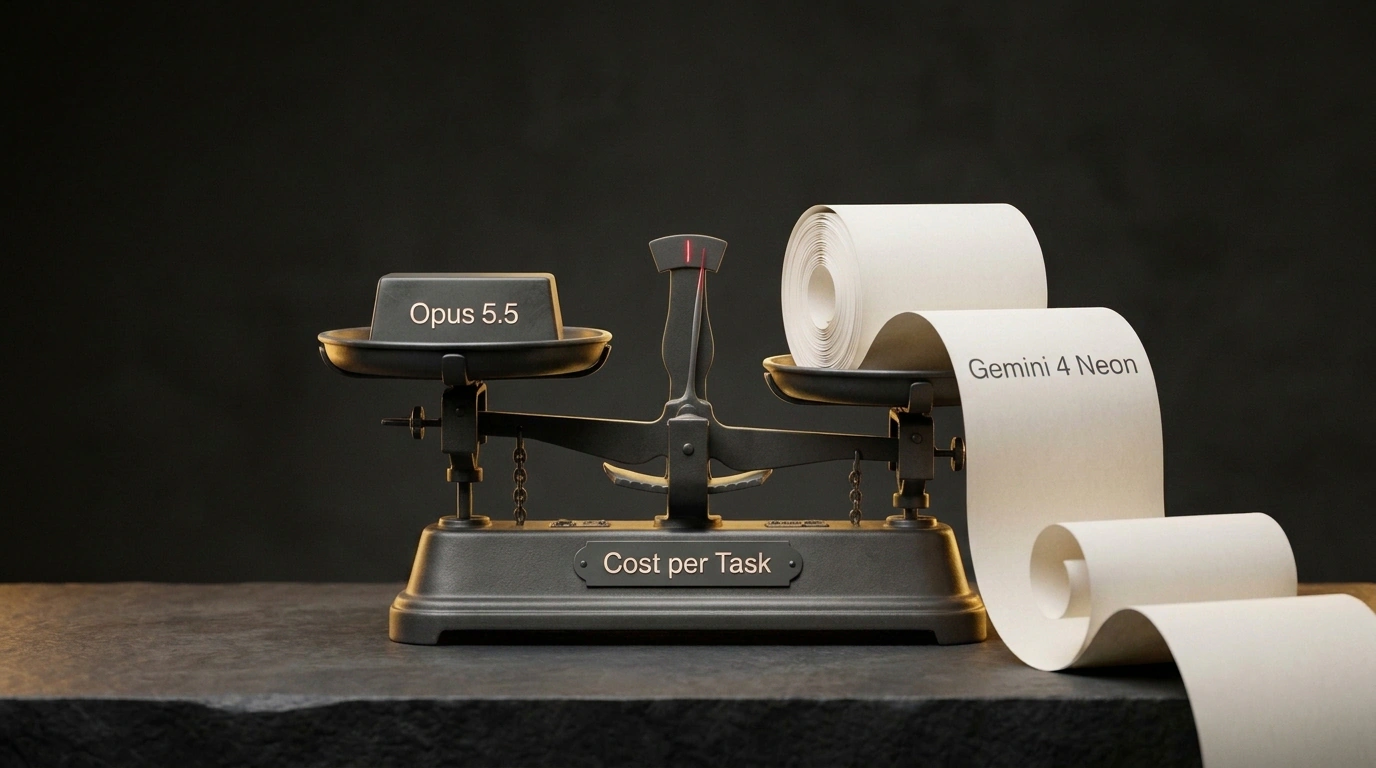
Will you save money on your API bill by moving workloads from Claude Opus 5.5 to Google's new Gemini 4 Neon? On paper, it looks like a no-brainer: Google charges 25% less per token ($3 per million input and $15 per million output, versus $4 and $20 at Anthropic). On independent benchmark Artificial Analysis, where models run the same task suite and average cost is tracked, Neon scores 61 against Opus 5.5's 59 and spends $6.44 per task versus $10.04. That sounds like an instant switch.
The final invoice, however, depends on both token price and output length. Internal thinking tokens are billed at output rates, which cost five times more than input tokens. That's where Neon's main quirk shows up: it thinks longer and writes more.
Why Verbosity Eats Up Cheaper Token Pricing
In direct API runs using identical prompts and default settings, that difference hits your wallet. On a 3D coastal town scene with a lighthouse, waves, and cars, visual quality tied: Neon had more cinematic lighting and water, while Opus 5.5 rendered sharper streets and lighthouse beams. The bill was the surprise: Neon took 3m 17s, generated around 25,000 tokens, and cost $0.37. Opus 5.5 finished in 2m 16s, used ~16,000 tokens, and cost $0.32. The cheaper model on paper ended up costing 15% more.
On a coffee subscription dashboard, both quality and cost matched closely ($0.40 vs. $0.41). Neither hallucinated on a fake pandas method, strict formatting, or logic checks. Yet on complex interactivity, lower cost sometimes meant broken output: in a watch configurator test, Opus 5.5 spent $2.74 to build a working 42-part mechanism, while Neon spent $1.86 on 9 parts with broken buttons.
Artificial Analysis's verbosity measure explains why—out of 94 models, Neon ranked 92nd for conciseness.
Output tokens across a full Artificial Analysis run
Over a long run of complex tasks, the per-token discount still wins out, giving Google a lower average cost. On a single standalone prompt, though, one extra reasoning loop easily wipes out the savings.
Three Scenarios Where Neon Clearly Wins
In three areas, Google's new model delivers without caveats.
First is visual and 3D browser prototypes. For landing pages, games, and Three.js scenes, Neon handles physics well: from a single image it builds a robot dog with 240 Hz physics, pulls a Hugging Face depth model to animate photos, and holds 60 FPS on a destructible voxel arena. Best results still require a detailed spec covering camera angles and steps.
Second is targeted debugging. When hunting down a specific bug, Neon's thoroughness becomes an asset. In a private test with 105 injected bugs across two repos, its top score of 63 beat GPT-6.2 Astra (62.7) and Claude Fable 5.2 (58). In other checks, it brought three broken projects to 100% passing tests and solved a low-level graphics bug in 20 minutes that had stumped older models for two weeks.
Third is heavy documents. Both models offer a one-million-token context window, yet in Google's long-text fact-retrieval test Neon hit 95% against 67% for Opus. Treat vendor benchmarks with healthy skepticism, of course, but Neon clearly brings strong headroom for thick PDFs and spreadsheets.
The December 1 Deadline and Pairing Both Models
If you're eyeing the Gemini lineup, check your calendar: introductory pricing on flagship Gemini 4 Carbon ends November 30, 2026, doubling on December 1 to match Opus 5.5. Neon stays the most affordable way to get comparable quality on Google's API, especially via batch pricing—an asynchronous queue that trades instant replies for a 50% discount.
| Model | Input / 1M | Output / 1M | Cached Read | Batch (-50%) |
|---|---|---|---|---|
| Gemini 4 Neon | $3.00 | $15.00 | $0.15 (implicit) | $1.50 / $7.50 |
| Gemini 4 Carbon (until Nov 30) | $2.00 | $10.00 | $0.10 | $1.00 / $5.00 |
| Gemini 4 Carbon (from Dec 1) | $4.00 | $20.00 | $0.20 | $2.00 / $10.00 |
| Claude Opus 5.5 | $4.00 | $20.00 | $0.20 | $2.00 / $10.00 |
| Claude Fable 5.2 | $8.00 | $40.00 | $0.20 | $4.00 / $20.00 |
Neon carries two API limits on Google's side: there is no free tier, and caching only works implicitly without manual prompt pinning like Claude API offers. All thinking tokens and tool definitions are billed in full.
Single API runs still don't replace multi-hour agent sessions with subagents, where Claude Opus 5.5 inside Claude Code behaves more predictably and economically. The smart play is keeping Claude as your base for long coding sessions and bringing in Neon as a specialist for visual prototypes, stubborn bugs, thick documents, and background batch jobs.