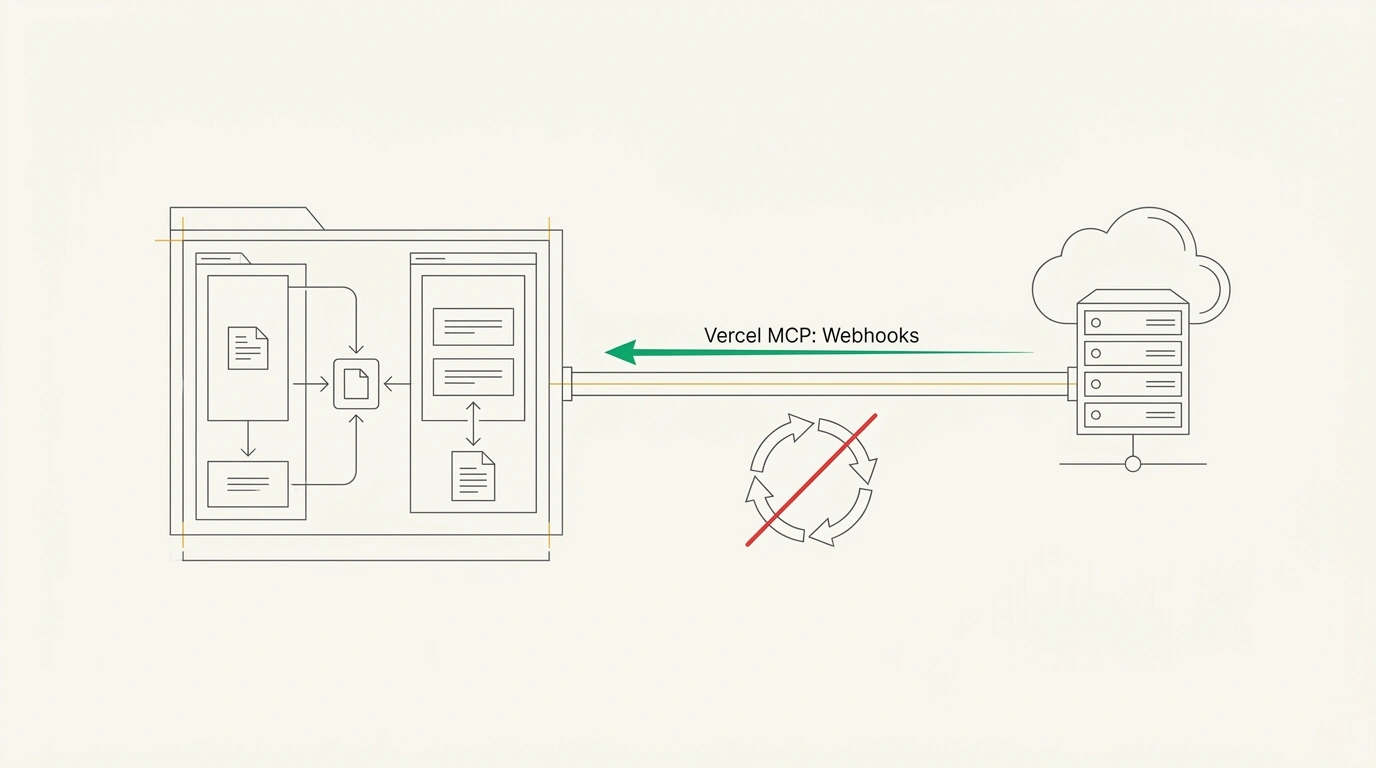
A modern coding agent can rewrite a module on its own and push commits to a repository, yet right after deploy that smart partner suddenly acts like an impatient kid in the back seat. While the cloud builds the project, the agent endlessly pokes the API asking, "Are we there yet?" The October 30 update to the Vercel MCP server and the Vercel Connect beta, broken down by Julian Goldie, solve this problem: now the agent stops spamming the server with checks and quietly waits for a signal that the build succeeded or failed.
The Polling Trap vs. the Event-Driven Model
Take a familiar workflow: your agent in Claude Code or built on the Vercel AI SDK updates packages, pushes a commit, and waits for Vercel to build it.
In classic polling, the agent cannot hear incoming notifications—so it keeps asking. Every 5–10 seconds it calls check_status and gets back a reply that the build is still running. A model's context window works like human working memory: every intermediate status report stays in the dialogue along with all its headers. As a result, up to 30–40% of your token budget goes up in smoke just reading "in progress."
The event-driven model in the Model Context Protocol (MCP) standard flips the mechanism. After pushing a commit, the agent subscribes to project events once and frees its context, going to sleep while compilation runs. If 45 seconds later the build fails due to a package conflict, Vercel itself sends a deployment.error signal with the error stack, and the agent immediately fixes the dependencies.
How Subscriptions and Webhooks Work Under the Hood of Vercel MCP
MCP serves as a universal adapter connecting models to external services (I covered its security earlier in a breakdown of MCP server architecture). Subscribing via @vercel/mcp, @vercel/connect, or @ai-sdk/mcp, the agent filters notifications by team, project, and environment, choosing the signals it cares about:
deployment.succeeded— the build succeeded, returning the public preview URL;deployment.error— the build failed, returning the builder's error stack log.
Behind the scenes, Vercel MCP spins up a temporary webhook—a doorbell that rings only when the courier is actually at the door. As long as the agent renews the subscription, the webhook stays alive; if forgotten, it expires and cleans itself up. One changelog detail I especially appreciated is the quota split: standard Vercel webhooks are capped at 40 per account, whereas MCP event webhooks get their own separate per-team quota. Every delivery follows the Standard Webhooks spec: the data field carries native JSON from Vercel, sealed with a cryptographic signature.
TypeScript Event Receiver and Beta Limitations
To catch the signal, I checked the Receive MCP Webhook Events recipe in the AI SDK Cookbook and verified it against the Vercel Webhooks documentation. Let's put together a server-side receiver that catches the notification after a 45-second deploy, verifies the x-vercel-signature header, and triggers a repair loop on failure:
import { createHmac } from "node:crypto";
import type { Request, Response } from "express";

export async function handleVercelMcpEvent(req: Request, res: Response) {
  const sig = req.headers["x-vercel-signature"] as string;
  const secret = process.env.VERCEL_WEBHOOK_SECRET || "";
  const hmac = createHmac("sha1", secret).update(JSON.stringify(req.body)).digest("hex");
  if (sig !== hmac) return res.status(401).json({ error: "Invalid signature" });

  const { type, payload } = req.body;
  if (type === "deployment.error") {
    await triggerAgentRepairLoop({
      projectId: payload.project.id,
      errorLog: payload.error?.log,
      commitSha: payload.deployment.meta?.githubCommitSha
    });
  }
  return res.status(200).json({ status: "acknowledged" });
}
Calling createHmac("sha1", secret) checks the request body's hash against x-vercel-signature and rejects forged requests with 401. When the signature matches, the type === "deployment.error" filter kicks off triggerAgentRepairLoop, passing the agent the project ID, payload.error?.log, and the commit hash githubCommitSha.
Keep three beta caveats in mind: closing the MCP client does not cancel the subscription (you need an explicit unsubscribe or timer expiration), the receiver requires an HTTPS domain without redirects using a Vercel OpenID Connect token (locally, ngrok works), and the MCP Events design itself remains an experimental proposal within the standard.
Moving from polling to event-driven signals saves more than a third of your token budget. To me, we delegate routine work to agents above all for peace of mind and reclaimed time: so we can stop staring at a build spinner and focus on real engineering while automation fixes broken packages on its own.