When developer and entrepreneur Rass Mic needed a PlayStation 5 Pro console in time for the GTA 6 launch, he didn't spend hours monitoring classifieds. On Greg Isenberg's podcast, he showed how he delegated the search to an agent in Grok Bot from xAI. The bot scoured eBay listings on its own, verified that the seller was a real store in Ontario two hours away, emailed the owner, prepared a talking-points script, and helped close the deal. Using the same setup, Rass Mic runs an entire staff of specialized assistants: in the evening he tasks an engineering bot with building a prototype app for the public sector, goes to sleep, and opens a finished GitHub repository in the morning.
Behind that episode sits a practical question that matters to anyone short on time: how do you offload daily digital drudgery onto Grok Bot—from clearing an overflowing inbox with tens of thousands of stale emails to coordinating work projects—while safely entrusting a neural network with live accounts? I examined xAI's platform architecture and cross-checked recent practitioner cases to show where the agent genuinely saves hours and where autonomy demands a tight leash.
From Chat Window to Cloud Computer: How Grok Bot Works Under the Hood
At the phrase "AI assistant," most people instinctively picture a standard chat window. It feels like writing a clever prompt should be enough for the model to do everything itself. In practice, a classic chatbot is locked inside a browser tab like a consultant in a soundproof booth: it can offer advice, but it can't click a single button in an external service, and the moment you close your laptop, work stops.
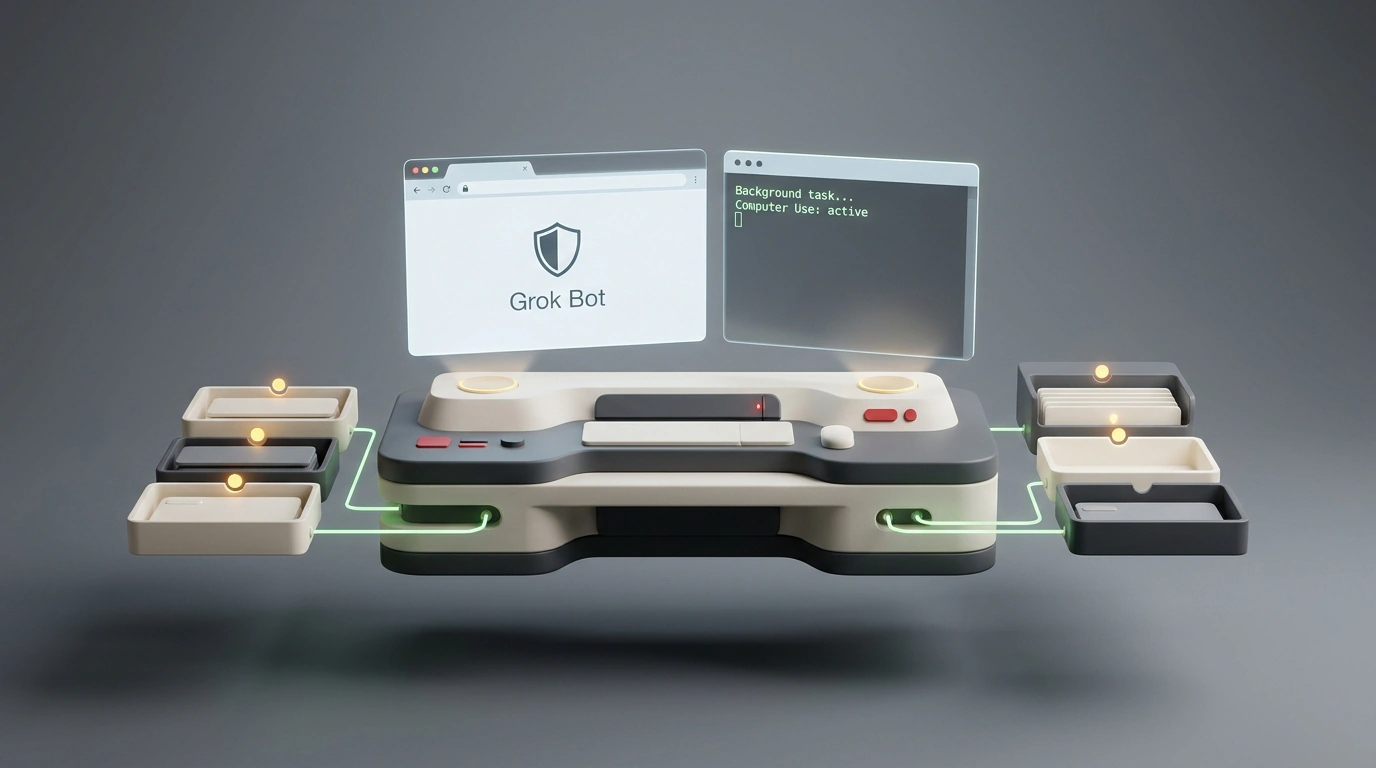
In the public beta of Grok Bot (available on SuperGrok-tier subscriptions), xAI engineers built the environment differently. When you click the plus icon in the sidebar, give the bot a name, and assign it a single role, it receives its own isolated virtual computer in the cloud (Computer Use). Every agent gets a Chromium-based browser, a Linux terminal (bash), a file system, and an OAuth token vault. Once you kick off a chain of actions, you can close the tab: the virtual machine keeps running in the background, preserving session state and long-term memory.
What struck me most in Rass Mic's approach was workspace hygiene. If you dump store layouts, taxes, and video ideas into one endless chat, any model will get tangled in context. Grok Bot follows the rule "one serious project, one dedicated agent":
- Project bots with clean context. Each major product—the Pluto and Bezalel apps, a Rust trading terminal, or his brother's Shopify clothing store—gets a separate bot that remembers the edit history and business constraints of that specific track.
- Chief dispatcher role. Grok Bot itself doesn't have to write every line of code manually. Rass Mic uses it from his smartphone as a coordinator that holds the big picture of the business and routes tasks over Tailscale and T3 Code to the terminal agent Claude Code running on Opus 5.5 (by the developer's math, a $200/month subscription covers $8,000 to $12,000 worth of equivalent API token volume).
- Design before code and deleting temporary bots. To keep websites from looking like generic templates, the agent first connects via MCP to the Paper editor, assembles a design system from Mobbin references, and refines the layout based on human feedback before transferring the frontend to Shopify. One-off bots are deleted as soon as the task is done. For more on how these workers are structured, read our breakdown of Grok Bot cloud agent architecture with schedules and task files.
Spring Cleaning Your Inbox: Batch Filtering Spam and Receipts Without Losing Important Emails
Once an agent has a cloud browser and memory, the best place to test its usefulness is clearing years of backlog. AI-services founder Jason West ran a vivid experiment in his hands-on walkthrough of Gmail cleanup. Over the years, his inbox had accumulated more than 613,000 emails. Whenever storage filled up, Jason couldn't be bothered to sort the archive manually and simply paid Google for extra gigabytes.
Instead of buying yet another storage tier, he created a digital-clutter agent on the x.ai/bot portal and tasked it with auditing his Gmail and Google Drive, then drafting a preliminary cleanup plan.
Here is how proper inbox triage is structured so the bot doesn't trash important documents or client threads:
- Initial audit without deletion. The agent scans senders and email frequency, separates live conversations and receipts from automated newsletters, and inspects files on Google Drive.
- Plan approval. The bot compiles a summary: which email categories eat up space, which newsletters haven't been opened in years, and which receipts should be archived. Not a single email is touched until a human approves.
- Batch purge. After confirmation, the agent runs in the background to clear out old digests and promos like Deliveroo food delivery coupons.
The result of one session for Jason West was roughly 32,000 deleted junk emails and 3 GB of freed space without paying for extra cloud storage. Requiring a plan before any deletion acts as the primary safety fuse here. A regular chatbot passively waits for your next message, whereas an agent with a virtual computer strives to complete its assignment at any cost. Every irreversible operation should therefore be split into two steps: autonomous reconnaissance by the bot, followed by human confirmation.
Coordinating Business Workflows, Phone Calls, and Hard Security Boundaries
The principle of "the agent drafts, the human signs off" lets you scale Grok Bot from personal email to company pipelines. As SEO agency head Julian Goldie showed in his demo of four agentic pipelines, his bots build interactive Pages right inside the chat with cards and control buttons:
- Lead Radar. On weekdays at
08:00, the bot scouts for clients. In a test across10dental practices in Leeds, it opened each site in the cloud browser, checkedtitletags, reviews, and service pages, scored the sites out of100, and flagged the top flaw. Notably, it honestly marked mobile speed asunverifiedso the team wouldn't pitch unconfirmed issues to prospects. - Outreach Desk. For
6shortlisted leads, a second agent writes a4-line email pointing out one real website issue. Drafts land in a queue with "Approve," "Edit," and "Skip" buttons—the sent counter stays at0until a staff member personally clicks approve. - Rank Room. Every Saturday morning, the bot cross-checks
58pages ofgoldie.agencyagainst Google People Also Ask questions, highlighting covered topics in green and gaps in orange with a ready-made article brief. - Quality Gate. Before delivering a client project, the bot audits the page against
6criteria: data sources, brand tone, meta tags, links, and zero fluff. On a test page for the Harbour Physio clinic with3errors, the agent passed only2of6checks, rejecting unsubstantiated stats, hype, and an overly longmeta description, while keeping the strategist's sign-off button locked until fixes were made.
In the first week of November (following Elon Musk's October announcement), Grok Bot gained phone calling, which Julian Goldie covered in his review of the platform's November features. To cancel an internet contract 3 days before renewal or confirm Friday's delivery on order 4471 with a supplier, you just set the goal and a restriction: "Do not agree to any changes to the order." Once you confirm the call card, the bot dials a US number (at launch, the feature works only in the US for individual calls), navigates voice menus, waits on hold, and conducts the conversation—introducing itself as a virtual assistant—while you watch a live transcript with "Take Over" and "End Call" buttons. Alongside this, the platform added file sharing via the Share menu on iPhone and Android, search across old chats, Team Bots with a hours-saved counter, and X monitoring (Rass Mic's content bot sends 3 video topics with tweets and titles at 09:00 and 17:00). We wrote about group coordination among such workers in our review of the autonomous Grok Bot platform and Superbots swarm.
Even inside xAI's isolated cloud containers, never grant a bot permission for irreversible actions without review. Deleting emails, sending client messages, and phone negotiations must pass through a manual approval gate, and when scraping websites, keep in mind that layout changes can break a browser agent's script.
Ultimately, working with Grok Bot calls for a healthy sense of proportion and sober judgment—especially around finances and personal data. Rass Mic himself connected his bank accounts via Plaid to an Advisor Bot not for reckless spending, but as a "cold shower" against impulsive ideas. When the developer got excited about buying a commercial building in Canada, the bot checked the deal against his budget, read the listing, spotted a 2009 boiler and furnace in the description (about 17 years old and due for replacement within 2 years), pointed out a suspicious ban on buyer representation, and talked its owner out of a questionable gamble. Don't try to put your entire life on unsupervised autopilot in one evening: start with one simple assignment like an inbox cleanup plan or an 8 a.m. morning brief, audit the agent's logic over a week, and always keep the confirmation button in your own hands.