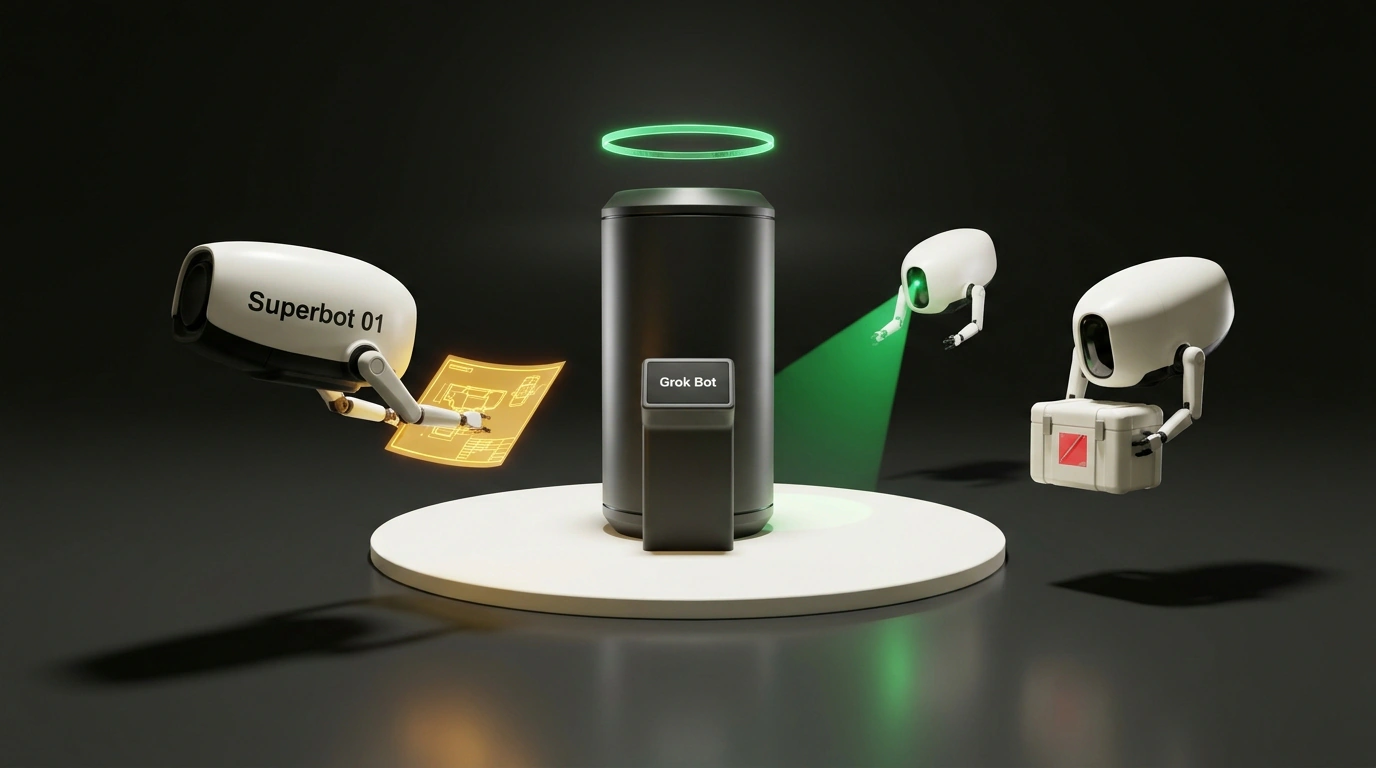
When xAI introduced its Grok chatbot late last year, most people saw it as a cheeky ChatGPT rival with sharp humor and live access to X's social feed. Behind that witty conversational facade, however, Elon Musk's team was building something fundamentally different.
With the major SuperGrok update, the ecosystem evolved into a full execution platform for autonomous worker agents—Grok Bot—complete with multi-agent Superbots workflows. Every bot you spin up is no longer just a thread in a chat list, but a Persistent Cloud Computer with its own isolated file system, a full headless browser, and a Linux terminal capable of running multi-hour autonomous jobs without keeping a browser tab open.
I dug into Grok Bot's runtime architecture, tested launching a Superbots swarm, and examined how context flows between agents. Let's see how this virtual office works and what it unlocks for practical automation.
A Persistent Cloud Computer: Agents with Their Own Memory
Browser-based bots have always suffered from ephemerality. Close the tab or lose Wi-Fi, and the session dies while your data vanishes.
Grok Bot allocates a lightweight container in xAI's cloud for each agent, packed with three key capabilities:
- Persistent State: The bot remembers uploaded files, site session cookies, and saved environment variables across runs.
- Full Headless Browser: Instead of scraping static HTML only, the bot executes complex client-side JavaScript, interacts with live DOM elements, scrolls infinite feeds, and captures screenshots.
- Background Scheduler (Cron & Webhooks): You can put a task on a timer (say, "every weekday at 08:30, gather fresh competitor listings") or trigger runs from an incoming webhook.
Multi-Agent Superbots: Teamwork Without a Human Micromanager
Things get genuinely interesting when you combine several specialized bots inside a single group chat—the Superbots architecture. Rather than forcing one bot to juggle everything, you assemble a coordinated crew with clear roles:
- Scout Bot: Monitors industry sources, tracks trends, and curates fresh posts.
- Analyst Bot: Runs an isolated Python script in the terminal, crunches numbers, and generates comparison tables.
- Editor Bot: Formats a polished document matching company brand guidelines and sends the link to your Telegram.
Coordination between bots is defined in a declarative swarm manifest:
{
  "swarm_id": "market-intelligence-swarm",
  "coordinator": "GrokSuperBot-Lead",
  "members": [
    {
      "bot_id": "web-scout-01",
      "role": "researcher",
      "capabilities": ["headless_browser", "web_search"],
      "schedule": "0 8 * * 1-5"
    },
    {
      "bot_id": "data-cruncher-02",
      "role": "analyst",
      "capabilities": ["python_sandbox", "csv_generator"]
    }
  ],
  "handoff_rules": {
    "on_research_complete": "trigger data-cruncher-02 with payload.scout_results",
    "on_analysis_complete": "notify_user_telegram"
  }
}
Triggering a background job programmatically and polling its status via the API takes a straightforward Python script:
import os
import requests
import time

XAI_API_KEY = os.environ.get("XAI_API_KEY")
headers = {"Authorization": f"Bearer {XAI_API_KEY}", "Content-Type": "application/json"}

# Launch a background job inside an isolated Grok Bot container
payload = {
    "bot_id": "web-scout-01",
    "directive": "Собери топ-5 обсуждений по теме Model Context Protocol в сети X за последние 24 часа",
    "execution_params": {"headless_browser": True, "save_to_workspace": True}
}

response = requests.post("https://api.x.ai/v1/grok-bots/execute", headers=headers, json=payload)
task_id = response.json()["task_id"]
print(f"Задача {task_id} запущена в облачном контейнере...")

# Poll for task completion
while True:
    status_resp = requests.get(f"https://api.x.ai/v1/grok-bots/tasks/{task_id}", headers=headers)
    status_data = status_resp.json()
    if status_data["status"] == "completed":
        print("Отчет успешно сформирован в файловой системе бота:")
        print(status_data["result_summary"])
        break
    time.sleep(10)
Practical Value and Boundaries
Moving from text chat to background script execution inside isolated VMs turns Grok Bot into a serious workhorse for founders and analysts. Multi-hour chores—tracking supplier prices, gathering customer feedback, reconciling warehouse stock—shift to agents humming quietly on remote servers.
Still, web autonomy calls for realism: when a bot runs into aggressive anti-bot shields (like Cloudflare Turnstile or strict CAPTCHAs), the session may pause and require a human to step in.
Grok Bot and Superbots show how far modern AI has grown up: the winner isn't the model that writes the prettiest poetry, but the platform that gives an agent hands, eyes, and a dependable isolated computer to get real work done.