Until recently, giving AI agents voice and multimedia capabilities felt like assembling a complex kit with missing instructions. Developers had to hand-write custom REST API wrappers, manage binary audio stream buffering themselves, rig up awkward workarounds for avatar lip-sync, and pass secret API keys through dozens of config files. Even a simple task—having an autonomous agent read out a morning briefing or generate a short sound effect—turned into a tedious side project.
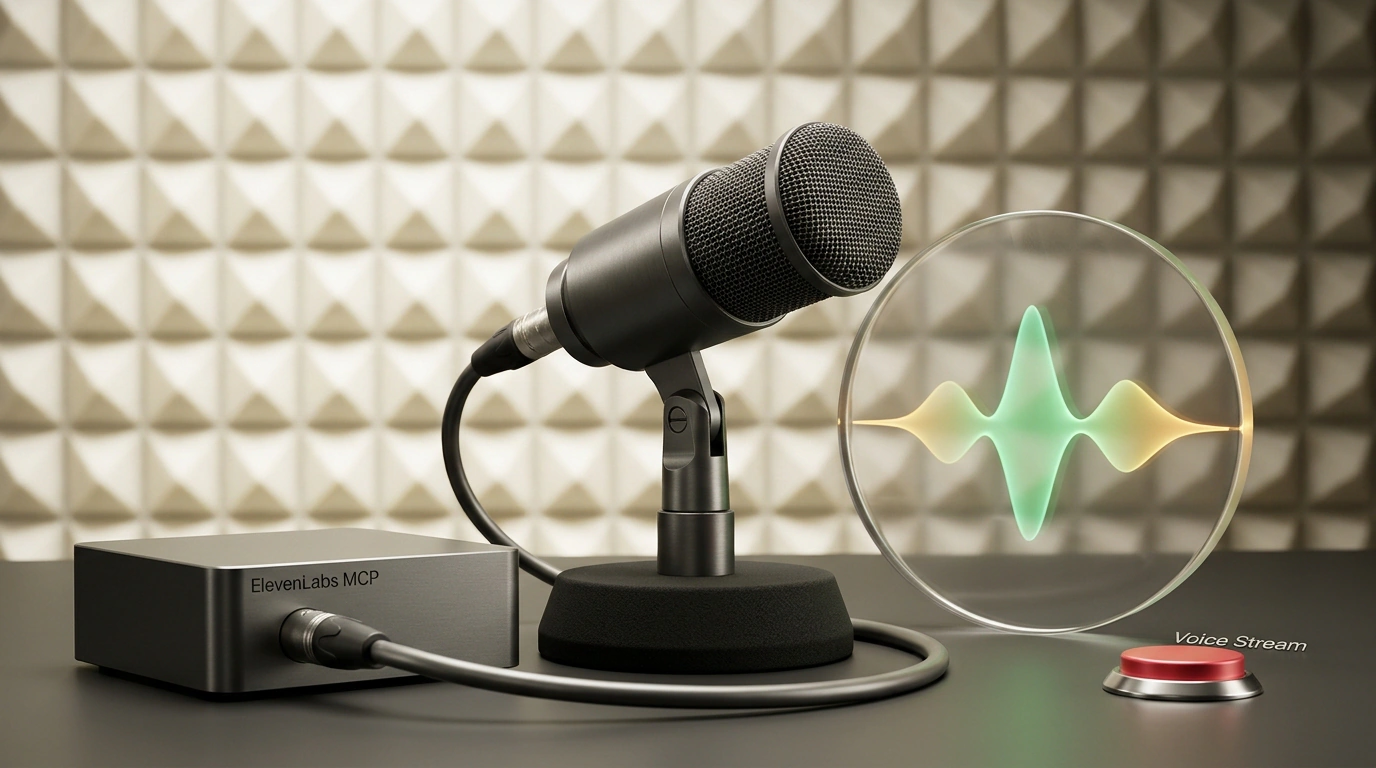
ElevenLabs, a recognized leader in realistic speech synthesis, voice cloning, and sound design, just fixed that from the ground up. The team released an official server built on the open Model Context Protocol (MCP)—elevenlabs-mcp. Now any compatible agent (in Claude Desktop, Cursor IDE, Windsurf, Claude Code, or the autonomous Hermes framework) gets a full professional audio studio in about three minutes via a standardized tool interface.
I examined the server's internals, tested both local and cloud connections, measured audio streaming latency, and tried multi-step media generation workflows. Here is what ElevenLabs MCP unlocks and how to hook it into your setup.
The Toolkit: From Speech Synthesis to Interactive Assistants
The elevenlabs-mcp server exposes a rich set of strictly typed functions straight to the language model, turning an agent into an all-around sound engineer and audio producer:
text_to_speech: Text-to-speech powered by flagship models (Eleven Multilingual v2 for crisp multilingual pronunciation, Eleven Turbo v2.5 for minimal inference latency), a deep catalog of hundreds of voices, and fine-grained control over emotional expressiveness and timbre stability.text_to_sound_effects: Studio-grade cinematic sound effects from a text prompt (pouring rain outside a window, roaring jet turbines, footsteps on gravel, futuristic UI clicks).voice_clone_instant: Instant digital voice cloning from an audio sample as short as 60 seconds.speech_to_text: High-accuracy audio transcription with word-level timestamps.create_conversational_agent: Spinning up an interactive conversational web agent with a defined persona, system prompt, and attached knowledge base.
The language model decides on its own when to call each tool. Give it an instruction like "Prepare a morning news audio digest with a warm voiceover and subtle cozy coffee-shop background ambience," and the agent first generates the ambient track, then synthesizes the narration, and merges the stems into a finished audio file.
Configuring Local and Cloud Connections
Wiring the server into a client (like Claude Desktop or a local terminal agent) uses the standard claude_desktop_config.json file.
For a local dev setup, launch the official package via npx:
{
  "mcpServers": {
    "elevenlabs": {
      "command": "npx",
      "args": [
        "-y",
        "@elevenlabs/mcp"
      ],
      "env": {
        "ELEVENLABS_API_KEY": "sk_live_your_secret_api_key_here"
      }
    }
  }
}
If you'd rather not keep a local Node.js process running—or you're configuring an agent inside a cloud VM—ElevenLabs also provides a managed hosted endpoint with token auth:
{
  "mcpServers": {
    "elevenlabs-cloud": {
      "url": "https://api.elevenlabs.io/v1/mcp",
      "auth": {
        "type": "bearer",
        "token": "sk_live_your_secret_api_key_here"
      }
    }
  }
}
Restart the client app, and every ElevenLabs method immediately appears in the agent's tool menu with full JSON Schema validation. The model sees valid numeric ranges (such as stability from 0.0 to 1.0) and supported audio formats (mp3, wav, pcm) right away.
Streaming Audio and Avatar Lip-Sync
One of the server's most sought-after features is streaming audio delivery (WebRTC / Chunked Transfer). In interactive voice assistants, latency makes or breaks the experience: wait longer than a second for sound, and the conversation feels stiff.
Pairing Eleven Turbo v2.5 over MCP delivers the first chunks of generated audio within 250–350 milliseconds after the LLM finishes generating text. Alongside the audio stream, the server can emit phoneme timing data (visemes), letting external 3D avatars or video models sync lip movements accurately in real time.
Why MCP Beats Classic API Wrappers
Open standardization via MCP shines brightest when building multi-agent pipelines. Previously, combining analytical writing in Claude, coding in Cursor, and voiceover in ElevenLabs meant maintaining bulky glue code across three incompatible SDKs.
With MCP, the architecture turns clean and modular:
- Declarative tool specs: The model reads standardized tool descriptions and plans multi-step call chains on its own without manual routing.
- Pre-flight validation: Type mismatches or missing required arguments are caught at the schema layer before a single network request fires, saving both time and quota.
- Credential isolation: Secret API keys stay safely inside the server environment and never leak into system prompts, context windows, or client logs.
- Quota and limit awareness: The server reports remaining character credits on your plan, letting the agent budget text length before calling the generator.
ElevenLabs' official MCP server is a textbook example of open standards sweeping away brittle custom scripts. Now any AI assistant can speak in a natural human voice without hundreds of lines of boilerplate glue.