The chronic curse of nearly every modern autonomous AI assistant is amnesia. You spend hours tuning a bot, explaining your project's architecture, teaching it which libraries to avoid, and dialing in its output format. Then you close the terminal, refresh the page, or restart the session—and your digital helper snaps back to factory defaults, staring at you with a blank slate.
Trying to patch this with black-box vector stores introduces a different headache: you can't see what facts the neural network actually remembered or how they're stored. Memory turns into an opaque box where hallucinations and stale notes pile up, and fixing a single bad entry by hand is impossible.
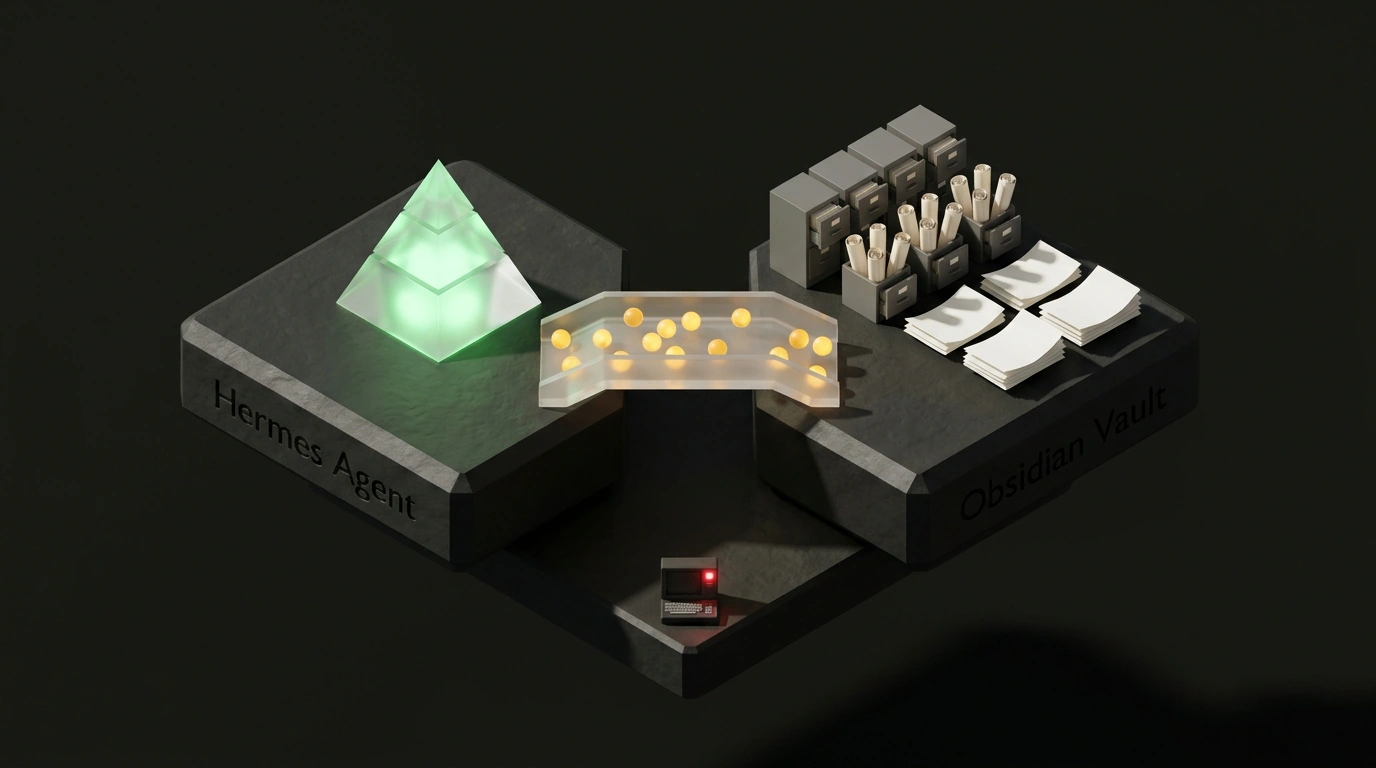
Nous Research came up with an elegant engineering fix inside its open-source Hermes Agent framework by adding native support for the popular Obsidian note editor. Now the agent's entire memory—from personal user preferences to project architecture decisions—lives as human-readable Markdown files linked together with [[Wikilinks]].
I spun up this setup locally, examined its three-tier storage model, and tested how multiple agents collaborate over one shared vault. Let's look at the architecture and how to wire shared memory for your own bot swarm.
Three-Tier Memory Model: Inside Hermes Storage
The architecture splits context cleanly across three functional layers (Split-Memory Architecture):
USER.md(Persistent User Profile): A compact file at the vault root loaded into the model's system context on every request. It holds unchanging baselines: time zone, preferred tech stack (such as "strictly TypeScript and pnpm"), communication style, security constraints, and working hours.MEMORY.md(Operational Rules and Lessons Learned): A living log of practical facts about codebases and systems that the agent updates on its own as it works. Hit a build error, and the agent writes down: "Runningnpm run buildin this repo requires Node.js v22; v20 fails with a parse error." Next time, it picks the right version immediately.state.db(Full-Text Session Archive): A local SQLite database storing complete dumps of finished conversations. When an agent needs details from a discussion a month ago, it runs a semantic search across the archive, pulls only the relevant snippet, and keeps the active context window uncluttered.
Configuring and Running the Obsidian Skill
The integration ships inside Hermes Agent as a built-in obsidian skill. To turn it on, just point it to your local vault directory:
# Bind a local Obsidian vault to the Hermes Agent configuration
export OBSIDIAN_VAULT_PATH="$HOME/Documents/SecondBrain"
hermes config set obsidian.vault_path "$HOME/Documents/SecondBrain"

# Initialize baseline profile and operational memory files
hermes memory init --template=developer-profile
If you also want to automate graph syncing and log new lessons from external scripts, a simple Python helper handles it cleanly:
import os
from pathlib import Path
import datetime

vault_path = Path(os.environ.get("OBSIDIAN_VAULT_PATH", Path.home() / "Documents/SecondBrain"))

def record_agent_lesson(topic: str, lesson_text: str, source_card: str = ""):
    """Appends an agent-learned lesson to MEMORY.md with a cross-reference."""
    memory_file = vault_path / "MEMORY.md"
    today = datetime.date.today().isoformat()

    new_entry = f"\n- **[{today}] {topic}:** {lesson_text}"
    if source_card:
        new_entry += f" (см. [[{source_card}]])"

    with open(memory_file, "a", encoding="utf-8") as f:
        f.write(new_entry)

    print(f"[Hermes Memory] Урок успешно зафиксирован в Obsidian: {topic}")

# Example: logging a lesson after refactoring a microservice
record_agent_lesson(
    topic="Миграция схемы Redis",
    lesson_text="Пул соединений в кластере требует keepalive-интервал 30s во избежание сброса сессий",
    source_card="infrastructure-redis-tuning"
)
Knowledge Graph Transparency and Swarm Memory
The biggest win of pairing Hermes with Obsidian is total transparency. You can open Obsidian at any time, switch on Graph View, and visually trace how projects, bugs, and architectural decisions connect. If an agent remembers something wrong, you don't retrain a model or wipe a vector DB—you just open a plain text file, fix the line by hand, and hit save.
Better yet, one Obsidian vault can serve as a shared brain for an entire swarm of agents:
- A research agent monitors news and drops summaries into
/Research. - A developer agent reads those briefs, writes code, and leaves a report in
/Engineering. - A QA agent runs tests, updates task statuses, and adds cross-links.
All of them coordinate through shared files and standard Wikilinks—no tangled coordination protocols required.
Hermes Agent plus Obsidian hands control of your data back to you. Long-term memory stops being an empty marketing buzzword and becomes a dependable, transparent local tool for daily work.