The biggest roadblock keeping autonomous AI agents out of real-world web workflows has always been personal data security. Suppose you set up a smart bot to monitor airfare deals, book hotels, or reorder office supplies. The moment it hits a login screen or checkout form, everything grinds to a halt: handing a language model your plaintext passwords or credit card number is pure security madness. One hidden prompt injection on a third-party page could trick the model into leaking your credentials to an attacker.
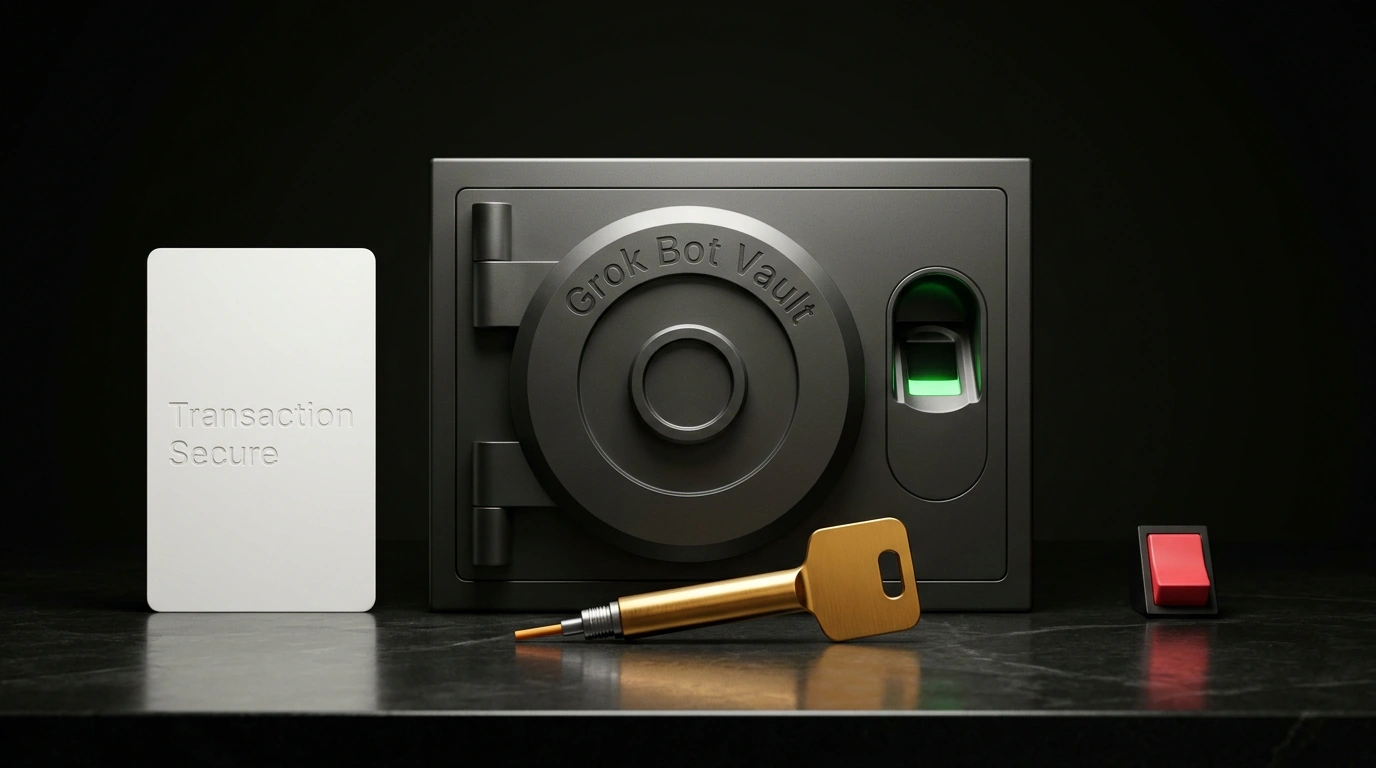
xAI's Grok Bot team tackled this with a dedicated security module—Grok Bot Vault (available starting in v0.75.2). It's an isolated hardware-backed store for logins, payment cards, and personal profiles built on a Zero-Knowledge Architecture. The language model never sees raw passwords or CVV codes: it works strictly with abstract vault references, while an isolated browser system daemon fills out forms on target sites.
I tested the Vault architecture, inspected its encryption scheme, ran an end-to-end checkout flow, and uncovered one critical caveat ("The Catch") that anyone trusting an agent with real company money needs to know. Let's unpack every detail.
Zero-Knowledge Architecture: How Secrets Stay Isolated
Grok Bot Vault rests on a strict wall between the model's reasoning loop and physical access to private secrets:
- Credential Store: You can import logins and passwords from popular managers (1Password, Bitwarden, Apple Keychain via standard CSV export), each bound strictly to allowed domain patterns (such as
*.amazon.comor*.booking.com). - Payment Details: Card numbers, expiration dates, and CVV codes are encrypted with AES-256-GCM and Argon2id key derivation.
- Secure Autofill: When an agent reaches a login or checkout page, it never reads the password from the database. Instead, it calls
vault.autofill(entry_type="credit_card"). The background browser daemon verifies the current URL against the allowed domain mask, types the credentials directly into the input fields, and returns only a boolean confirmation to the model:{"success": true}.
Here is what a Vault entry manifest looks like:
{
  "vault_entry_id": "ent_987412ab",
  "domain_pattern": "*.amazon.com",
  "entry_type": "web_login_and_payment",
  "encryption": {
    "algorithm": "AES-256-GCM",
    "key_derivation": "Argon2id"
  },
  "permissions": {
    "allowed_bots": ["procurement-bot-01"],
    "require_user_approval_for_checkout": false
  }
}
On the agent script side, triggering checkout takes just a few safe lines with zero direct access to private keys:
async def execute_checkout(page_context, order_total_usd):
    # The agent never sees the card number; it triggers a system autofill call
    autofill_result = await page_context.vault_autofill(
        entry_type="credit_card",
        match_domain=True
    )
    if not autofill_result["success"]:
        raise SecurityException("Не удалось применить платежные реквизиты из Vault: несовпадение домена")

    # Complete the transaction by clicking the site's native checkout button
    await page_context.click("button#place-order")
    return {"status": "order_placed", "charged_amount": order_total_usd}
Role-Based Access and Team Audit Trails
In enterprise setups, a single Vault may serve dozens of bots and employees. To keep chaos at bay, xAI built in role-based access control (RBAC):
- Bot ID Binding: In
allowed_bots, an admin explicitly lists which virtual agents are permitted to invoke a given entry. - Immutable Audit Trail: Every Vault access attempt is logged to a tamper-evident audit log recording the exact timestamp, agent ID, target URL, and autofill outcome.
- Instant Credential Rotation: When a service password changes, the admin updates it once in the Vault UI, and every linked bot picks up the fresh credential immediately without touching code.
The Main Gotcha: Auto-Charging Without Confirmation ("The Catch")
Now let's talk about the fly in the ointment that xAI experts call "The Catch." Reviewing the operational rules turned up a critical architectural detail: cards saved in Vault are applied and confirm payment automatically without a mandatory push notification per transaction unless a specific safeguard is enabled in the bot's config.
Picture this: you tell a bot to buy a batch of cables priced under 5,000 rubles. It lands on a supplier's site, misses a layout quirk showing the price per unit instead of per pack—or overlooks an expensive courier fee—triggers autofill, clicks Pay, and money leaves your card instantly with no SMS confirmation.
To shield yourself and your company from expensive surprises, stick to two golden rules of digital hygiene:
- No primary payroll cards: Never link your main debit card or a high-limit credit card to Vault. Use virtual cards only, locked with a strict daily spending cap (for example, no more than 5,000 rubles per day) and overdraft disabled.
- Approval Gate: For meaningful purchases, always set
require_user_approval_for_checkout: true. The bot will fill out the form, pause right before the final click, and send a screenshot of the cart to your messenger for explicit sign-off.
Grok Bot Vault solves one of the hardest problems on the autonomous web. It's a mature leap toward genuine AI assistants—provided users pair it with grown-up risk awareness and tight financial limits.