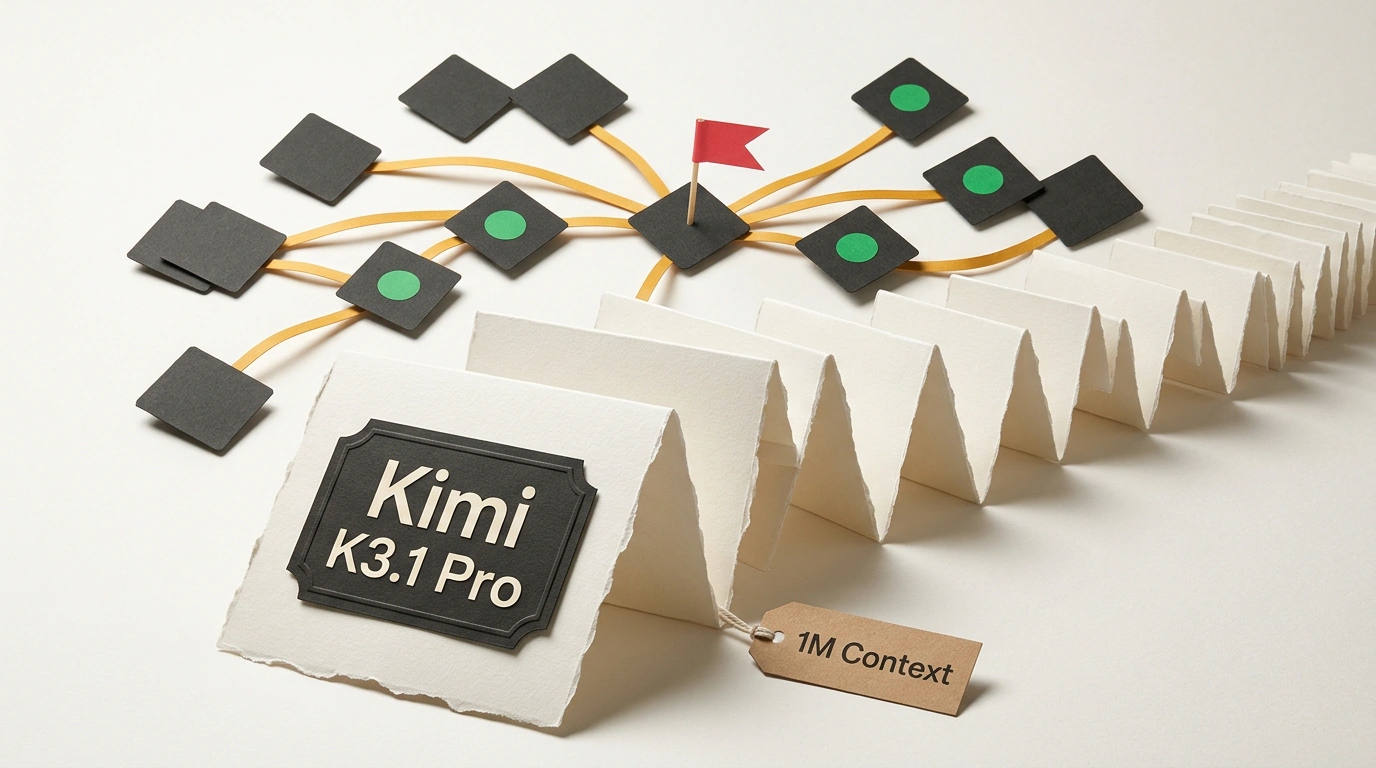
A genuinely historic milestone just landed in open-source AI. Chinese research lab Moonshot AI officially released the open weights for its flagship multimodal language model, Kimi K3.1 Pro. This isn't just another mid-sized open release: it's an architectural giant in the Mixture-of-Experts (MoE) class packing 2.8 trillion total parameters.
What really stands out is the engineering optimization underneath: despite that colossal total footprint, generating each token activates a dynamic pool of just 104 billion parameters. The model supports a native 1-million-token context window, chewing through hundreds of pages of dense documentation, entire code repositories, and long multimedia recordings without breaking a sweat. Weights are already live on Hugging Face and ModelScope, and leading open inference engines (vLLM, SGLang, TensorRT-LLM) shipped day-one support.
I read through Moonshot AI's technical report, checked hardware requirements, tested inference via vLLM, and compared its numbers against top closed models. Let's see how this sparse architecture works and how to deploy a system of this scale on your own servers.
The K3 Architecture Stack: Delta Attention and Stable LatentMoE
The classic roadblock for trillion-parameter neural networks is staggering RAM and compute demand. If K3.1 Pro were a traditional dense model, running it would require supercomputer clusters costing tens of millions of dollars. Moonshot AI solved that at two foundational layers:
- Kimi Delta Attention (KDA) paired with Gated MLA (Multi-head Latent Attention): In standard attention, the KV-cache grows strictly linearly with context length, devouring hundreds of gigabytes of VRAM as you approach a million tokens. KDA's hybrid design compresses hidden-state projections into a compact latent space, shrinking the KV-cache by 4–6x compared to standard Multi-Head Attention. That lets the model hold its train of thought and reliably pull "needles from the haystack" even at an extreme depth of 900,000 tokens without logic decay.
- Stable LatentMoE routing: The architecture houses 256 specialized expert networks, dynamically picking the 8 most relevant experts per input token. To prevent "expert collapse"—where a couple of popular blocks get overloaded while the rest sit idle—engineers added latent load balancing with an auxiliary entropy penalty, keeping traffic smooth and evenly distributed.
Deploying and Running Inference with vLLM
For serving Kimi K3.1 Pro inside an enterprise perimeter, the optimized vLLM engine has become the de facto standard. Using tensor parallelism and weight quantization, you can spread the model cleanly across multi-GPU server nodes running NVIDIA H100 or H200 accelerators.
Here is a minimal, verified Python script to initialize the model and run distributed inference:
from vllm import LLM, SamplingParams

# Initialize distributed inference for Kimi K3.1 Pro across two nodes
llm = LLM(
    model="moonshotai/Kimi-K3.1-Pro",
    tensor_parallel_size=8,
    pipeline_parallel_size=2,
    max_model_len=131072, # Baseline inference window for enterprise production
    trust_remote_code=True,
    gpu_memory_utilization=0.92
)

sampling_params = SamplingParams(
    temperature=0.6,
    top_p=0.95,
    max_tokens=4096,
    repetition_penalty=1.05
)

prompt = "Проведи архитектурный аудит распределенного хранилища данных и составь план миграции на PostgreSQL 18:"
outputs = llm.generate([prompt], sampling_params)

for output in outputs:
    print("Ответ Kimi K3.1 Pro:")
    print(output.outputs[0].text)
To spin up a lighter OpenAI-compatible REST API server using 4-bit FP4/AWQ quantization—squeezing the model onto more accessible server setups—run this CLI command:
# Launch a high-throughput Kimi K3.1 Pro API server via vLLM CLI
python3 -m vllm.entrypoints.openai.api_server   --model moonshotai/Kimi-K3.1-Pro-FP4   --tensor-parallel-size 8   --max-model-len 65536   --port 8000   --gpu-memory-utilization 0.95   --enforce-eager
That gives you a local endpoint ready to plug into everyday tools—from Cursor, Cline, and Continue to internal multi-agent pipelines.
Closed API Comparison and Practical Boundaries
In independent tests covering coding, mathematical analysis, and ultra-long document summarization, Kimi K3.1 Pro posts scores right alongside closed commercial flagships like GPT-4o and Claude 3.5 Sonnet:
- On 1M-token needle-in-a-haystack retrieval tests, accuracy tops 98.4%.
- On coding benchmarks SWE-bench and HumanEval, it handles multi-file refactoring, dependency bug hunting, and comprehensive unit-test generation cleanly.
- For teams without their own GPU racks, Moonshot AI also offers a high-speed cloud API tier, Kimi Highspeed, priced below $0.50 per million input tokens.
The main barrier to self-hosting K3.1 Pro is hardware. Even quantized to 4-bit, the model requires at least 8 H100-class GPUs (80GB) for a full deployment, ruling out consumer desktop cards. Still, for large fintechs, banks, and telecoms bound by strict compliance rules that forbid sending data outside their private perimeter, Kimi K3.1 Pro's open weights are a lifeline: world-class AI inside a closed network with zero dependence on external US clouds.