Producing quality video with generative AI used to feel like a fragmented chore. A creator had to bounce across disconnected apps: write scripts and timings in one tool, generate reference frames in another, run clips through video generators (Runway, Luma, Kling), and then drag dozens of fragments into Premiere or DaVinci Resolve for color grading, sound, and manual splicing.
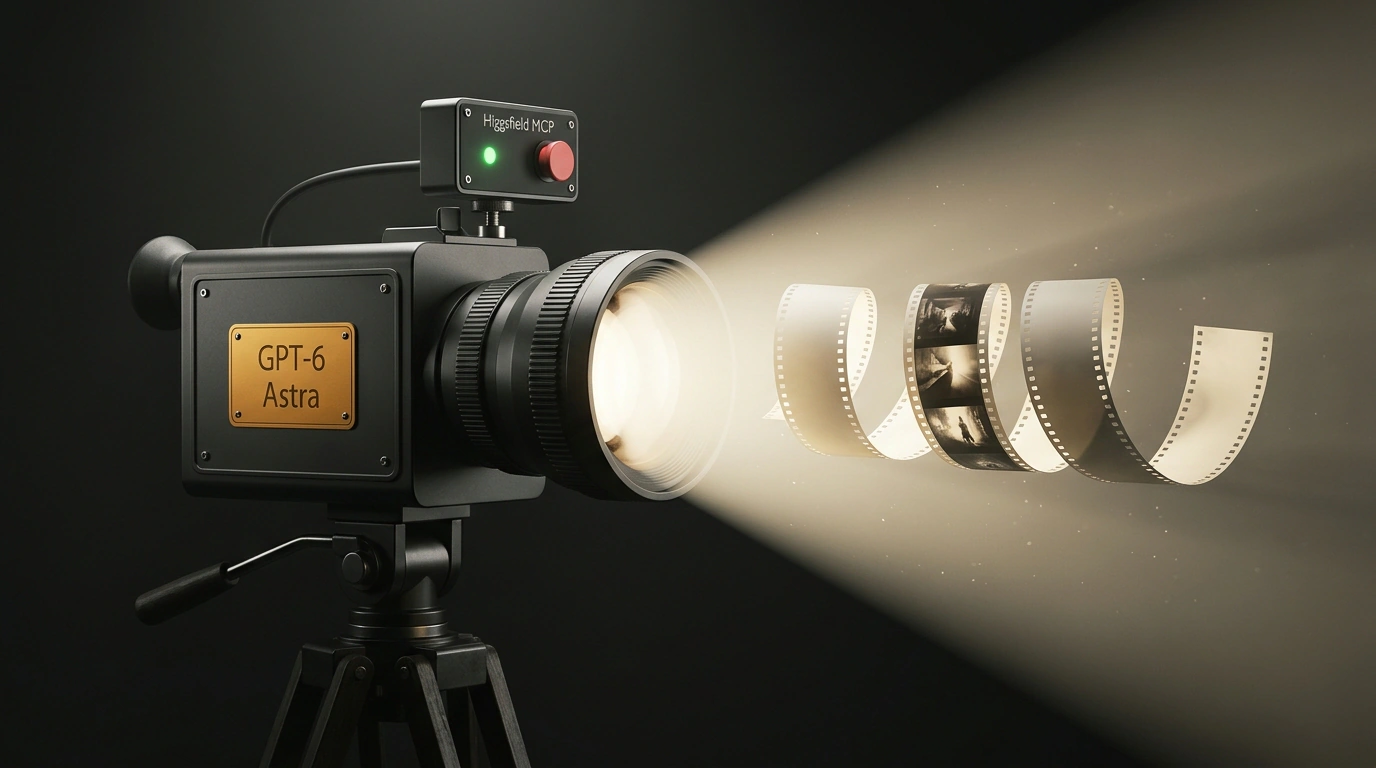
With Higgsfield AI releasing an official Model Context Protocol (MCP) server and wiring it into OpenAI GPT-6 Astra, video production just stepped up to end-to-end automation. In this setup, GPT-6 Astra acts as the virtual director and screenwriter, while Higgsfield MCP serves as the soundstage and virtual camera operator.
I explored the architecture, configured the server manifest in an agent environment, and tested assembling a multi-scene demo clip from a text script. Let's look at how the pipeline works and how to generate cinematic scenes from a single prompt.
Division of Labor: Virtual Director and Physical Renderer
End-to-end production relies on a crisp split between narrative logic and video rendering:
- GPT-6 Astra (Director & Screenwriter): Analyzes the creative brief, shapes the dramatic arc, breaks the story into timed scenes, writes voiceover narration, and plans camera moves (pans, dollies, lens tilt angles).
- Higgsfield MCP (Execution Video Engine): Accepts typed commands over MCP, drives generative models (including specialized Seedance v2 Cinema architectures), maintains character facial consistency across cuts, and computes smooth camera trajectories.
Manifest Setup and Programmatic Tool Calls
Hooking Higgsfield MCP into an agent environment (like Claude Desktop or a local Python agent) uses a standard JSON config:
{
  "mcpServers": {
    "higgsfield-video": {
      "command": "npx",
      "args": ["-y", "@higgsfield/mcp-server"],
      "env": {
        "HIGGSFIELD_API_KEY": "hg_live_981248abcdef0123456789",
        "DEFAULT_VIDEO_MODEL": "seedance-v2-cinema",
        "DEFAULT_RESOLUTION": "1080p"
      }
    }
  }
}
At execution time, GPT-6 Astra emits a structured tool call detailing camera motion and character consistency:
import json

# Agent-generated Higgsfield MCP tool call to render a scene
tool_call_payload = {
    "tool": "higgsfield_generate_scene",
    "arguments": {
        "prompt": "Кинематографичный пролет камеры над залитым неоновым светом ночным городом, отражения на мокром асфальте, фотореализм",
        "duration_seconds": 6,
        "camera_motion": {
            "pan": "left_to_right",
            "zoom": "in_smooth",
            "speed": "moderate",
            "angle_pitch_degrees": -15
        },
        "character_consistency": {
            "avatar_id": "cyber_detective_male_01",
            "keep_clothing": True
        }
    }
}

print("[Higgsfield MCP] Запуск рендеринга сцены с кинематографической траекторией...")
print(json.dumps(tool_call_payload, ensure_ascii=False, indent=2))
Virtual Camera Control: From Push-Ins to the Vertigo Effect
Higgsfield's edge over conventional video generators is precision camera control. Instead of random warping, the agent passes physical motion vectors:
- Pan & Tilt: Horizontal panning and vertical tilting at an exact angular speed.
- Dolly Zoom (Vertigo Effect): Simultaneous optical zoom and physical camera push-in, warping perspective dramatically.
- Orbit 360: Full circular fly-around keeping focus locked on the subject.
- Optics Simulation: Simulating anamorphic cinema lenses with signature horizontal flares and shallow bokeh.
Temporal Consistency and the "Nothing Real" Demo
Generative video's classic curse has always been "face-hopping": a character's face shifts from shot to shot, outfits morph, and props melt into thin air.
Higgsfield solves that with persistent digital avatar IDs (avatar_id). The agent attaches a character's latent vector to every generation call, ensuring facial features, hair, and wardrobe stay locked across the entire video.
A vivid showcase of this pairing is the viral short film demo "Nothing Real", directed end-to-end by GPT-6 Astra through Higgsfield MCP commands:
- Script, storyboard, and camera motion parameters were generated in a single pass.
- The agent rendered 8 sequential scenes with smooth transitions.
- Manual artifact trimming and color-matching were eliminated completely.
- The virtual camera executed complex cinematic paths without losing subject sharpness.
GPT-6 Astra plus Higgsfield MCP offers a clear glimpse of media's future: the one-person studio becomes real, with AI handling technical rendering while the human keeps pure creative direction.