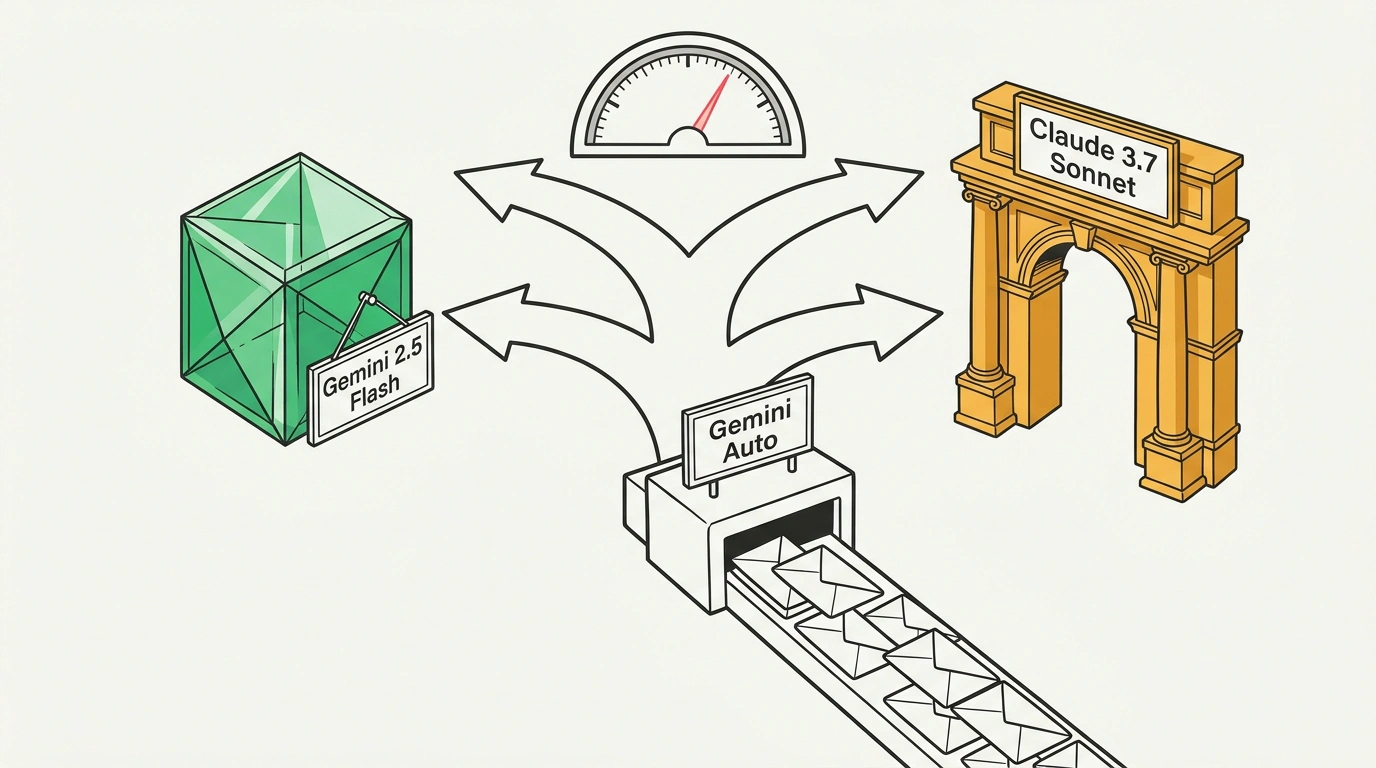
Enterprise AI engineering has been quietly heading toward an efficiency crunch. Systems architects face a daily trade-off: route every incoming request to heavy frontier models (like Claude 3.5 Sonnet or GPT-6), and your token budget melts while simple queries feel sluggish; shift the whole pipeline onto ultra-light, fast models (like Gemini Flash), and the system stumbles and hallucinates on tricky math, deep security audits, and architectural code reviews.
At the Gemini at Work conference, Google Cloud unveiled a pragmatic answer: serverless API Gateway Model Routing with an enterprise Auto Mode. The real surprise isn't just the router—it's that Google dropped the single-vendor ego. The gateway dynamically routes traffic not only across Gemini tiers, but also to rival Anthropic Claude models hosted in Vertex AI Model Garden.
I examined the gateway's architecture, read through the OpenAPI manifest spec, and tested automated traffic splitting on real workloads. Let's see how this smart switch works and how to wire dynamic model balancing into your stack.
Inside the Server-Side Complexity Classifier
Rather than forcing teams to maintain brittle hand-written rules or train local classifiers, Auto Mode pushes routing logic straight into a managed, serverless Google Cloud proxy gateway.
Every incoming request is scored in fractions of a millisecond by a lightweight arbiter model across a few core signals:
- Semantic complexity: Routine jobs (sentiment tagging, named-entity extraction, translation, table formatting) go straight to high-speed Gemini 4 Flash.
- Context length and multimodality: Payloads packing long videos, hundreds of PDF pages, or massive log dumps over 128,000 tokens route to long-context flagship Gemini 4 Carbon with its 2-million-token window.
- Complex refactoring and architecture analysis: When a prompt involves multi-file dependencies, deep reasoning, or intricate logic design, the gateway seamlessly hands the session to Anthropic Claude 3.5 Sonnet.
To client apps, the gateway looks like a single unified endpoint fully compatible with the OpenAI Chat Completions spec. Developers don't have to rewrite application code—just update a declarative manifest.
Declarative Routing Spec and Client Code
Traffic-balancing rules are defined using standard OpenAPI 3.x with Google's x-google-api-management enterprise extension:
openapi: 3.0.0
info:
  title: Enterprise AI Model Router
  version: 1.0.0
paths:
  /v1/chat/completions:
    post:
      summary: Unified Auto Routing Endpoint
      x-google-backend:
        address: https://vertexai-router.googleapis.com/v1/auto
      x-google-api-management:
        routing_strategy:
          default_model: "gemini-4-flash"
          rules:
            - match:
                intent: "code_refactor_or_complex_reasoning"
                min_complexity_score: 0.75
              target_model: "anthropic.claude-3-5-sonnet"
            - match:
                context_length_tokens_gt: 128000
              target_model: "gemini-4-carbon"
On the client side, calling the unified Python gateway couldn't be simpler:
import os
from openai import OpenAI

# Connect to the Google Cloud Vertex AI gateway via the OpenAI-compatible interface
client = OpenAI(
    base_url="https://gateway.endpoints.my-enterprise-project.cloud.goog/v1",
    api_key=os.environ["VERTEX_ROUTER_API_KEY"]
)

# Request with model="auto": the gateway picks between Flash, Carbon, and Claude
response = client.chat.completions.create(
    model="auto",
    messages=[
        {"role": "system", "content": "Ты корпоративный инженерный ассистент."},
        {"role": "user", "content": "Проанализируй этот pull request, выяви потенциальные гонки данных в горутинах и предложи архитектурный патч."}
    ],
    temperature=0.2
)

# Response metadata includes the actual model invoked
actual_model = response.model
print(f"[Маршрутизатор сработал] Задача выполнена моделью: {actual_model}")
print(response.choices[0].message.content)
In the response headers, the gateway returns the exact model that handled generation along with the classifier's complexity score—making it easy to track analytics and fine-tune switching thresholds.
Economics and Enterprise Security
Switching on Auto Mode delivers immediate financial relief. In typical enterprise workloads, 70% to 85% of user and agent requests are straightforward enough for inexpensive Gemini 4 Flash to handle effortlessly. Offloading that volume from heavy models cuts overall API spend by 60–75%.
Meanwhile, running Claude through Google Cloud's infrastructure solves the top headaches for corporate legal and security teams:
- Every request executes inside the company's private virtual cloud (VPC Service Controls).
- Strict Cloud IAM permission boundaries apply across the board.
- Customer data is guaranteed never to be used for external model training.
- Every transaction is logged end-to-end in Cloud Audit Logs with IP addresses and user IDs.
Auto Mode in Google Gemini proves the era of multi-model pragmatism has arrived: the future belongs not to isolated vendor monopolies, but to smart gateways that pull the best out of every leading model.