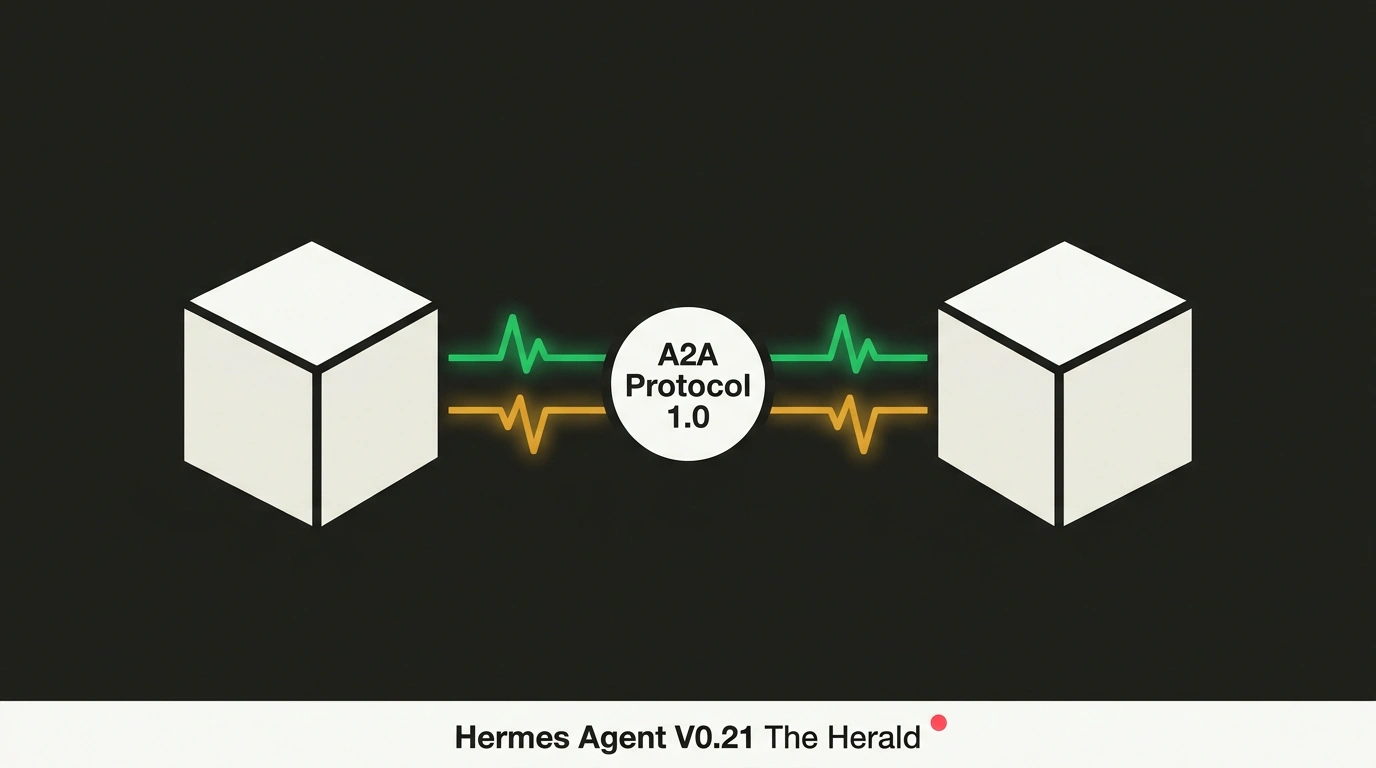
Applied AI suffered for a long time from stubborn fragmentation. Every major vendor or open-source framework lived on its own isolated island: bots inside one library chatted happily with each other, yet couldn't say a word to agents from a neighboring ecosystem. If you ran a data-analysis agent on LangGraph, a QA agent on CrewAI, and a local CLI worker, teaching them to exchange tasks safely over a network was a major engineering headache.
Nous Research took a foundational step toward connecting those islands with Hermes Agent V0.21, codenamed "The Herald Release." Its centerpiece is an open specification and implementation of the Agent-to-Agent Protocol v1.0 (A2A)—tearing down walls between closed systems and turning agents into full-fledged network services.
The release also ships an ultra-low-latency local voice inference module and deterministic citation verification. I spun up a Hermes network node, tested A2A over a local network, and checked how well its fact-checking holds up on real tasks. Let's unpack these architectural additions.
Bidirectional A2A 1.0: Every Agent as Both Client and Server
A2A v1.0 turns each running agent into an independent network node communicating via JSON-RPC over HTTP and WebSockets. A Hermes Agent can operate in two network modes simultaneously:
- Server Mode: Hermes opens a secured network socket, publishes its skill manifest at
GET /a2a/v1/capabilities, and listens for incoming jobs atPOST /a2a/v1/tasks. External scripts, CI/CD pipelines, or remote bots can delegate work to it using cryptographic token auth. - Client Mode: The agent discovers other A2A-compatible nodes on the local network or through a corporate service registry. To the model, a remote agent looks like an ordinary local tool: it simply calls
delegate_task(target="agent-lawyer", input={...})without worrying about network routing or serialization.
During the handshake, nodes exchange cryptographic signatures and capability manifests—ensuring a code-compilation job never accidentally lands on a bot that only formats prose.
Socket Configuration and Python Client Call
Setting up an A2A server in hermes.config.json is clean and concise:
{
  "a2a_server": {
    "enabled": true,
    "listen_host": "0.0.0.0",
    "listen_port": 7443,
    "auth_token_hash": "sha256:d8e8fca2dc0f896f7e8a9b1c2d3e4f5a6b7c8d9e0f1a2b3c4d5e6f7a8b9c0d1e",
    "advertised_name": "Hermes-Security-Auditor",
    "capabilities": ["static_analysis", "test_generation", "vulnerability_scan"]
  }
}
Calling a remote agent over A2A from the client side takes a straightforward async Python script:
import httpx
import json

async def delegate_to_remote_agent(remote_url: str, task_payload: dict, auth_token: str) -> dict:
    """Delegates a task to a remote A2A agent with citation verification enabled."""
    headers = {
        "Authorization": f"Bearer {auth_token}",
        "Content-Type": "application/json"
    }
    payload = {
        "protocol": "a2a-v1.0",
        "task_id": "task_20261030_sec_01",
        "action": "execute_task",
        "input": task_payload,
        "require_citation_verification": True
    }

    async with httpx.AsyncClient(timeout=60.0) as client:
        response = await client.post(f"{remote_url}/a2a/v1/tasks", headers=headers, json=payload)
        response.raise_for_status()
        result = response.json()
        print(f"[A2A Узел] Задача принята удаленным агентом: {result.get('worker_node')}")
        return result
Real-Time Voice Inference: Beating Latency
The second major addition in V0.21 is a built-in local Real-Time Voice Engine. Previously, talking to an agent by voice meant chaining three cloud APIs: audio went to Whisper for transcription, text went to an LLM, and the reply went to a speech synthesizer. That triple hop added two to four seconds of lag, turning conversation into an awkward wait.
Hermes V0.21 uses a lightweight direct voice inference stack built on an optimized llama.cpp engine. The model works directly on raw audio streams over WebSockets. On a standard workstation with an RTX 4090-class GPU, conversational Voice Latency drops to 280–350 milliseconds. You speak into the mic and the agent answers right away, without uncomfortable dead air.
Deterministic Citation Verification
One of the sneakiest flaws in analytical AI agents is reference hallucination. A model can write a crisp report while attributing a quote to a nonexistent author or citing a line number in a file that actually holds completely different code.
In Hermes V0.21, Nous Research added a strict deterministic string validator—the Citation Verification Harness:
- Whenever an agent includes a quote or source reference, the validator intercepts the outgoing message before it reaches the user.
- The system automatically fetches the referenced document or repo file, extracts the cited span, and computes its Levenshtein distance.
- If the quote matches the original at over 95% accuracy, the reply passes and earns a green verification badge.
- If the quote is garbled or missing from the source, the validator blocks output and bounces the task back to the agent with a system warning: "Citation verification failed: snippet not found in file. Re-check the facts."
Hermes Agent V0.21 lays the groundwork for an Agentic Internet—where A2A 1.0 breaks down silos and lets diverse systems form distributed networks with verifiable accuracy.