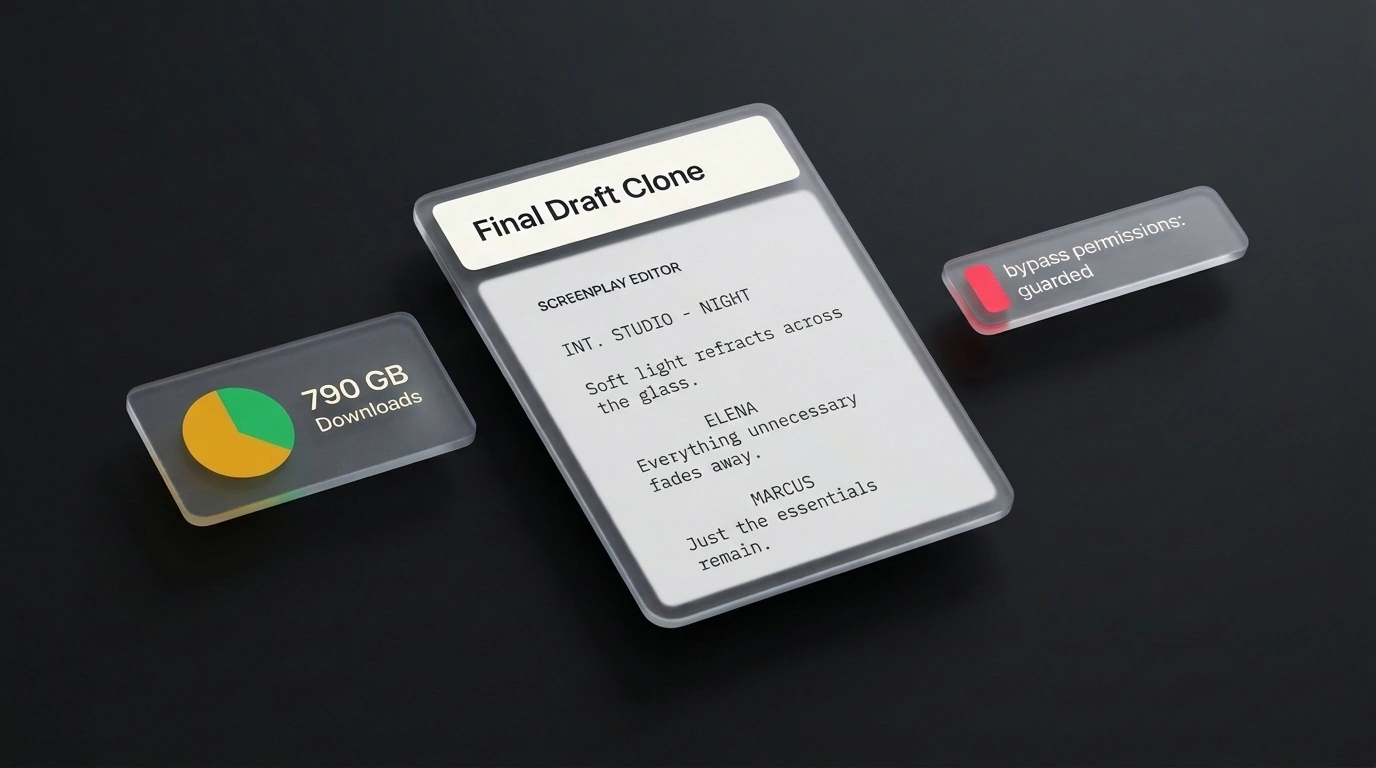
"I saw a director friend using a Hollywood screenwriting app that costs $200 a year, said 'no way am I paying for that,' and built my own in three prompts."
With that line, Riley Brown showed how artifacts in Claude Code have outgrown the 'cloud office' format. Anthropic has already officially launched Claude Whiteboards, Sheets, and Data and Claude Design, yet the real shift is happening inside Claude Code. There, all seven artifact types (Whiteboard, Design System, Design, Slides, Document, Data, Sheets) work directly on top of your local folders, terminal, and plugins.
Local Disk Access and Edits via @Claude
Unlike a browser chat, Claude Code sees the real files on your computer. Riley asked it to scan his drive and build a Clear first tab in Sheets. The agent immediately spotted 790 GB in the Downloads folder—mostly heavy 3D video renders. One comment right inside the spreadsheet—@Claude, can we make this a pie chart?—turned the numbers into an interactive pie chart with hover tooltips.
Pairing two artifacts in one sidebar, which Riley calls the Session Rail, works just as smoothly. In a single session, you have a text Document and a Design board open side by side. You write text, tag @Claude right inside a paragraph, and the agent running on Claude Opus 5.5 writes code to draw matching illustrations, places them on Design, and inserts them into your doc. Don't like one image? Click it, type 'Redo it', and the agent regenerates just that block.
Ephemeral Software in Three Prompts
From there, the line between a document and a finished app disappears. This approach is called ephemeral software: narrow utilities a team spins up with AI for a specific job instead of buying a subscription—and happily throws away once the job is done.
The Final Draft (~$200/year) case makes the point. Riley writes short-film scripts with his team, so in his first prompt he asked Claude Code to build a web clone of Final Draft, push the code to GitHub, deploy the site on Vercel, and connect a Convex database. As he puts it, the gap between an artifact and a live web service is now almost zero: three words—GitHub, Vercel, and Convex—get you there, and all three have free starter tiers.
Two quick follow-up prompts later, a team script editor went live on finaldraftriley.app. The agent looked up standard shortcuts on its own (Enter for character and dialogue, Tab for parentheticals), added real-time collaboration, printing, and PDF export. It even added a feature Final Draft doesn't have: pasting images directly into scene comments. From one example, the broader rule is clear: any useful artifact can become an internal web tool in a single evening.
The Cost of Speed: Where to Draw the Trust Line
The upside is obvious—save $200 a year and get a tool tailored to your habits. The price of that speed is taking security seriously.
The first trap shows up right in the prompt for finaldraftriley.app: Riley disabled authentication (no auth needed) because only a couple of people use the app. That works for a private draft, but on anything holding client data or sitting on a public link, skipping auth leads straight to a leak.
The second risk is bypass permissions mode, where the agent runs terminal commands and edits files without asking. Riley praises it for total freedom, yet that is the exact catch: one bad command or prompt injection can wipe a working folder before you can hit stop.
When it came to money, though, Riley drew a hard line. Using Claude Code, he built a custom MCP server—a software bridge to his business bank account API. The agent checks balances, looks up exchange rates, and prepares draft batch payouts in pounds, euros, and Australian dollars. Even so, a human always makes the final click.
- Give the agent drafts and analysis: disk cleanups, summaries, rate checks, and preparing draft payments.
- Keep irreversible actions human-only: sending money, deleting files, and accessing services with someone else's data.
Two more steps are right ahead: Team plans are already testing Claude Motion (turning dashboards into animated videos with narration and MP4 export), while Claude Remote, shown in the walkthrough, gives you phone access to local sessions while Claude Fable 5.2 and Opus 5.5 finish building your next tool at home.