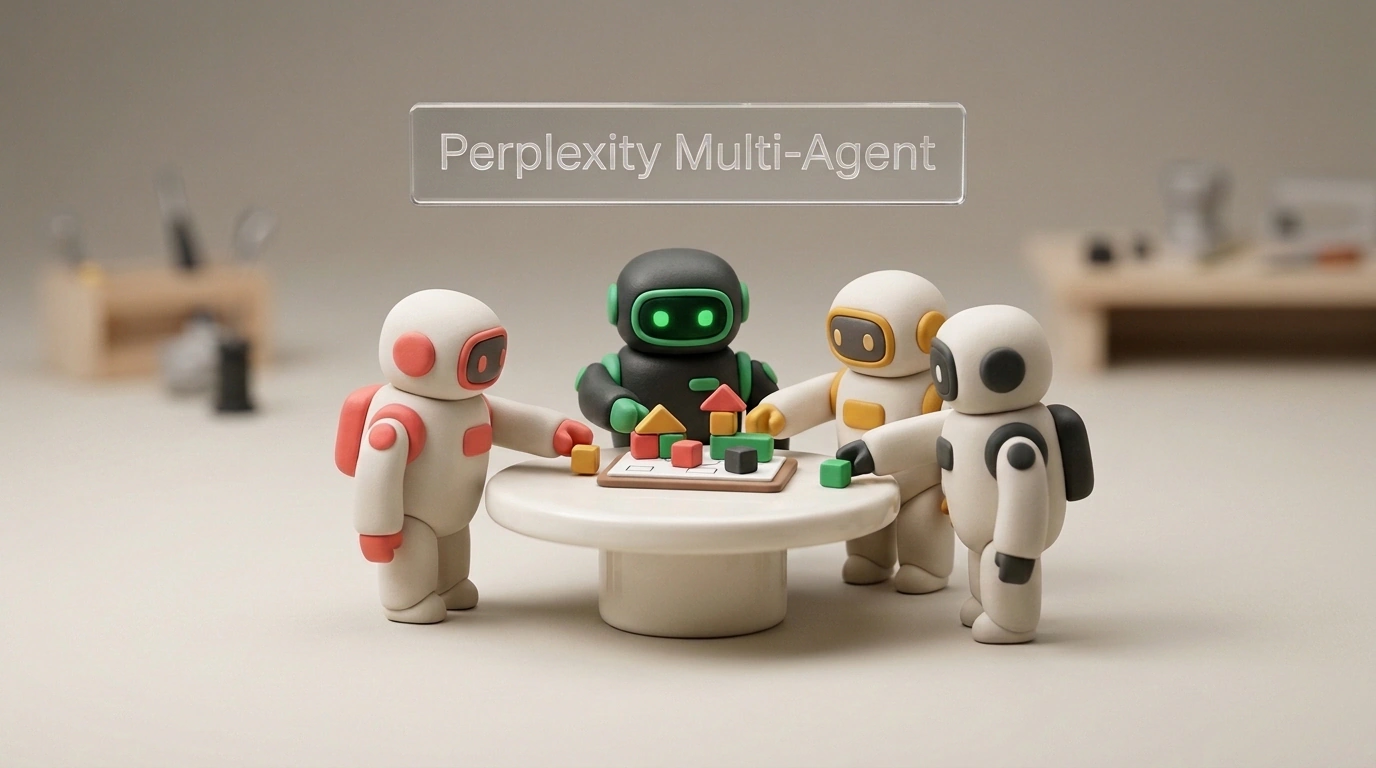
Anthropic, OpenAI, and Google spend billions trying to prove whose flagship is smarter. On November 17, 2026, Perplexity sat their top models around the same table. Inside Perplexity Computer (and the Teammates tool), it launched Multi-Agent mode—a new top notch on the effort slider, sitting right above Ultra. Then came a second twist: the company released its strongest setup and immediately advised users to turn it on as rarely as possible.
For context, Perplexity Computer handles multi-step work like deep research, data analysis, or app building. In September 2026, it introduced four effort levels capped at Ultra. Now a fifth sits on top, and it's not just about 'thinking a bit longer'.
How the Crew Is Built and Why Agents Argue
Under the hood runs multi-agent orchestration, where one lead model splits a big task into pieces, assigns helpers, and pulls the final answer together. In Multi-Agent, a default quartet from three rival labs starts the job: lead model Claude Fable 5.2 (makes the plan, does part of the work, and merges the result) plus three helpers—Claude Opus 5.5, GPT-6.1 Sol, and Gemini 4 Carbon.
You aren't locked into that lineup; you can name specific models right in your prompt. When a job needs backup, Fable 5.2 and GPT-6 Astra join in, and the lead can spin up to 16 agents at once.
The real hook is cross-checking. Different model families have different blind spots, so these agents don't sit in separate silos. They talk directly: tossing evidence back and forth, challenging each other's assumptions, flagging mismatches, and coordinating edits in shared files. Meanwhile, you don't have to juggle sixteen chats—you talk only to the lead in one thread. Ask a follow-up, and it pings the right agents so the team picks up from where it left off. The UI shows which models are active, and stopping the thread halts all of them at once.
Ultra, Model Council, and Multi-Agent: What's the Difference?
Perplexity now has three similar-sounding modes, including Model Council (which sends one prompt to several models independently so you can compare answers). In practice, they solve different problems.
| Mode | How Work Is Organized | Do Models Talk to Each Other? | Best Suited For |
|---|---|---|---|
| Ultra | Lead assigns subtasks to helpers | No, reports go only to the lead | Complex multi-step tasks without cross-review |
| Model Council | Several models answer separately | No, the system just summarizes agreements and disputes | Debatable judgment calls where you want independent views |
| Multi-Agent | Up to 16 agents across rival flagships | Yes, they share evidence, debate, and edit shared files | Heavy research and large builds with tightly linked parts |
The easiest way to remember it: Ultra is a manager with workers who don't see each other's work; Model Council is an expert panel submitting answers in sealed envelopes; Multi-Agent is a team at one whiteboard catching each other's mistakes before the final deliverable.
What Tests Show and Where the Quota Catch Is
Perplexity compared mixed crews against four copies of a single lead model on two benchmarks: Terminal-Bench 4.1 (tough hands-on terminal and coding tasks) and WANDR (Perplexity's own test for broad, deep search with live source verification).
According to the company, every mixed crew beat four copies of its own lead model on both tests. The top score on Terminal-Bench 4.1—0.727—went to a crew led by Gemini 4 Carbon. Still, a dose of realism helps here: these are Perplexity's internal numbers without outside auditing, and exact WANDR scores weren't published separately.
Co-founder Aravind Srinivas ties the launch to building an 'automated researcher' that forms hypotheses, runs experiments, and double-checks findings step by step, alongside the November 16 announcement of Perplexity Frontier Research.
Multi-Agent is available only to Perplexity Max and Enterprise Max subscribers, and for now only on the web—mobile and desktop apps are promised later. Perplexity warns plainly that the mode is tuned for maximum quality and burns through limits fast, so save it for your highest-stakes tasks.
The line is clear. When you need to untangle a messy topic with conflicting sources, test competing theories, or compile major research before a big decision, the four-flagship crew earns its keep. For a quick question or daily routine, leave the slider alone—Ultra or Model Council will get it done and keep your limits intact.