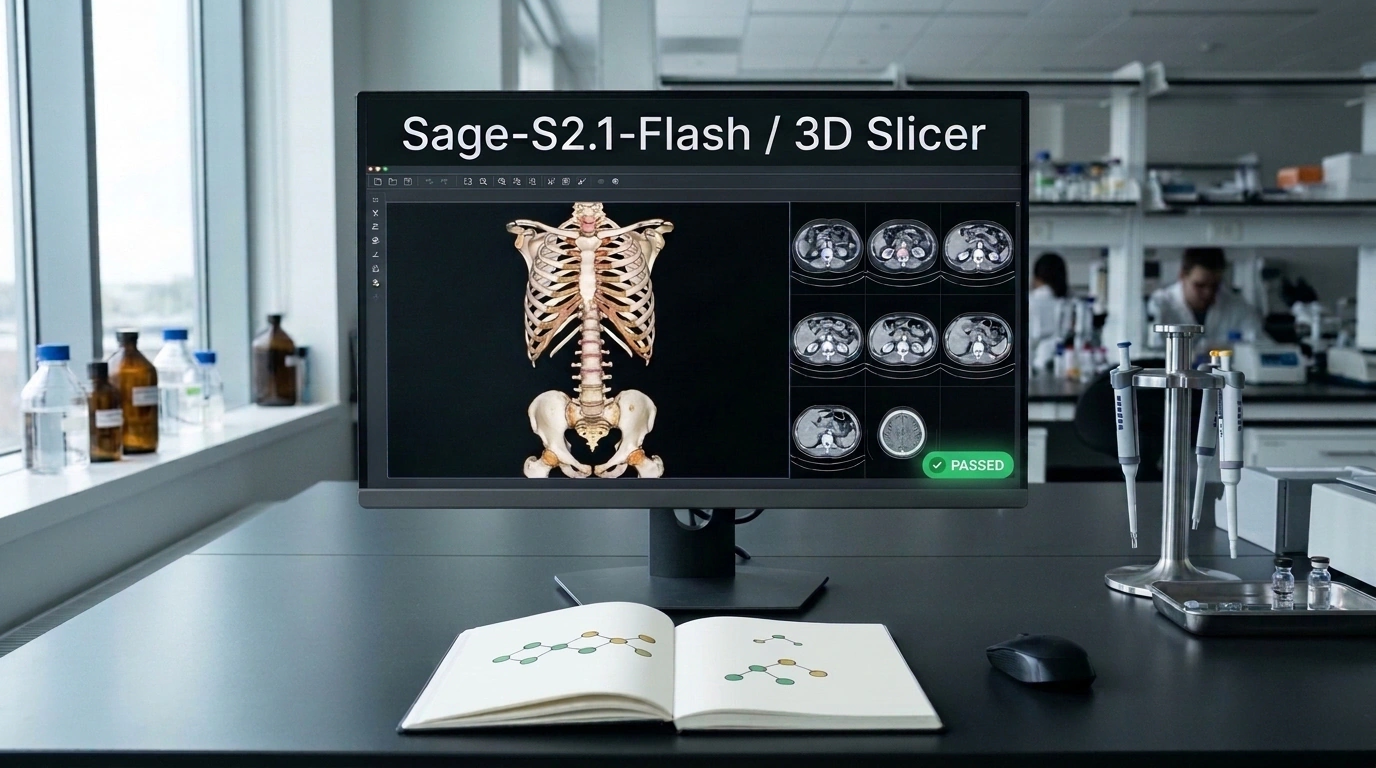
Drop a folder of 12,487 jumbled medical scans into a regular chatbot and ask it to build a 3D human skeleton. At best, you'll get a polite guide on how to do it yourself. The new open-source model Sage-S2.1-Flash from Shanghai AI Lab's InternLM team did something different: it opened 3D Slicer (the free software doctors and researchers use to inspect CT and MRI scans), pulled out the 139 needed CT slices, ran an order-consistency check, caught its own mistake, re-sorted the sequence, and finished the 3D model.
That result rests on two things: the model reads raw scientific files directly and runs inside an agentic loop with self-checking. The weights are out under the permissive MIT license, so you can download, fine-tune, and ship them even in commercial products.
Under the Hood: A Team of Experts and 'Translators' for Science
Sage-S2.1-Flash uses a Mixture of Experts (MoE) architecture: it has 320 billion total parameters, yet only about 18 billion activate for each new word (token). Picture a large research institute: for a specific problem, you don't call all three hundred staff into one room—you summon just the team of twenty specialists you need. The model keeps the knowledge of a giant while responding much faster than dense models of the same size.
Its main differentiator is the Sage SciPerception module. Ordinary multimodal models have to be fed scientific data as screenshots or text summaries. That is like studying a photo of a formula on a whiteboard instead of the formula itself: relationships get lost, and numbers turn into guesswork.
Sage adds dedicated encoders—specialized 'translators' that convert raw scientific formats straight into numerical vectors the neural network understands. The model natively reads over ten data types: molecular graphs, crystal structures, proteins, DNA and RNA, spectra (including X-ray diffraction and mass spectra), EEG and ECG biosignals, and even satellite light curves. A researcher can hand over a spectrum or crystal structure directly and ask to identify a compound or estimate material properties.
How the Agent Catches Its Own Mistakes
The most telling part of the demo on the project website isn't sorting 139 slices out of 12,487 files—it's what happened next. After sorting the scans, Sage-S2.1-Flash ran an order-consistency check, and the test failed.
A standard script would have produced a warped model or crashed. Here, the model saw the failure, stepped back, rebuilt the right slice sequence on its own, and only then generated the 3D skeleton in 3D Slicer. The entire gap between 'AI that advises' and 'AI that executes' fits inside that short loop: open the tool, run a step, check your work, and fix mistakes on the fly.
Where Sage Beats Rivals and Where It Falls Short
Shanghai AI Lab compared six models—Sage S2.1 Flash, DeepSeek-V4.1-Flash-1017, Qwen3.8-Max, GLM-5.3-Flash, GPT-5.6 Sol, and Claude Opus 5—across 15 benchmarks. Overall, Sage took first place on four tests and second on seven more. Here are the key numbers from the official model card:
| Benchmark | Task | Sage S2.1 Flash | Closest Rival |
|---|---|---|---|
| MLE-bench Lite | ML engineering | 90.3 | DeepSeek-V4.1-Flash-1017 — 89.2 |
| OfficeQA Pro | Complex documents | 72.2 | DeepSeek-V4.1-Flash-1017 — 69.7 |
| Harvey LAB | Legal tasks | 25.0 | Qwen3.8-Max — 24.2 |
| SpreadsheetBench 2 | Spreadsheets | 37.1 | DeepSeek-V4.1-Flash-1017 — 35.8 |
| Terminal-Bench 2.1 | Terminal work | 87.9 | Claude Opus 5 — 90.2 |
| SWE-bench Pro | Software engineering | 60.6 | Claude Opus 5 — 76.5 |
In ML engineering, dense documents, and spreadsheets, Sage matches or beats the leaders. Still, it's no universal flagship killer: in pure coding, terminal tasks, and repository builds, it trails Claude Opus 5 noticeably and slips behind DeepSeek-V4.1-Flash-1017 in places.
Keep two limits in mind. First, the table comes from Shanghai AI Lab itself—there are no independent runs yet. Second, MoE's 'lightness' is tricky at deployment: only 18 billion parameters are active, yet your GPU memory still has to hold all 320 billion weights. A home laptop won't run this; it is built for university and enterprise GPU clusters that cannot send sensitive research data to outside clouds.
You can download the model on Hugging Face in the original BF16 format, or grab the official FP8 version to save memory.