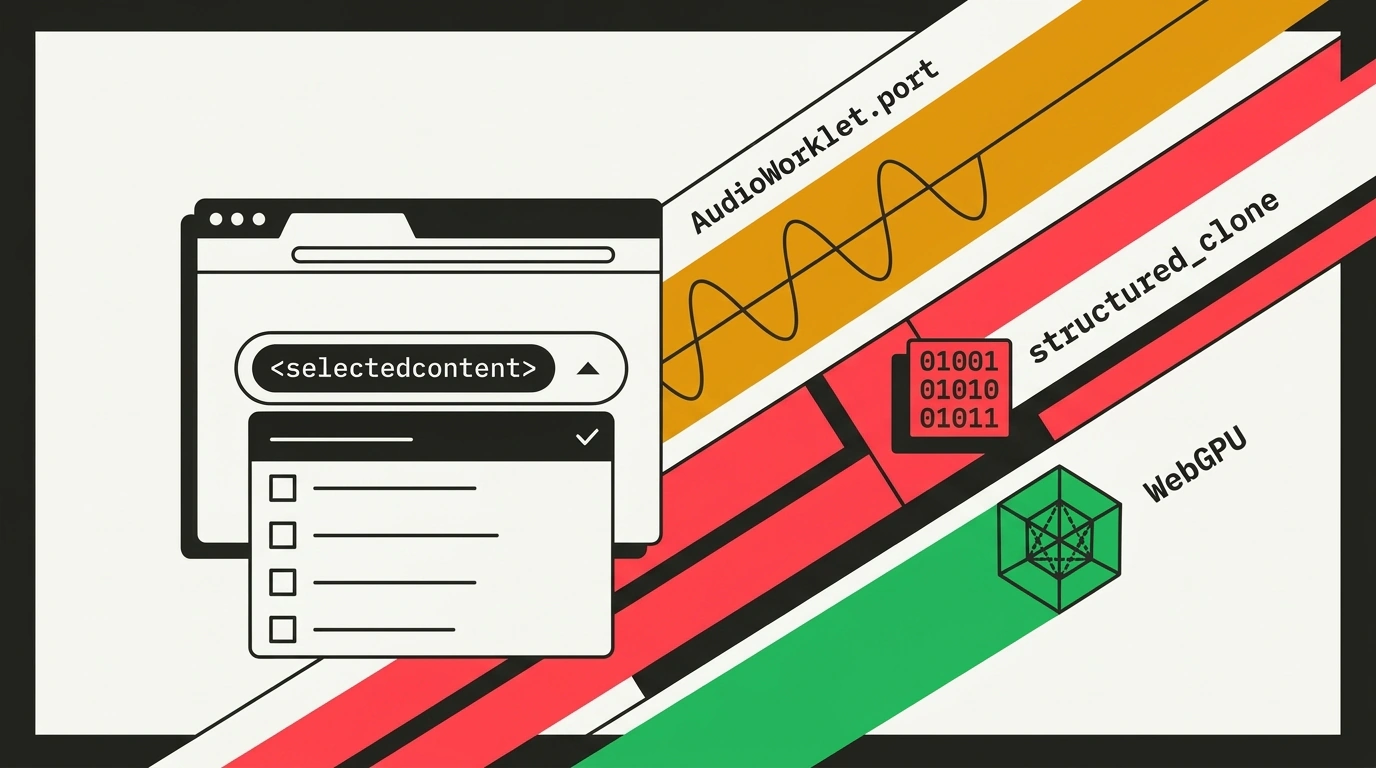
On November 18, 2026, the WebKit team released Safari Technology Preview 257 for macOS Golden Gate and macOS Tahoe—Apple's test browser build for previewing upcoming Safari features. The release notes list over a hundred changes, but once you strip away internal noise, the update hits four clear areas: custom forms, browser audio, extensions, and graphics. Along the way, it fixes a batch of quiet Safari bugs that have caused production headaches for years, from lost analytics on tab close to printing at a bizarre 90 pixels per inch.
If you want to try the new features today, the installer is on Apple's developer resources page, and existing preview installs update through macOS System Settings.
Forms: Customizable <select multiple> Preview and Fixed File Pickers
Styling a native <select> on the web has always been painful, and multi-select made things even worse. Teams ended up pulling in heavy JS libraries, building dropdowns out of <div> elements, and breaking keyboard navigation and screen readers in the process. In STP 257, WebKit takes two steps toward sane forms. First, <select multiple size="1"> on macOS now renders as a clean dropdown menu instead of a clipped box.
Second, this build includes a preview of extended <select multiple>—turned off by default behind an experimental flag. It relies on two pieces: listbox rendering support and a <selectedcontent> element inside the select button (see the MDN documentation on customizable select for spec details). The browser automatically clones each chosen <option> into <selectedcontent> and updates the button contents without a single line of client JS.
<!-- Browser clones selected options into selectedcontent automatically -->
<select multiple>
  <button>
    <selectedcontent></selectedcontent>
  </button>
  <option value="js">JavaScript</option>
  <option value="ts">TypeScript</option>
  <option value="rust">Rust</option>
</select>
This markup hands the boilerplate back to the engine: you style the button and options, and the browser gathers active values for you. The release also fixes a bug where moving one <selectedcontent> element broke updates for other items in the same select.
There's another fix that will save plenty of headaches on everyday sites. Previously, programmatically clicking a hidden <input type="file"> from an event handler could fail to open the file picker in Safari. Now that activation works during transient user activation—the brief trust window right after a real click or key press, matching how showPicker() behaves.
A couple of small but annoying layout bugs are gone too: scrolling inside a long <textarea> no longer jumps on the first edit below the fold, and <select> baselines now align via vertical-align: text-bottom just like Chrome and Firefox. Small detail, fewer shifting forms.
Web APIs: Direct AudioWorklet.port Channel and Rescued pagehide Analytics
In the Web Audio API, AudioWorklet handles glitch-free sound processing by running audio code on a separate thread without blocking the UI. Until now, though, it had an awkward quirk: just to pass shared settings or sync state to that thread, you had to create a full AudioWorkletNode. An entire audio node just for a message channel.
STP 257 adds the AudioWorklet.port and AudioWorkletGlobalScope.port pair. Now the main page thread and the worklet's global scope talk directly with no extra wrapper.
// On the main page thread
const ctx = new AudioContext();
await ctx.audioWorklet.addModule('dsp.js');

// Send shared config straight to the worklet global scope
ctx.audioWorklet.port.postMessage({
  type: 'config',
  gain: 0.8,
});

// Inside dsp.js (AudioWorkletGlobalScope)
port.onmessage = (event) => {
  console.log('Получена настройка:', event.data);
};
Audio engine initialization gets much cleaner, and WebKit also plugged a nasty leak: previously, an AudioWorklet thread could stay alive after a document stopped, causing WebAssembly.Memory allocations to fail with out-of-memory errors after repeated reloads. Elsewhere in Web APIs, WebKit added support for the WebAuthn cross-device fallback URL extension for sign-in flows from another device.
Still, the biggest relief in this section is fixing 'silent' bugs that normally eat up entire evenings of debugging. First, it fixes lost pagehide beacons—background analytics sent via navigator.sendBeacon when someone closes a tab. Previously, the tab process could shut down before the beacon hit the network, dropping events. Second, FileSystemWritableFileStream.close() no longer resolves its promise before the file is actually written to disk, and File System Access operations stopped reporting success early.
Third, WebKit fixed a subtle garbage-collection bug with AbortSignal.any(): if you didn't hold an explicit reference to the combined signal, GC could collect it even though source signals could still fire, leaving event listeners stuck in memory. Finally, window.print() no longer hangs forever waiting on active XMLHttpRequest calls like long-polling—the print dialog opens cleanly after the load event.
Web Extensions: Passing Blob and ArrayBuffer Without JSON Hacks
Anyone who has built a browser extension knows this pain: you want to pass an image, audio clip, or binary buffer from a content script to a background script, but legacy JSON serialization only understands strings and numbers. You had to convert files to base64, bloating data size by a third and burning CPU on pointless encoding.
STP 257 enables "message_serialization": "structured_clone" in manifest.json. It switches runtime.sendMessage() to the structured clone algorithm—the browser's built-in mechanism for copying complex JS objects directly, including ArrayBuffer and Blob.
{
  "manifest_version": 3,
  "name": "Binary Snapshot Extension",
  "version": "1.0.0",
  "message_serialization": "structured_clone"
}
One line in the manifest lets an extension pass binary data between pages and background scripts without manual text encoding. Extension authors also get several handy additions: windowId on runtime.MessageSender, new enums under browser.* (cookies.SameSiteStatus, declarativeNetRequest.ResourceType, extension.ViewType, menus.ContextType), and a clear warning when mixing up action and browser_action between Manifest V2 and V3.
Under the hood, extensions use memory more carefully: each event listener registers once, and messages are delivered without making extra copies per listener. WebKit also closed three security and stability gaps: tabs.update() no longer navigates tabs to javascript: or file: URLs without file-access permissions, declarativeNetRequest stopped double-counting existing rules toward quotas, and Content-Security-Policy-Report-Only headers no longer block Safari extension scripts from loading.
WebGPU, Smooth Scrolling, and Long-Awaited CSS Fixes
On the graphics side, the headline addition is dual-source blending in the WebGPU API. Normally, a fragment shader outputs one color per pixel to blend with the background. With dual-source-blending (via the @blend_src attribute in WGSL), the shader outputs two color values—src0 and src1—into a single color buffer. That sounds niche, but it's what enables crisp subpixel font smoothing and complex Porter-Duff compositing modes without extra render passes.
For performance, STP 257 tackles three sore spots at once. It fixes choppy scrolling on 60 Hz Mac displays and adds soft rubber-band spring animations when scrolling to document edges on macOS. It introduces a compositing layer limit for giant elements using will-change—before, one careless will-change on a large container could spike memory use, whereas now the engine keeps it in check. It also speeds up rendering pages with many gradients in Adaptive Dark Mode.
Finally, CSS developers get a welcome batch of targeted fixes. ::first-letter and ::first-line pseudo-elements can now be animated, and their allowed properties now match the spec. CSSStyleSheet.insertRule() is fixed for @scope rules, and container query cqi units (1% of a container's inline size) now recalculate properly when padding changes on a box-sizing: border-box element.
Print styles get a long-overdue fix too: Safari finally switched from its odd 90 to the standard 96 CSS pixels per inch, which had caused print layouts to drift slightly compared to other browsers for years. The same release removes invisible text selection on sites like GitHub, eliminates a two-pixel position: sticky jitter inside overflow-x: clip, and stops player buttons from overlapping captions on video.js sites.