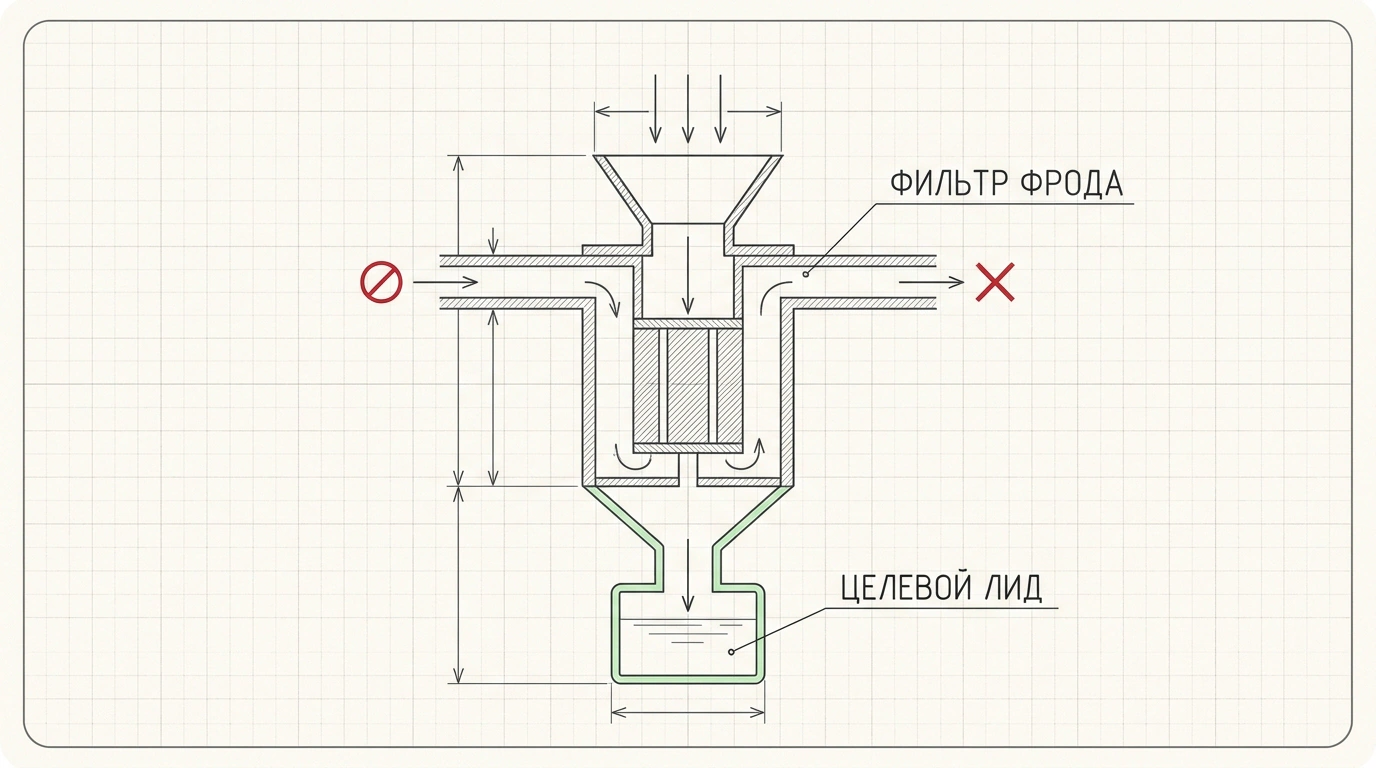
Ever seen this month-end scene? Your PPC specialist walks in with a gorgeous slide deck. Charts climb steadily, CTR ticked up two points, lead volume crossed a hundred, and Cost Per Lead (CPL) fell by nearly a third. The specialist is ready for a bonus and champagne—while you stare at a cash shortfall, wondering why boxes sit dusty in the warehouse, sales reps in the CRM are howling at endless spam, and real paid invoices are nowhere in sight.
Marketing runs on one unforgiving truth people love to forget: Yandex Direct's ad interface exists to serve and sell Yandex traffic, not to guarantee your net profit. Leave optimization to algorithms without a scalpel and an X-ray, and they will brilliantly find the cheapest way to hit your surface KPIs—even if your business bleeds out. Recently, marketer Denis Kremnyov sparked a sharp industry discussion around hidden setup flaws that vanish completely from standard reports. I decided to dissect those mechanics piece by piece, cross-check them against years of live campaign audits, and build a step-by-step technical audit protocol that exposes even the sneakiest budget leaks.
The First-Metric Trap: Why Cheap Leads Bankrupt Projects
The first and most common illusion is blind faith in blended Cost Per Lead (CPL). Inside the ad dashboard, a click triggers a conversion, the system logs a win, and its neural nets train on that signal. Yet the algorithm has zero clue what happened after someone hit "Submit."
Look at a real case from Kremnyov's practice for a company installing access-control systems (ACS) and electronic locks. In May, the company runs ads on broad, near-intent queries like "electronic lock installation" and "access systems," spends 95,000 rubles, and collects 38 inbound inquiries. Dashboard CPL reads an exact 2,500 rubles. For complex B2B engineering, that looks terrific.
Now open the CRM and qualify those 38 leads:
- Ten callers wanted a cheap biometric mortise lock for an old apartment door and expected a handyman for 1,500 rubles.
- Six more called asking to repair a ten-year-old third-party intercom—something the company doesn't even service.
- Five wanted to buy standalone controllers at retail without installation (the company operates strictly on turnkey supply-plus-commissioning contracts).
- Only 17 of the 38 inquiries matched the actual commercial profile: office centers, warehouse complexes, and factory gates.
Do the plain arithmetic: true Cost Per Qualified Lead wasn't 2,500 rubles—it was 95,000 / 17 = 5,588 rubles. More than double! Judging solely by the ad dashboard, a marketing director would happily pour another half-million rubles into that campaign assuming sales would scale proportionally. Instead, they would scale incoming junk by 60%, paralyzing the sales floor. Flaws like these Yandex Direct Mistakes quietly drain ad budgets while staying invisible to surface-level audits.
In June, the team flipped the script: rewrote landing pages strictly for business buyers, blocked retail keywords, and shifted ad copy to "ACS for offices and industrial sites." June's numbers: 90,000 rubles spent, only 30 leads (down a quarter!), and surface CPL jumped to 3,000 rubles. An inexperienced manager would panic. Yet 21 of those 30 leads were qualified buyers. True cost per qualified lead dropped from 5,588 to 4,285 rubles. Less noise, cleaner traffic, higher contract close rates.
Ad Promises vs. Reality: When Copy Sabotages Sales
Landmine number two gets planted whenever a marketer or copywriter chases maximum CTR at any cost. Out come shouty headlines, impossible discounts, promises of a free engineer on site in 15 minutes anywhere in the region, or 0% financing with zero down.
Watch what happens in the buyer's head. A user clicks with a specific mental anchor—convinced they're getting a free engineering design or equipment at five-year-old wholesale prices. The moment your landing page or first phone call reveals that the "free design" applies only to contracts over 3 million rubles and minimum orders start at 200,000, instant backlash kicks in.
Inside the ad dashboard, everything looks spotless:
- CTR skyrockets (everyone loves freebies);
- CPC drops thanks to high ad quality scores;
- Lead forms fill up with dozens of contacts.
Meanwhile, the sales floor turns into a war zone. A rep dials the number and gets blasted: "You promised 500 rubles—why are you quoting me six thousand?!" The lead dies in thirty seconds. Predictably, management blames the sales rep for weak objection handling. Yet the fix isn't in call scripts—it's in first-screen honesty. Your ad copy should filter out non-paying traffic BEFORE the click, even if surface CTR dips. Overpromising is a hidden tax on disappointment that you pay twice: once for the click, and again in demoralized staff.
The Black Hole Between Traffic and CRM: Anatomy of a Sales-Floor Leak
Look at problem number three, where every second company stumbles. Suppose traffic is spotless, the offer is transparent, and leads land cleanly in your CRM. Still, deals aren't closing. Who takes the blame? The owner opens the ad-spend sheet and snaps: "Yandex Direct doesn't pay off—shut it down."
Follow our ACS case into August. The company invests 100,000 rubles and collects 32 leads, 23 of them strictly qualified. With a clean funnel, close rates should soar. Yet by month-end, fewer contracts close than in June. When analysts traced deal movement step by step inside the CRM, ugly cracks appeared:
- 40% of leads waited over 4 hours for a first callback, and evening inquiries sat in "New" status until midday the next workday;
- On 8 qualified leads, reps simply forgot to send the commercial quote after the initial discovery call;
- Workload inside the team was lopsided: one senior rep spent 70% of their week nursing old accounts while hot inbound leads went to a trainee who couldn't clearly explain the difference between standalone and networked controllers.
In long B2B deals with 3-to-8-week decision cycles, every pause is fatal. While your rep is "putting together the quote," the buyer opens the next search tab and books an audit with a faster rival. Unless you track handling-speed metrics—time to first touch, decision-maker reach rate, quote-sent rate—alongside ad campaigns, you'll keep firing PPC specialists while millions leak into operational sloppiness. A proper audit requires knowing How to Tell Useful Advice From Hidden Risks in a Yandex Direct Audit and pinpointing exactly where the revenue chain snaps.
Analytics Architecture Bugs: Fake Micro-Goals and Multi-Conversions
Technical flaw number four hides inside Yandex Metrica itself. When you run automated bidding like "Maximize Conversions," the algorithm hungrily hunts for signals to optimize around. Configure goals sloppily, and the system starts chasing actions completely detached from your cash register.
Here are the classic web-analytics rakes I see on audits constantly:
- Goals firing on modal opens. A visitor clicks "Request a Callback," a pop-up opens, and instead of submitting, they hit the X button. Metrica logs
Open_Modal. The robot cheers "conversion!" and floods your site with chronic pop-up clickers. - Duplicate conversions from one visitor. Someone visits the site, taps a clickable phone number, opens your Telegram bot, and then fills out a quiz. Yandex Direct reports "3 conversions." The analyst celebrates a cheap CPL, even though it's one person with one potential order.
- Training auto-bidding on lightweight micro-events. When a campaign lacks real transactions, specialists feed the algorithm soft goals: "70% page scroll," "viewed Contacts page," or "60+ seconds on site." The algorithm obediently finds restless scrollers or bot farms engineered to mimic engagement, leaving real buyers out in the cold.
To defuse this trap, run end-to-end goal validation. Open your call log and CRM and match every conversion against its yclid or ClientID. If Metrica claims 80 conversions while your CRM logged only 35 unique inbound inquiries over the same window, your campaign is optimizing on ghosts. These Hidden Auto-Bidding Optimization Traps steadily rot an ad profile: once the algorithm locks onto junk behavior, raising bids won't save it.
Mixing Disparate Product Lines: The Tyranny of Averages
Problem five is accounting blindness caused by tossing products with wildly different margins into a single campaign pot.
Imagine a company selling industrial video surveillance and accessories. Its catalog spans:
- Wall jacks, connectors, and pre-made patch cords at a 1,200-ruble average ticket and 200-ruble net margin;
- Home CCTV kits for private houses at a 45,000-ruble ticket and 12,000-ruble margin;
- Facial-recognition and server-side video analytics for factories at a 2,500,000-ruble ticket and 600,000+ rubles in margin.
Dump all three into one campaign under one automated strategy and cannibalization starts immediately. The algorithm quickly sees that patch-cord inquiries come in at 150 rubles, whereas factory-system leads cost 4,000–7,000 rubles. So the system proudly beats your target average CPL by routing 85% of budget into penny-ante retail parts. Soon your warehouse is scrambling to pack 1,200-ruble orders while the high-margin enterprise contracts that actually pay salaries get zero impressions.
A real audit enforces strict segmentation by product unit economics—not just keyword type:
- Group campaigns strictly by allowable CPA ceiling;
- Give high-ticket, high-margin lines separate campaigns with locked budgets so automated bidding can't drift into cheap near-intent traffic;
- Always measure each line's net contribution to gross profit, never blended top-line revenue.
Search Campaign X-Ray: Auto-Targeting and Negative Keywords
Now let's get surgical inside Yandex Direct settings. Even with a sharp offer, platform defaults can quietly drain your budget.
Front one is mandatory auto-targeting. Yandex made it compulsory in search campaigns; left unchecked, it blends your ads into a wide pool of loosely related queries. Open the Search Queries report, filter by impression condition "Auto-targeting," and inspect the split across categories:
- Target queries (hottest, exact-intent searches);
- Narrow queries (specific product modifications);
- Broad queries (a budget killer on capped spend);
- Related queries (you sell mobile cranes and show up for excavator rentals);
- Alternative queries (showing on direct substitute competitors).
For most commercial B2B niches, "Broad" and "Related" need to be shut off ruthlessly or dropped to micro-bids. Otherwise, you'll pay for informational clicks from students writing term papers or DIYers hunting wiring diagrams.
Front two is cross-campaign negatives and global negative lists. Run multiple search campaigns (brand, category, model) and they inevitably bid against each other on the same query. A broader-keyword campaign steals the click from a tighter one, driving up CPC and hurting landing-page relevance. Running your keyword list through cross-negatives eliminates self-competition. Also update account-level negative lists constantly: excluded cities, DIY markers ("with your own hands," "manual," "schematic," "torrent," "used," "Avito"), and rival brands you don't carry.
Scrubbing Networks: Filtering Junk Placements and RSYA Fraud
While search users at least type out what they want, the Yandex Advertising Network (RSYA) turns into algorithmic anarchy unless you play defense manually. Today's biggest RSYA drain is ads firing inside mobile apps, clickbait doorway sites, and casual gaming portals.
Infographic diagram of RSYA traffic cleanup with a multi-layer filter blocking junk mobile apps and bots.
Open the standard Placements report in Report Wizard and you're almost guaranteed to spot culprits starting with:
com.game.*orcom.cleaner.*(mobile games, flashlight apps, memory cleaners);dsp-*(external ad exchanges with murky traffic origins);- Entertainment portals packed with horizontal auto-scrolls and full-screen mobile pop-ups.
Watch how clicks happen there: a kid is playing a mobile game, a banner flashes right over the "fire" button, and an accidental tap bills you 30–50 rubles. Or someone tries to tap the close button on a doorway site, the X shifts a pixel, and they're forced onto your site—2 seconds on page, 95% bounce rate. Worse, if you run pay-per-conversion bidding, mobile bot farms use scripts to submit fake leads with random phone numbers just to collect network payouts.
Your RSYA cleanup checklist:
- Block all mobile app domains and gaming bundle IDs (a properly maintained blocklist runs into hundreds of entries).
- Disable external DSP networks where placement context can't be verified.
- Flag placements with Bounce Rate > 60% across 50+ clicks and block them at campaign level.
- Watch for weird overnight spikes: dozens of clicks pouring in at 3:00 AM from one region with zero conversions signals warm-up bots faking browsing history.
Time and Regional Blind Spots: When Averages Hide a Crisis
Diagnostic layer seven looks at geo-targeting and ad scheduling. It's easy to soothe yourself with "across Russia, the campaign averages out fine." Averages are the ultimate hiding spot for waste.
Slice Metrica and Yandex Direct by region and compare against real logistics and close rates. Often, distant regions quietly eat 35% of spend while shipping costs wipe out order margin—or local warehouses lack stock, leaving reps stalling buyers with delivery promises for weeks. Either shut those regions off or split them into dedicated campaigns with adjusted pricing offers.
Ad scheduling shows the exact same trap. Businesses run ads 24/7 assuming "someone might want to submit a form at night." Sounds nice on paper; in practice, 90% of overnight traffic is idle browsers with low buying intent. If a lead lands Saturday at 11:00 PM and sales doesn't call until Monday at 10:00 AM, close rate drops near zero. Set downward bid adjustments for off-hours or pause weekend delivery unless an on-duty rep or fast bot is catching those leads live.
Final Audit Protocol: Rescuing Project Economics
Let's draw the line. To stop burning cash and turn Yandex Direct into a net-profit engine, audit your account on a strict five-step protocol:
- Reconcile CPL vs. CPA end-to-end: Track the cost of a qualified lead that actually reaches a quote or proposal—not a raw form fill.
- Audit Metrica goal hygiene: Strip micro-goals out of auto-bidding, eliminate duplicate events, and track unique commercial inquiries only.
- Perform search-query surgery: Cut off-target auto-targeting tiers, run cross-negatives between campaigns, and block informational tails.
- Block RSYA parasites: Exclude mobile apps, gaming networks, and external DSPs feeding misclicks and bot traffic.
- Sync with sales execution: Measure time to first touch, monitor quote-delivery rates, and never touch ad settings until you've confirmed the leak isn't sitting on the sales floor.
Advertising isn't a lottery or black-box AI magic. It's a strict mathematical system where every invested ruble needs a clear path all the way to a paid receipt. Manage the numbers deliberately, inspect what's underneath the dashboard, and don't let pretty charts hide real losses.