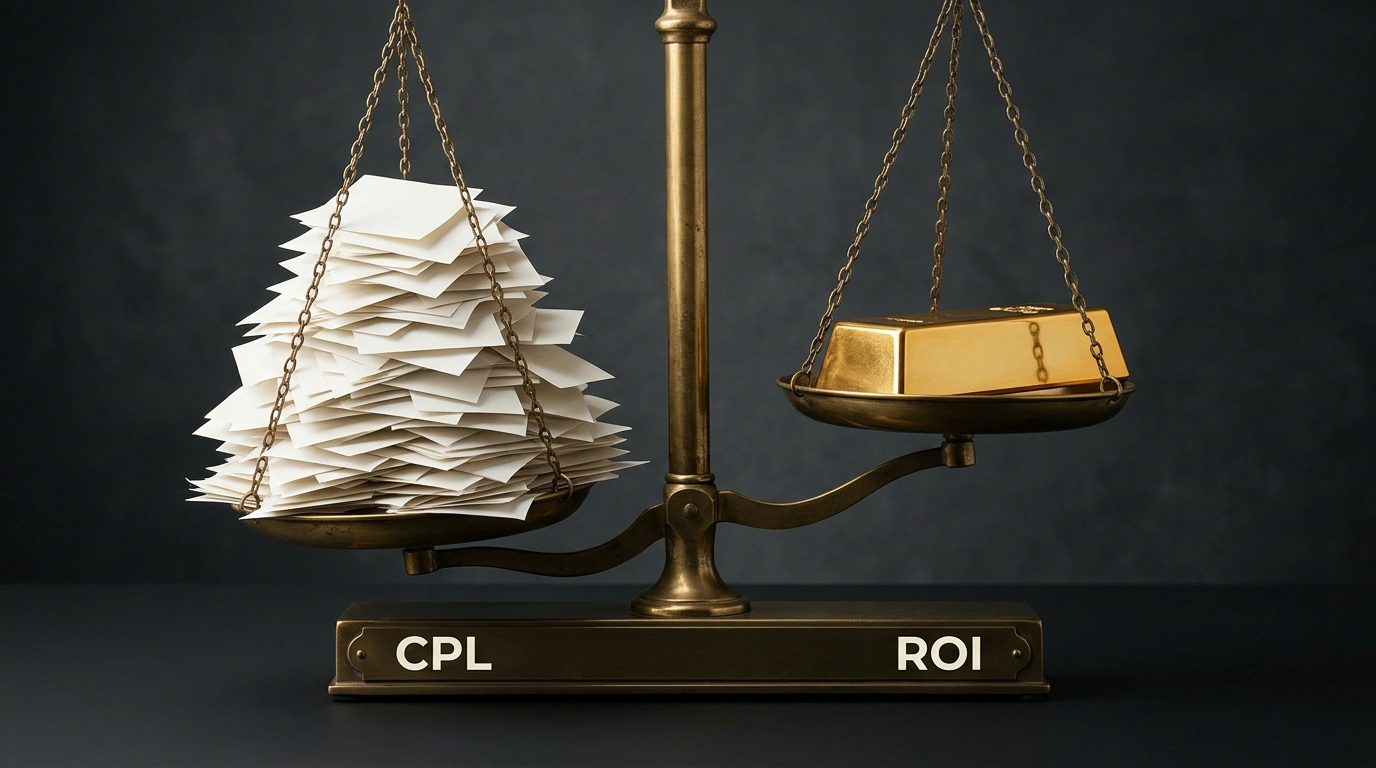
If you manage marketing or sales, you've definitely heard this sacred mantra from business owners: "Why is our lead costing 1,000 rubles? Competitors are getting leads for 300! Fix the targeting right now and make them cheaper!" So the marketer salutes, opens up broad audiences, strips the website form down to a single field, launches a bare-bones quiz—and presto: the dashboard proudly displays a 300-ruble CPL (Cost Per Lead). Reports look festive, charts point up.
Two months later, the sales director walks into the meeting and announces that revenue targets were missed, sales reps are burned out and quitting, and the company bank account hasn't budged. The owner fumes that "ads don't work." GUSAROV agency founder Andrey Gusarov breaks down exactly why blindly chasing dirt-cheap leads is the fastest route to a cash crunch and a paralyzed sales floor.
Deadly Math: Why Expensive Leads Beat Cheap Ones
Let's grab a calculator and dissect real funnel economics. Picture a typical business with a $300 average deal size running two different ad sources:
- Channel #1 (false economy): A lead costs just $5. The owner is thrilled. Yet the crowd is ice-cold: to close one deal, a rep has to call 20 people (a 5% close rate). Worse, buyers hesitate and stall, so real cash doesn't hit the account for 60 days.
- Channel #2 ("expensive" traffic): A lead costs $15—three times as much! Most clients panic and shut a channel like this off on day one. Yet the audience here is informed and warmed up: one in five buys (20% conversion), and payment lands in the bank within 7 days.
Now calculate true Customer Acquisition Cost (CAC): In Channel #1, one sale takes 20 leads at $5: CAC = $100. In Channel #2, one sale takes 5 leads at $15: CAC = $75.
The gap is unmistakable: the "expensive" channel actually acquires a paying customer 25% cheaper! The tragedy is that 90% of founders stare only at CPC and CPL and pick Channel #1. They willingly pay $100 per deal instead of $75 and lock up working capital for two months instead of one week. That's why The Cheap-Lead Illusion: Why Businesses Drown in Inquiries While Starving for Revenue remains the #1 source of friction between owners and marketers.
Hidden Costs: How Junk Traffic Burns Payroll
The financial bleed doesn't stop at ad spend. In Channel #1, getting a single sale forces your rep to run 20 qualification calls, sit through 15 brush-offs like "I clicked by mistake," "just browsing," or "no budget," log CRM notes, and burn three full workdays on dead-end conversations.
In Channel #2, the rep calls five qualified prospects and closes a deal in two hours. What does payroll cost when your sales team spends all week grinding through garbage leads? When reps deal with clueless inquiries every day, morale craters, close rates drop even on good leads, and staff turnover starts draining HR resources. Worse, low-quality traffic invites ad fraud—which is why it pays to understand Why Marketing Isn't Accountable for Profit: Fraud Schemes and How to Protect Your Business before paying contractors for padded lead counts.
The only healthy yardsticks for traffic are Cost Per Qualified Lead (CPQL) and true ROMI weighted by payback speed. If you want to keep your sales floor from burning out:
- Ban evaluating marketing on raw CPL alone.
- Enforce a strict lead-disqualification rule in your CRM with mandatory loss-reason logging.
- Optimize ad campaigns strictly around segments that convert into real cash with a fast deal cycle.