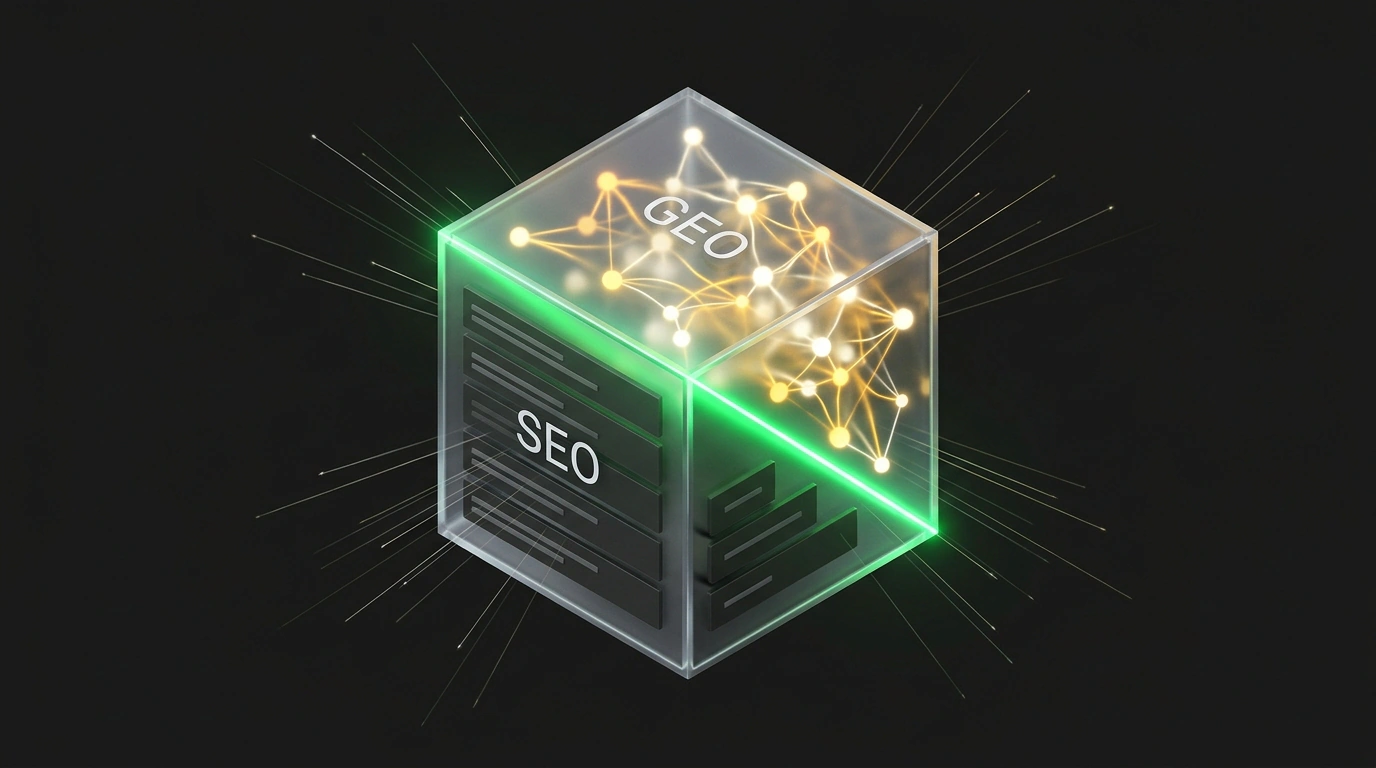
If you still measure search marketing by keyword rankings and spots in classic organic SERPs, here's a wake-up call: traditional search is rapidly giving way to conversational engines. AI Overviews, ChatGPT Search, Perplexity, and Alice's neural answers have already shaved 18–25% off the organic CTR of the #1 search result. Users no longer wade through ten blue links and banner clutter—they ask an AI a question and get a synthesized answer on the spot. If your brand isn't in that answer, to the customer you might as well not exist.
We've entered the era of Generative Engine Optimization (GEO). Indexing, ranking, and citation run on completely different rules here. Unlike classic SEO, where backlink volume and keyword density ruled, large language models think in entities, semantic graphs, and trusted data clusters. We previously broke down How Search Works in the LLM Era: Citation and Ranking Mechanics in ChatGPT and AI Overviews. Today, let's examine three fresh real-world cases and releases: Pressfeed's GEO package launch, Semrush's engineering checklist, and TexTerra's live Perplexity stress test.
Pressfeed Launches a GEO Service for Brand Visibility in AI Answers
Journalist-query platform Pressfeed has officially rolled out a commercial GEO product for companies trying to lock in citations inside ChatGPT, Alice AI, and Perplexity. The logic is straightforward: an LLM doesn't train exclusively on your corporate website. In fact, analytics show your own site accounts for only a third of AI mentions, while the remaining two-thirds come from independent third-party sources—media outlets, industry rankings, and expert columns.
Pressfeed packaged GEO not as a replacement for SEO, but as an extra layer atop PR and content marketing. It expands a brand's digital footprint by securing regular executive commentary in trade media, published case studies, and press releases—tightly binding the company name to target semantic clusters. When a model builds a synthesized answer to "which CRM fits logistics," it scans vector memory and fresh web indices for authoritative proof of reliability. If a brand is cited in Cossa, RBC, and industry roundups in the context of warehouse automation, the LLM is far more likely to include it in its shortlist.
Semrush's Four Steps
Semrush's analytics team published a technical breakdown of the signals that determine whether content gets cited by generative engines. They laid out four foundational steps that move a website out of AI's blind spot and into trusted primary-source status.
Step one is strict structured-data markup using Schema.org standards. Generative parsers love JSON-LD, Article, Product, Organization, and FAQPage schemas. The cleaner your entities are tagged, the easier it is for a vector engine to connect your brand to a specific problem. Step two is establishing an entity presence in Wikidata and authoritative open knowledge bases—to an LLM, a Wikidata knowledge-graph entry acts like a verified digital passport.
Step three is fact density per square inch of text. Both during training and in RAG (Retrieval-Augmented Generation) mode, models filter out stylistic fluff and marketing hype. They crave hard numbers, measurable specs, benchmarks, and direct founder quotes. Step four is third-party citation verification. When recognized industry leaders link to your study or analytical report, the model boosts that node's weight across the semantic graph. In short, Semrush is urging teams to rebuild content pipelines: write less ad copy and publish more technically rigorous datasets.
The TexTerra Experiment
Agency TexTerra ran an eye-opening visibility audit for an over-the-counter medical product inside Perplexity, testing how accurately the AI generated factual claims. The case exposed generative search's Achilles' heel: hallucinations and factual distortion.
The team tested ten common consumer queries—indications, dosages, side effects, and comparisons with alternatives. Up to 30% of Perplexity's citations contained distortions or leaned on sloppy third-party rewrites whenever the manufacturer's official site lacked direct, unambiguous Q&A answers. The model latched onto high-authority aggregator portals where copywriters had scrambled dosages five years earlier. Once the brand's team added MedicalWebPage schema to the primary domain, updated official press releases, and cleaned up external mentions, Perplexity rebuilt its search output within two weeks—lifting factual accuracy to 95%.
The takeaway is simple: if you don't actively manage your public digital footprint, the AI will invent facts about your product on its own—and you'll pay for its hallucinations in lost customers. Knowing How to Set Up GEO Instead of SEO to Win Citations in ChatGPT, Gemini, and Alice is fast becoming a core marketer skill. Experiment time is over—it's time to structure your brand for language models.