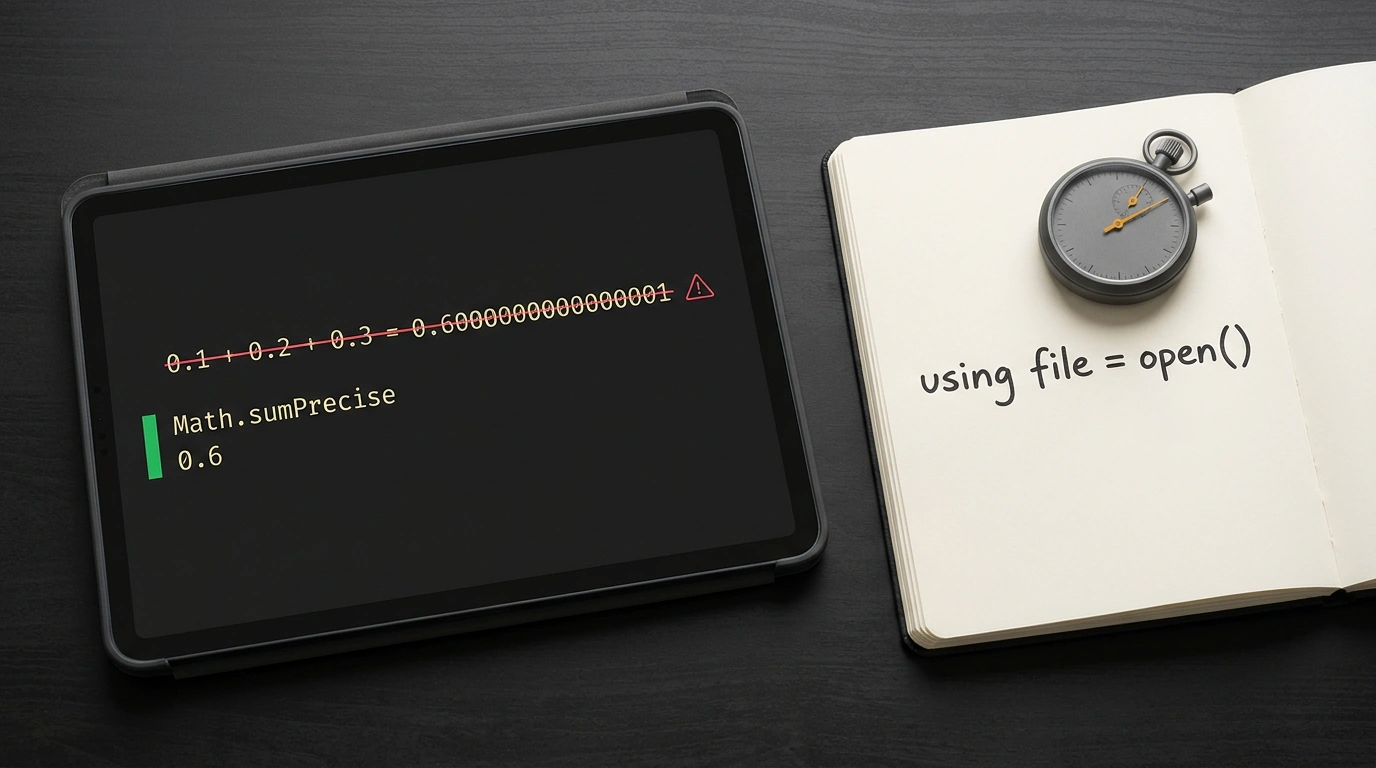
Every JavaScript backend developer knows the classic floating-point joke: open a console, add 0.1 + 0.2, get 0.30000000000000004, and go wrap a third-party library like bignumber.js so you don't botch cents in an online store's shopping cart.
With Node.js moving to a new six-month public testing cycle, the alpha phase of the next major release has kicked off: Node.js 27 Alpha. The main technological engine of this release is the global upgrade to V8 15.6, replacing the 14.6 branch from Node.js 26.
Project lead engineer Joyee Cheung detailed the changes in the official platform blog and the nodejs/node repository. And trust me: behind the fresh syntactic sugar lie fundamental architectural overhauls to the runtime, garbage collector, and data serialization format.
Native Precise Arithmetic and Long-Awaited Iterators
Let's start with the welcome ECMAScript additions that make code cleaner and safer without external npm packages.
The star of the release is Math.sumPrecise(iterable). It implements a summation algorithm that compensates for IEEE 754 floating-point error accumulation:
// Good old reduce with floating-point drift
const oldResult = [0.1, 0.2, 0.3].reduce((sum, n) => sum + n, 0);
console.log(oldResult); // 0.6000000000000001

// Native V8 15.6 method in Node.js 27 Alpha
const preciseResult = Math.sumPrecise([0.1, 0.2, 0.3]);
console.log(preciseResult); // 0.6
The second major block is the full stabilization of Iterator helpers:
Iterator.prototype.join(separator): lets you join elements of an infinite or lazy generator into a string without allocating an intermediate array in RAM viaArray.from();Iterator.prototype.includes(value): fast membership check in an iterable stream;Iterator.zip(iterables)andIterator.zipKeyed(object): clean combination of parallel sequences into tuples or keyed structures:
// Zip IDs and roles into a single stream
const ids = [101, 102, 103];
const roles = ['admin', 'editor', 'viewer'];

const pairedUsers = Iterator.zip([ids, roles]).toArray();
console.log(pairedUsers);
// [[101, 'admin'], [102, 'editor'], [103, 'viewer']]
Tectonic Shift: Buffers Now Count Against the Heap Limit
Now let's move to the under-the-hood changes that can spring surprises in production.
Historically, memory for Buffer and ArrayBuffer objects in Node.js was allocated outside V8's managed heap (off-heap memory). That created a treacherous bug: an app could actively read gigabyte-sized files or stream heavy video, allocating hundreds of megabytes of buffers, while V8's garbage collector didn't even think about running because the internal heap stayed tiny. Eventually, the container would get abruptly killed by the Linux kernel's OOM Killer.
In V8 15.6, this model is radically redesigned: buffer memory is now directly accounted for in V8's global allocation limit. The garbage collector reacts much sooner to spikes in binary allocations, freeing unused descriptors.
In parallel, engineers raised the default Old-Space Limit for mid-sized servers. On machines with 4 to 15 GB of RAM, the default heap limit is calculated as half of physical memory. For instance, on a server with 8 GB of RAM, the default heap ceiling jumped from 2 GB to 4 GB.
On top of that, garbage collector pauses (GC pauses) during major cycles dropped in stress tests from 45 milliseconds down to an impressive 10 milliseconds, and Array.prototype.sort switched from classic TimSort to the faster PowerSort.
Breaking Serialization Change: Why You Can't Mix Versions
A critical warning for microservice architectures: V8 15.6 changes the internal binary format used by v8.serialize(), structuredClone(), and cross-thread messaging via postMessage().
What does this mean in practice?
Node.js 27 preserves backward compatibility and reads older serialized payloads without issue. However, if a service on Node.js 27 tries to send a serialized object over Redis, RabbitMQ, or a network socket to a service running Node.js 26 or 24 LTS, the older runtime will crash with a fatal invalid or unsupported version error.
Mixing different major platform versions in a distributed cluster without converting to neutral JSON or Protobuf is now strictly off-limits.
Takeaways and Preparation Strategy
While Node.js 27 is in Alpha, you shouldn't deploy it in production: C++ native addon specifications (N-API) may still change before the fall 2027 release.
Still, npm package authors and platform engineers should test their CI pipelines right now. Check how your file-streaming services behave under the new buffer accounting, update floating-point tests to account for Math.sumPrecise, and make sure inter-service serialization is isolated from engine-specific binary formats.
