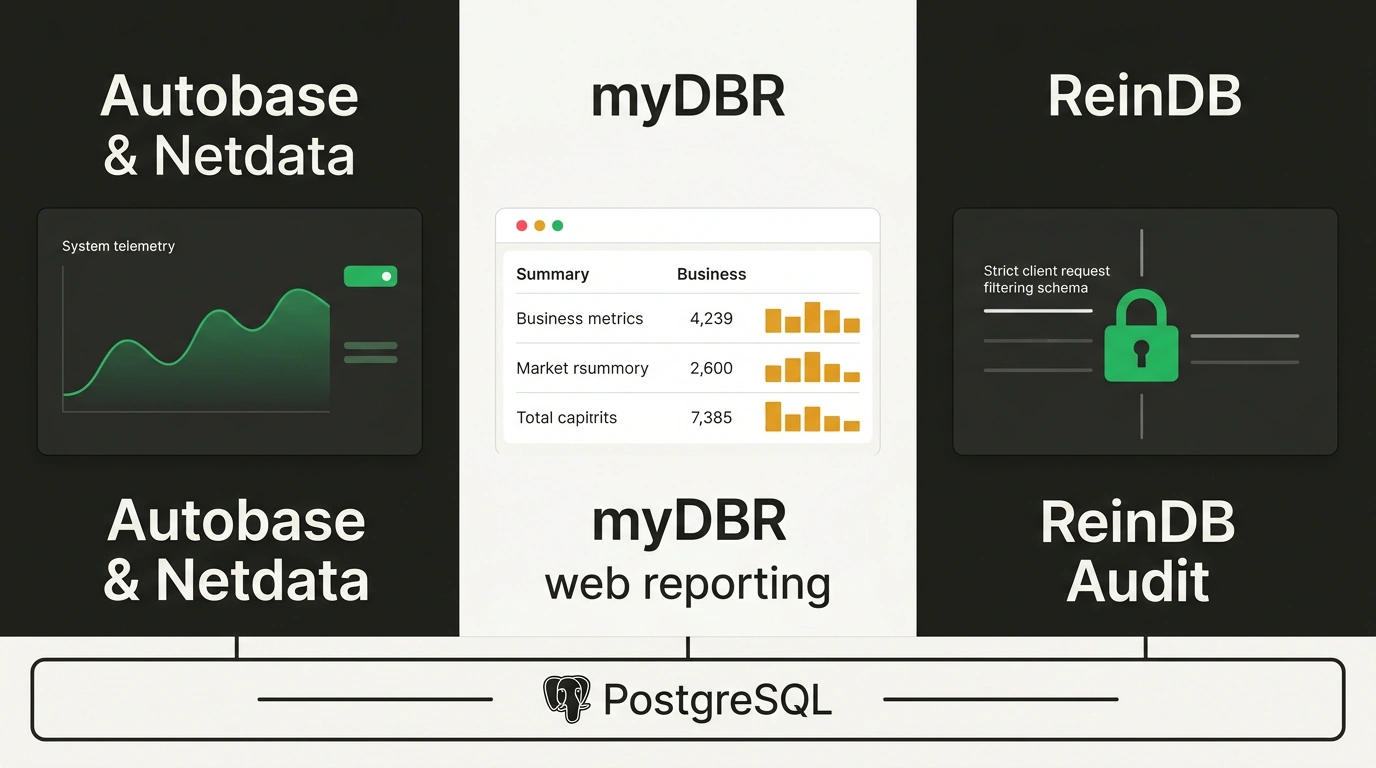
A modern production PostgreSQL cluster stopped being a single process running SQL queries on one dedicated server a long time ago. Today it's a complex distributed engineering stack: high-availability topologies with automatic leader failover, connection poolers like PgBouncer, regular business reporting pipelines, and continuous profiling systems for slow transactions.
In early November, the DBMS community unveiled three notable releases of specialized tools covering core operational needs for admins and developers—from deep OS-level monitoring to building secure data marts.
Autobase 2.12
The internal database orchestration platform Autobase 2.12 (developed by Vitaliy Bakumov as an open-source DBaaS solution for deploying fault-tolerant PostgreSQL clusters) received a major observability upgrade.
The headline feature is deep integration with the ultra-fast Netdata agent. Instead of heavy custom metric collectors, Autobase now ships ready-made, preconfigured real-time dashboards:
- System level: CPU usage, disk I/O (IOPS and disk queues), and node network traffic;
- Database engine level: transactions per second, buffer cache hit ratio, table and index scan statistics, and lock contention counts;
- Connection pooler level: PgBouncer pool monitoring with a split view of active client sessions and server descriptors.
In addition, version 2.12 adds automatic Multi-AZ instance distribution across AWS, GCP, and Azure, introduces AWS Secrets Manager support, and completely eliminates passing credentials via the insecure PGPASSWORD environment variable in favor of protected password files.
myDBR 7.7
Enterprise development has an eternal dilemma: the business constantly needs operational dashboards and report exports, while developers don't want to spend weeks building React frontends and writing boilerplate backend controllers.
The fresh release of the BI platform myDBR 7.7 advances the data-first analytics concept for PostgreSQL versions 12–17+. myDBR's architectural principle is dead simple: all report business logic is written as native stored procedures and functions in PL/pgSQL.
The developer writes a clean SQL query returning a cursor, and myDBR handles the entire user-facing layer:
- Interactive web UI with date and parameter filters;
- Responsive charts, graphs, and geospatial maps;
- Scheduled exports to Excel, PDF, and CSV;
- Strict permission auditing with native support for PostgreSQL Row-Level Security (RLS), ensuring regional managers only see rows for their own branch without risking cross-tenant data leaks.
ReinDB
Every database administrator's worst fear when hooking up third-party profiling services is the risk of taking down production. Heavy APM agents requiring superuser privileges and closed-source C kernel extensions have often caused outages themselves.
ReinDB takes an agentless approach built on a 100% Read-Only architectural principle. Monitoring only requires creating a single service account with read-only access to the pg_stat_statements system view.
ReinDB continuously collects execution plan statistics and builds a baseline behavioral profile for each query. The moment a query starts degrading (say, due to stale planner statistics or index bloat), the service flags the anomaly, compares historical EXPLAIN plans, and suggests a ready-to-run optimization script complete with mandatory rollback commands. Basic monitoring for a single database is free for developers.
Together, these three tools reflect a mature industry trajectory: instead of trying to turn the relational DBMS itself into an all-in-one monolith, the ecosystem is building reliable, modular, and safe satellites around the core for every operational task.