When we talk about package managers, we usually picture routine chores: fetching tarballs from the npmjs registry, resolving dependency versions in a lockfile, and laying out symlinks in node_modules. It seems like a settled discipline where there's little room for anything genuinely revolutionary.
Yet the pnpm team, led by Zoltan Kochan, simultaneously shipped feature release pnpm 12.18.0 and maintenance patch pnpm 11.28.11, with source code available in the pnpm/pnpm repository.
The update centers on deep convergence between the package manager and autonomous AI assistants (Agent Skills), support for platform-specific builds on next-generation registries, and a radical speed boost for large monorepos.
Skills for AI Agents: How pnpm Delivers Instructions to .claude/skills
Modern libraries increasingly ship not only executable JavaScript or TypeScript types, but also specialized system instructions for AI coding agents (such as Claude Code or Cursor). These instructions describe how to properly generate migrations, call internal APIs, or configure a test environment.
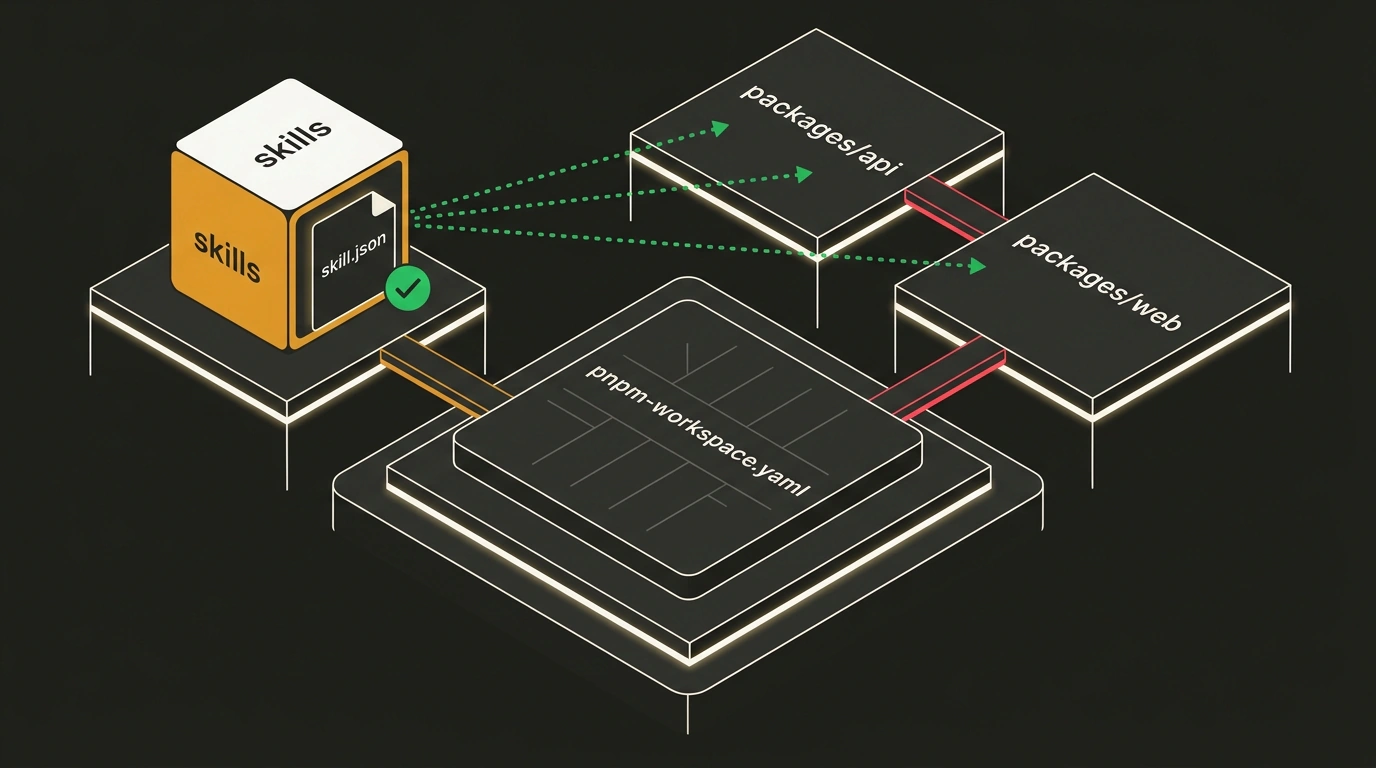
Previously, developers had to copy those markdown files by hand. pnpm 12.18.0 introduces a standardized skill-linking pipeline:
- If an installed package
@company/auth-kitcontains askills/login/directory, pnpm automatically creates a symlink in the local project at.claude/skills/login; - If two different packages ship a skill with the same name, pnpm cleanly resolves the collision by assigning a unique prefix
pnpm-<package-name>-<skill>; - Hierarchical nesting up to three levels deep is supported (for example,
skills/database/postgres/SKILL.md).
The marquee addition, though, is interactive security control via pnpm approve:
# 1. Install a library with a bundle of agent skills
pnpm add -D @company/cloud-toolkit

# 2. Interactively approve which skills are allowed to be linked
pnpm approve
The CLI opens an interactive prompt where the developer can check only trusted skills. The approved selection is saved in package.json:
{
  "name": "my-enterprise-app",
  "pnpm": {
    "permissions": {
      "@company/cloud-toolkit": {
        "skills": ["deploy-guide", "audit-rules"]
      }
    }
  }
}
Any unauthorized or malicious instructions are blocked from entering the AI assistant's context, protecting the repository against sophisticated Prompt Injection attacks via third-party npm packages.
Platform-Specific Package Variants on pnpr Registries
The second major step in pnpm 12.18 is support for specialized registries with serverType: pnpr. This is built for the ecosystem of compiled native addons (C++, Rust, Zig):
- Targeted packaging:
pnpm pack --variant <target>generates slim tarballs with platform suffixes likesqlite3-5.1.0~linux-x64-glibc.tgz. - Deduplicated publishing:
pnpm publish --upload-variantuploads binaries for different operating systems to the registry's staging area. - Traffic savings: during installation, the client downloads only the manifest for its target architecture instead of pulling megabytes of metadata for every platform in existence. Across a sample of 787 packages, compressed registry metadata shrank from 30.3 MB down to a modest 2.5 MB gzipped.
And for air-gapped corporate environments without direct internet access, there's a new command to pre-populate the cache:
# Populate the local store with downloaded tarballs
pnpm store add ./pre-downloaded-tarballs/*.tgz

# Fully offline installation in an air-gapped environment
pnpm install --offline --frozen-lockfile
Monorepos: 11x Faster Thanks to Smart package.json Skipping
If you work in a monorepo of a hundred or two hundred packages, you've probably noticed annoying delays when running commands like pnpm -r test or pnpm exec. Before running a script, pnpm had to reopen and parse the package.json files of every single package in the workspace, even if they hadn't changed in months.
In versions 12.18.0 and 11.28.11, the verifyDepsBeforeRun dependency-check algorithm was rewritten from scratch:
- pnpm computes a state hash of the sources and skips reading JSON manifests for unchanged packages;
- In a stress test on a 300-project monorepo,
pnpm -r exec trueexecution time dropped from 490 milliseconds to 42 milliseconds; pnpm deployfixed a frustratingENOENTcrash triggered by dangling symlinks pointing to external directories;- The
side-effects-cachenow properly invalidates on targeted updates to binary dependencies, preventing subtle build bugs.
These updates prove once again that pnpm has outgrown the role of a simple alternative package manager and evolved into a mature engineering platform—addressing both the security demands of the AI era and the pain points of large-scale enterprise development.

