You've probably seen the frenzy sweeping corporate tech. Business owners terrified of "missing the AI train" are racing to hire custom agencies, dropping tens or hundreds of thousands of dollars on bespoke, turnkey agent systems. Integrators promise the moon, duct-tape together a fragile web of prompts, scrapers, and brittle adapters, and three months later the client is stuck holding the bag: OpenAI or Anthropic ships a base model update, and the whole custom contraption collapses like a house of cards.
AI Makeover founder Liam Ottley just laid out a sobering reality check: businesses need to stop burning budgets on custom glue code and wait for mature enterprise platforms. We touched on a similar shift in our piece on the end of prompt hacks and the move to systemic agents; now let's unpack the architectural roots of this mess.
Henry Ford's Lesson: Where We Are Today
Liam draws a sharp parallel to the dawn of the auto industry in the late 1800s. Before Henry Ford's assembly line, every car was a one-off craft project: mechanics hand-machined custom gears, bolts, and axles. Those carriages cost a fortune, broke down on their first drive, and needed a dedicated mechanic who knew that specific engine's quirks.
That is the exact stage applied AI sits in today. Every dev shop is writing its own "unique orchestration framework," reinventing the wheel from scratch. The moment the major labs standardize platform protocols, all that bespoke code turns into unmaintainable tech debt overnight.
The Seven Layers of a Mature AI Platform
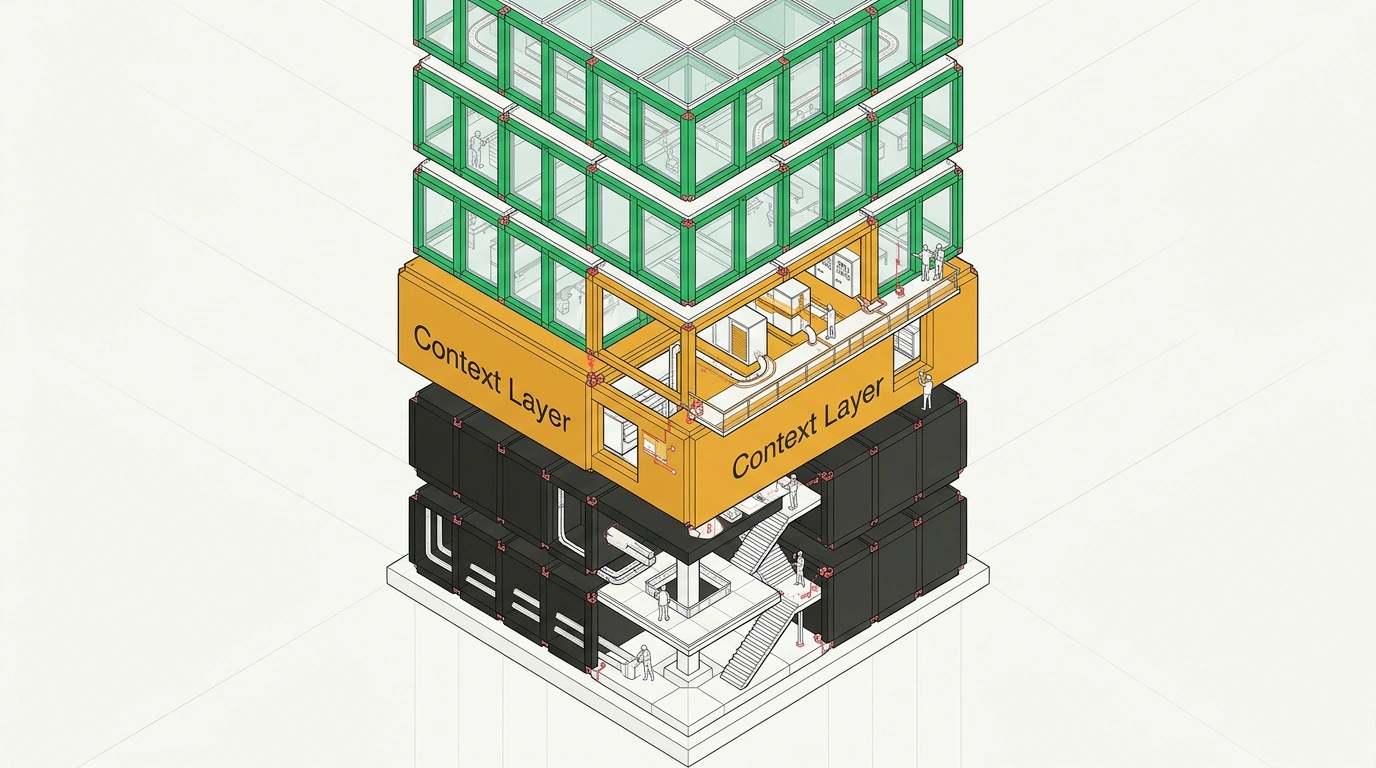
To map where the market is heading, Liam breaks a full corporate AI Operating System (AIOS) down into seven foundational layers:
- Agents: specialized digital workers (analyst, copywriter, recruiter, code reviewer).
- Context: company SOPs, brand tone of voice, job descriptions, past decision logs, and security rules.
- Data: live connections to real company stores—CRM, ERP, Postgres databases, and inventory systems.
- Harness: safe code-execution sandboxes, automatic transaction rollbacks on failure, and error recovery.
- Orchestration: smart task routing across multiple agents and clean human handoffs.
- Interface: a unified, ergonomic UI/UX where staff work with agents as easily as in Slack or Notion.
- Integration: battle-tested, industrial-grade connectors to hundreds of external enterprise APIs.
Building all seven layers with a small custom dev team is next to impossible. Writing your own harness and orchestration today all but guarantees obsolescence tomorrow.
The "AI Waiting Room" Strategy: Where to Put Your Money
Liam recommends a practical stance he calls The AI Waiting Room. That doesn't mean sitting on your hands—it means investing only in what stays yours no matter which model wins:
- Invest in the Context Layer: get your internal SOPs crystal clear, digitize quality rubrics for every department, and spell out explicit rules and boundaries. If a guideline is ambiguous to a human employee, no agent on earth will execute it reliably.
- Rely on off-the-shelf tools: handle today's workflows with proven mainstream products (ChatGPT Dots, Claude Code, Manus, solid n8n/Make pipelines).
- Don't pay for reinvented wheels: if a vendor quotes you half a million rubles to build a proprietary context engine, politely pass. Within six months, major providers will ship that out of the box as a managed cloud feature.
Before paying for custom AI development, ask the agency three blunt questions: 'What happens to this system when the next base model drops?', 'How many engineering hours a month will it take to maintain this custom API glue?', and 'Can we migrate these workflows to another platform without rewriting the backend?' Honest answers will save you millions of rubles.
Bottom line: the future of enterprise AI belongs to standardized assembly lines. Your job today is prepping clean raw materials—structured data and clear rules—rather than forging your own steam engine in the garage.