Whenever tech social media starts talking about autonomous AI agents in software engineering, the conversation usually spirals into two extremes. On one side, you have starry-eyed hackathon founders promising to fire every programmer by next Monday. On the other, battle-weary senior engineers who fed a legacy codebase to an agent and got broken tests and a pile of hallucinated libraries in return.
That makes real production numbers from a large enterprise all the more interesting. At the Moscow conference AI Native Conf, Andrey Usenko, co-head of a business division at Raiffeisenbank, shared how they rebuilt their engineering pipeline end to end. Architect Alexey Rybak summed up the headline result: since August 2026, the team has closed over 1,000 production tasks without a single manual human commit.
Here is the most instructive part: the architecture that actually works in production completely upends the popular hype-driven stereotypes.
A Lone Agent vs. a Zoo of Roles
If you have followed frameworks like CrewAI or LangGraph, you know the classic setup: spin up an "architect agent," a "tester agent," and a "reviewer agent," and let them chat back and forth.
The bank's engineers quickly discovered that in production, this zoo of roles triggers cascading failures. Agents end up playing a game of telephone, lose track of intermediate states, and burn through budget arguing with each other. In the end, the team made a radical call: they switched to a single autonomous agent, armed with as complete a system context as possible.
Death to Microservices, Victory for grep
The second surprise had to do with repository layout. For an agent to understand dependencies without breaking adjacent contracts, the department consolidated 200 scattered microservices into roughly a dozen monorepos. When the entire project lives in one place, the model doesn't have to guess how a neighboring team's data schema is structured—the full type tree is right there.
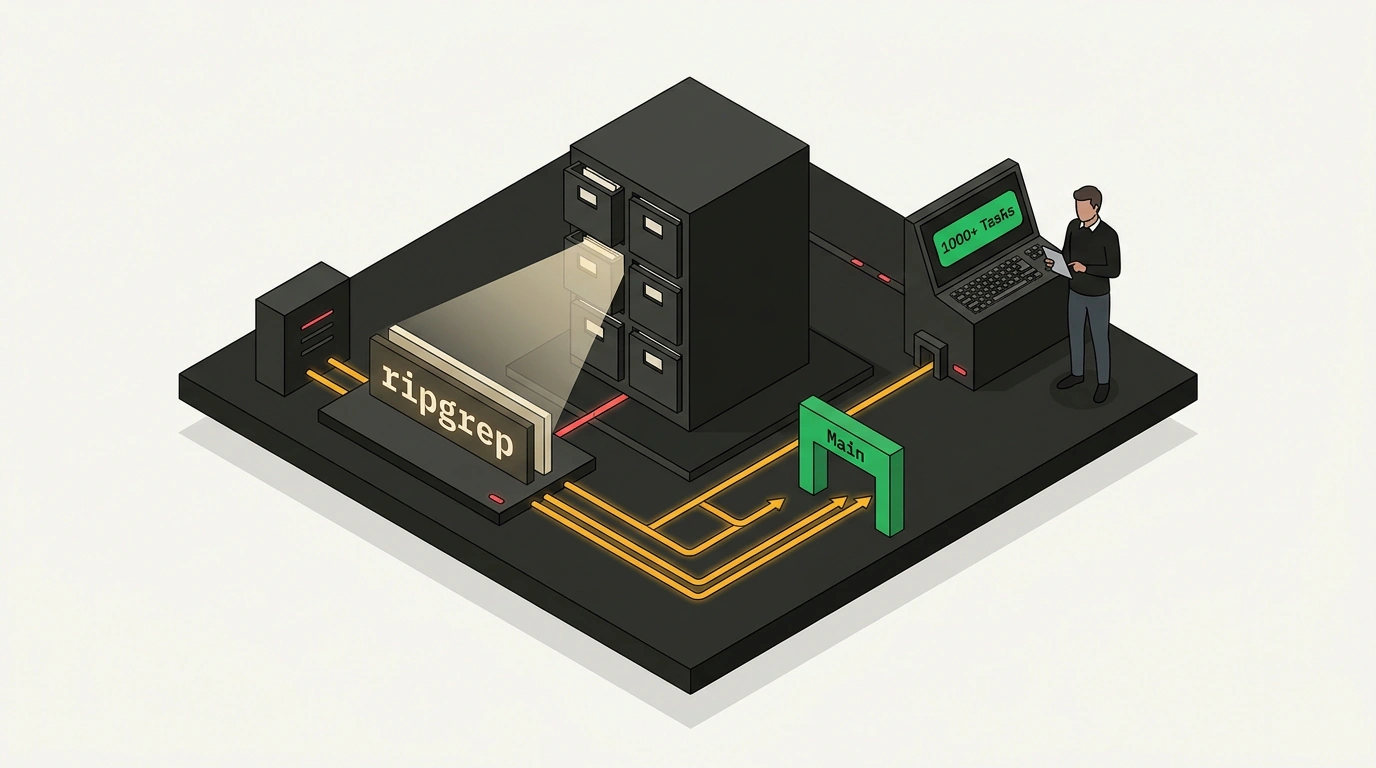
They also threw out heavyweight vector databases (RAG) and semantic code embeddings altogether. Vector search kept pulling in blurry, irrelevant snippets. In its place, they brought back good old fast text search—plain grep and ripgrep. Inside a monorepo, deterministic matching on class names, interfaces, and import paths delivers 100% precision with zero guesswork.
The Product Engineer Role and a Self-Learning Loop
Still, the biggest shift happened on the human side. The traditional relay race—where a ticket bounces for weeks from a product manager to a systems analyst, then to backend, frontend, manual QA, and release engineering—was eliminated.
In its place came the Product Engineer role. The product owner enters a business task directly into a dedicated agentic environment, and the product engineer oversees its end-to-end journey through the pipeline, owning the final outcome. The system's core operational metric is the percentage of tasks the agent solves on the first pass. Whenever tests fail, the agent inspects the diagnostics, rewrites the code, and distills successful patterns into a template knowledge base.
Earlier, we examined autonomous loop engineering and harness wrappers, and Raiffeisenbank's experience reinforces the same fundamental lesson: autonomous development doesn't run on LLM magic—it runs on strict engineering hygiene. Without exhaustive test coverage and a rock-solid sandbox, an agent pipeline will wreck production in minutes. But once that discipline is in place, typing characters by hand in an IDE starts fading into history.