If you use large language models for heavy lifting—say, auditing a massive codebase or generating a multi-file application—you know exactly where most systems choke. A model might boast a two-million-token input window, yet the moment it starts writing, it taps out at 32k or 64k output tokens. You end up chopping the output into pieces, stitching chunks together by hand, and watching the logic snap halfway through a script.
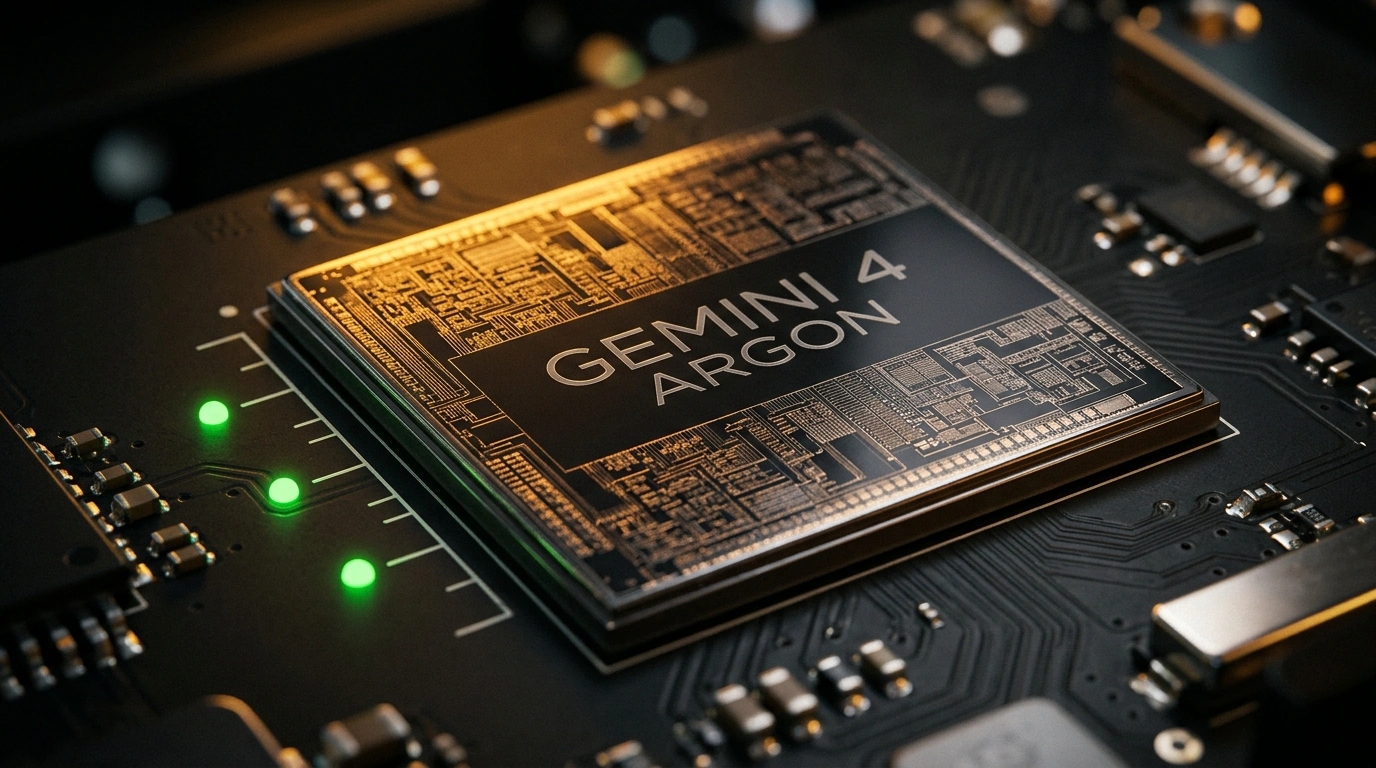
Google just took a sledgehammer to that bottleneck with Gemini 4 Argon. It's the first flagship of a new generation where input and output context share one seamless space: its long decode feature lets the model generate up to one million tokens of continuous output. We already tested this in our piece on practical uses of Gemini 4 Argon, and now let's dig deeper into the release specs.
Dropping Temperature for Three Reasoning Levels
Argon's biggest architectural shift is moving toward deterministic problem-solving. Google stripped out the usual stochastic knobs: the model completely ignores temperature, top_p, and top_k. Instead of rolling dice on randomness, you control reasoning depth with a single thinking_level parameter:
- minimal: fast responses for trivial text transforms and basic formatting.
- medium: balanced mode for everyday code refactoring, legal doc review, and fact-finding.
- high: maximum reasoning depth, building full hypothesis trees before committing to an answer.
Benchmark Records and Real-World Code
In both synthetic evals and practical tests, Argon posted standout numbers:
- #1 on Vals Index: in the benchmark testing complex real-world coding and legal analysis, the model scored 68.9—the first time a Gemini flagship has ever taken the top spot on this independent leaderboard.
- Spatial Reasoning (ERQA): on spatial orientation and 3D modeling, Argon scored 87, setting an all-time record among frontier models.
- Prompt Injection Defense (Gray Swan): under adversarial stress testing, its safety layer neutralized 99.3% of attacks, with successful prompt injections occurring in just 0.7% of cases.
What impressed me most, though, was the telemetry from Google Anti-Gravity. Engineering teams saw a 35% jump in accepted agentic code, while forced rollbacks dropped by nearly a third. Even better, "corner-cutting" (where a model drops a lazy // TODO: implement later instead of writing a tricky function) fell to a record low of 2%.
When calling Gemini 4 Argon directly via the SDK, set max_output_tokens to at least 32,000, since the model spends a hefty chunk of its budget on internal reasoning. Also bump your client's network timeout to at least 15 minutes so deep analysis runs don't drop mid-stream.
Day-One Adoption in Manus
Tellingly, autonomous agent platform Manus integrated Gemini 4 Argon on launch day. Inside Manus 2.0, it's now the default engine for Wide Research (multi-hour deep desk research), web app generation, and procedural 3D modeling in Manus Studio.
The model is live in Google AI Studio, via API on Google AI Pro and Ultra plans, and cybersecurity researchers can apply for dedicated quotas through the Google Fairwind program. It's a serious tool built for anyone who needs long-horizon reasoning without compromises.